
非酒精性脂肪性肝炎相关肝细胞癌中瘦素和肥胖相关的差异甲基化模式。
Differential methylation patterns in lean and obese non-alcoholic steatohepatitis-associated hepatocellular carcinoma.
机构信息
Department of Epidemiology, University of Nebraska Medical Center, 984395 Nebraska Medical Center, Omaha, NE, 68198-4395, USA.
Department of Pathology and Microbiology, University of Nebraska Medical Center, Omaha, NE, USA.
出版信息
BMC Cancer. 2022 Dec 6;22(1):1276. doi: 10.1186/s12885-022-10389-7.
BACKGROUND
Nonalcoholic fatty liver disease affects about 24% of the world's population and may progress to nonalcoholic steatohepatitis (NASH), cirrhosis, and hepatocellular carcinoma (HCC). While more common in those that are obese, NASH-HCC can develop in lean individuals. The mechanisms by which HCC develops and the role of epigenetic changes in the context of obesity and normal weight are not well understood.
METHODS
In this study, we used previously generated mouse models of lean and obese HCC using a choline deficient/high trans-fat/fructose/cholesterol diet and a choline supplemented/high trans-fat/fructose/cholesterol diet, respectively, to evaluate methylation differences in HCC progression in lean versus obese mice. Differentially methylated regions were determined using reduced representation bisulfite sequencing.
RESULTS
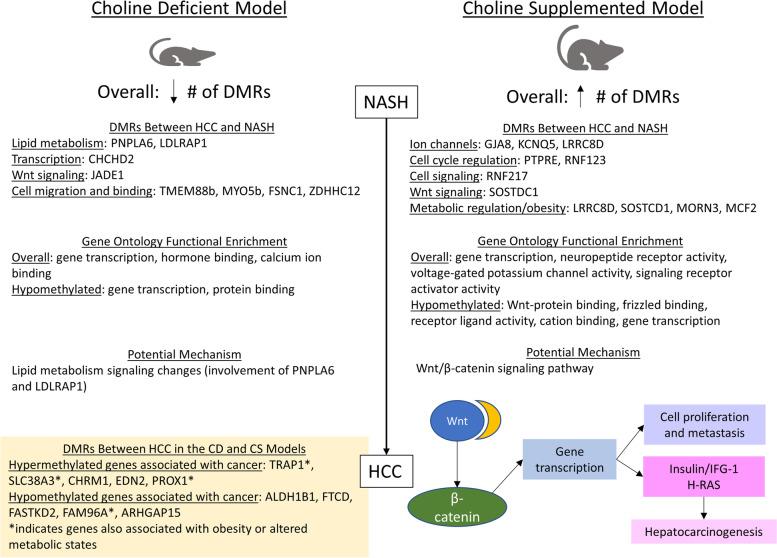
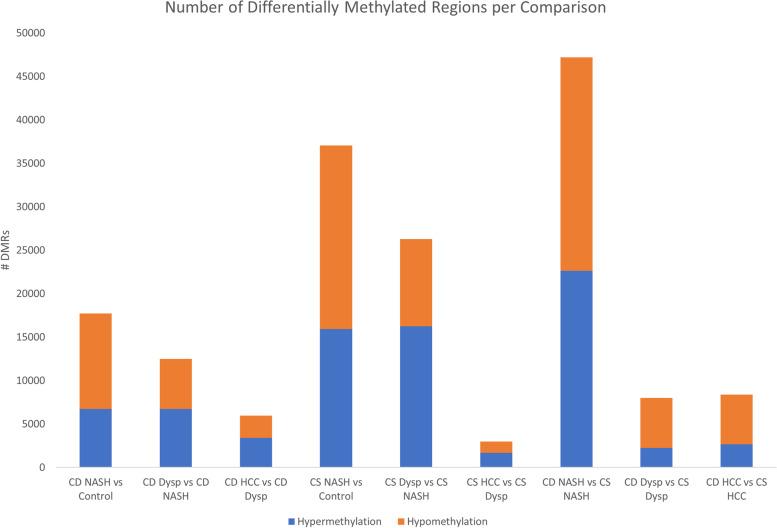
A larger number of differentially methylated regions (DMRs) were seen in NASH-HCC progression in the obese mice compared to the non-obese mice. No overlap existed in the DMRs with the largest methylation differences between the two models. In lean NASH-HCC, methylation differences were seen in genes involved with cancer progression and prognosis (including HCC), such as CHCHD2, FSCN1, and ZDHHC12, and lipid metabolism, including PNPLA6 and LDLRAP1. In obese NASH- HCC, methylation differences were seen in genes known to be associated with HCC, including RNF217, GJA8, PTPRE, PSAPL1, and LRRC8D. Genes involved in Wnt-signaling pathways were enriched in hypomethylated DMRs in the obese NASH-HCC.
CONCLUSIONS
These data suggest that differential methylation may play a role in hepatocarcinogenesis in lean versus obese NASH. Hypomethylation of Wnt signaling pathway-related genes in obese mice may drive progression of HCC, while progression of HCC in lean mice may be driven through other signaling pathways, including lipid metabolism.
背景
非酒精性脂肪性肝病影响全球约 24%的人口,并可能进展为非酒精性脂肪性肝炎(NASH)、肝硬化和肝细胞癌(HCC)。尽管 NASH-HCC 在肥胖人群中更为常见,但在瘦人中也可能发生。HCC 发生的机制以及肥胖和正常体重背景下表观遗传变化的作用尚未得到很好的理解。
方法
在这项研究中,我们使用先前生成的肥胖和瘦小鼠 HCC 模型,分别使用胆碱缺乏/高反式脂肪/果糖/胆固醇饮食和胆碱补充/高反式脂肪/果糖/胆固醇饮食,来评估瘦鼠与肥胖鼠 HCC 进展中的甲基化差异。使用简化代表性亚硫酸氢盐测序确定差异甲基化区域。
结果
与非肥胖小鼠相比,肥胖小鼠的 NASH-HCC 进展中观察到更多的差异甲基化区域(DMRs)。两个模型之间甲基化差异最大的 DMRs 没有重叠。在瘦 NASH-HCC 中,观察到与癌症进展和预后(包括 HCC)相关的基因,如 CHCHD2、FSCN1 和 ZDHHC12,以及脂质代谢,包括 PNPLA6 和 LDLRAP1,的甲基化差异。在肥胖 NASH-HCC 中,观察到与 HCC 相关的已知基因,包括 RNF217、GJA8、PTPRE、PSAPL1 和 LRRC8D,的甲基化差异。Wnt 信号通路相关基因在肥胖 NASH-HCC 的低甲基化 DMR 中富集。
结论
这些数据表明,差异甲基化可能在瘦 NASH 与肥胖 NASH 的肝癌发生中起作用。肥胖小鼠中 Wnt 信号通路相关基因的低甲基化可能推动 HCC 的进展,而瘦小鼠中 HCC 的进展可能通过其他信号通路驱动,包括脂质代谢。


 Zotero 插件