
新型阿仑膦酸钠-CGS21680 缀合物可减少绝经后骨质疏松症和炎症性骨溶解小鼠模型中的骨吸收并诱导新骨形成。
Novel alendronate-CGS21680 conjugate reduces bone resorption and induces new bone formation in post-menopausal osteoporosis and inflammatory osteolysis mouse models.
机构信息
Division of Translational Medicine, Department of Medicine, NYU Langone Health, 550 First Avenue, Medical Science Building, Room, New York, NY, 251, USA.
Molecular Recognition Section, Laboratory of Bioorganic Chemistry, National Institute of Diabetes and Digestive and Kidney Diseases, National Institutes of Health, Bethesda, MD, USA.
出版信息
Arthritis Res Ther. 2022 Dec 9;24(1):265. doi: 10.1186/s13075-022-02961-0.
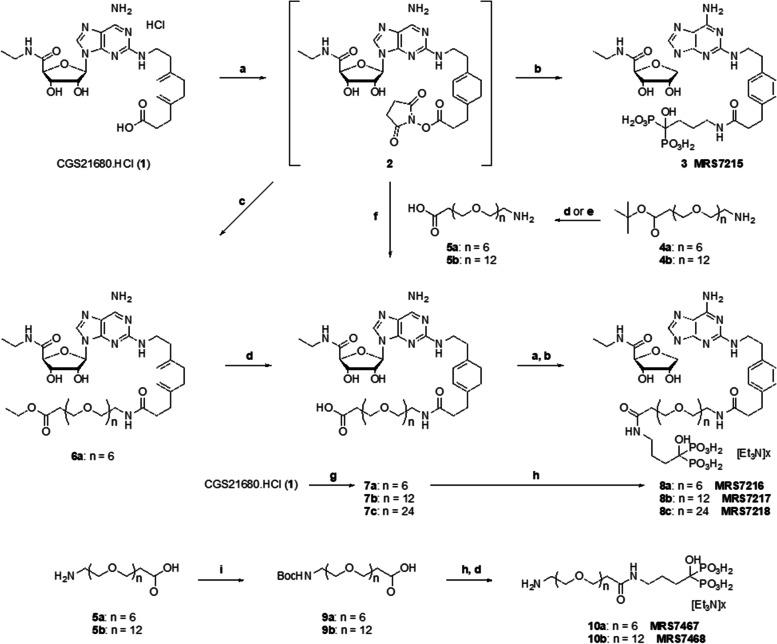
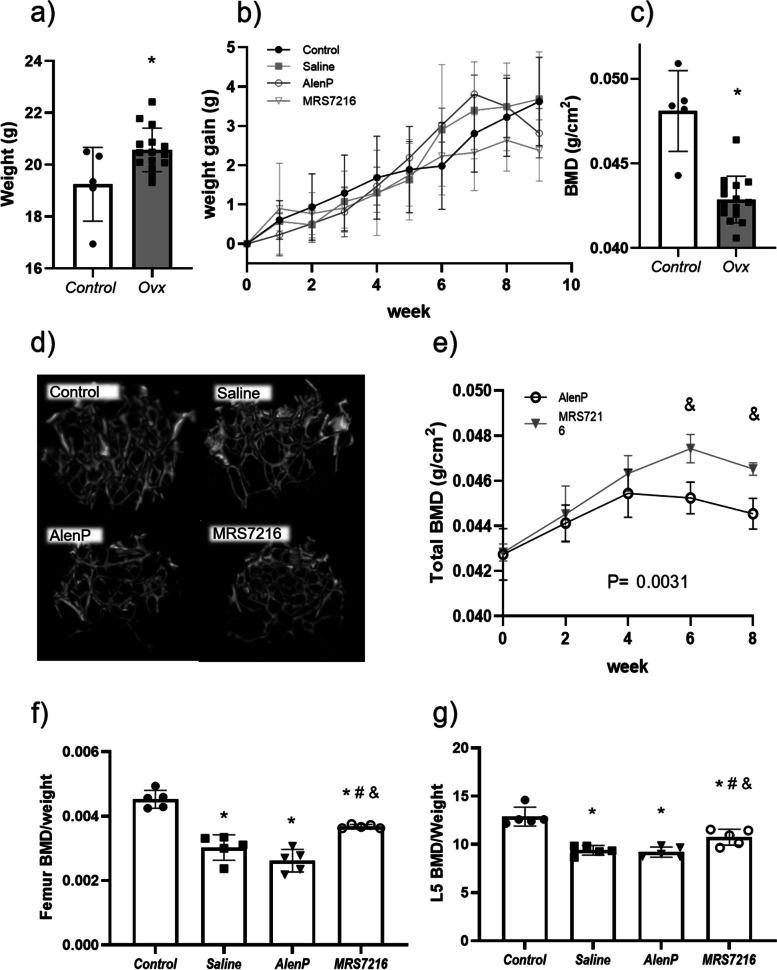
Loss of bone is a common medical problem and, while it can be treated with available therapies, some of these therapies have critical side effects. We have previously demonstrated that CGS21680, a selective A adenosine receptor agonist, prevents bone loss, but its on-target toxicities (hypotension, tachycardia) and frequent dosing requirements make it unusable in the clinic. We therefore generated a novel alendronate-CGS21680 conjugate (MRS7216), to target the agonist to bone where it remains for long periods thereby diminishing the frequency of administration and curtailing side effects. MRS7216 was synthesized from CGS21680 by sequential activation of the carboxylic acid moiety and reacting with an appropriate amino acid (PEG, alendronic acid) under basic conditions. MRS7216 was tested on C57BL/6J (WT) mice with established osteoporosis (OP) and WT or A2A KO mice with wear particle-induced inflammatory osteolysis (OL). Mice were treated weekly with MRS7216 (10mg/kg). Bone formation was studied after in vivo labeling with calcein/Alizarin Red, and μCT and histology analyses were performed. In addition, human primary osteoblasts and osteoclasts were cultured using bone marrow discarded after hip replacement. Receptor binding studies demonstrate that MRS7216 efficiently binds the A2A adenosine receptor. MRS7216-treated OP and OL mice had significant new bone formation and reduced bone loss compared to vehicle or alendronate-treated mice. Histological analysis showed that MRS7216 treatment significantly reduced osteoclast number and increased osteoblast number in murine models. Interestingly, cultured human osteoclast differentiation was inhibited, and osteoblast differentiation was stimulated by the compound indicating that MRS7216 conjugates represent a novel therapeutic approach to treat osteoporosis and osteolysis.
骨丢失是一种常见的医学问题,虽然可以用现有的治疗方法治疗,但其中一些治疗方法有严重的副作用。我们之前已经证明,CGS21680,一种选择性 A 腺苷受体激动剂,可预防骨丢失,但它的靶毒性(低血压、心动过速)和频繁的给药要求使其在临床上无法使用。因此,我们生成了一种新型的阿仑膦酸盐-CGS21680 缀合物(MRS7216),将激动剂靶向到骨骼中,在那里它可以长时间保留,从而减少给药频率并减少副作用。MRS7216 通过顺序激活羧酸部分并在碱性条件下与适当的氨基酸(PEG、阿仑膦酸)反应,由 CGS21680 合成。MRS7216 在已建立骨质疏松症(OP)的 C57BL/6J(WT)小鼠和 WT 或 A2A KO 小鼠中进行了磨损颗粒诱导的炎症性骨溶解(OL)测试。每周用 MRS7216(10mg/kg)治疗小鼠。用 calcein/Alizarin Red 体内标记后研究骨形成,并进行 μCT 和组织学分析。此外,使用髋关节置换术后丢弃的骨髓培养人原代成骨细胞和破骨细胞。受体结合研究表明,MRS7216 可有效结合 A2A 腺苷受体。与载体或阿仑膦酸盐治疗的小鼠相比,MRS7216 治疗的 OP 和 OL 小鼠有显著的新骨形成和减少骨丢失。组织学分析显示,MRS7216 治疗可显著减少小鼠模型中的破骨细胞数量并增加成骨细胞数量。有趣的是,该化合物抑制了培养的人破骨细胞分化,并刺激了成骨细胞分化,这表明 MRS7216 缀合物代表了治疗骨质疏松症和骨溶解的一种新的治疗方法。



 Zotero 插件