
8-氧鸟嘌呤修复系统在肿瘤发生和癌症治疗中的作用。
The Role of 8-oxoG Repair Systems in Tumorigenesis and Cancer Therapy.
机构信息
Center for Cell Structure and Function, Key Laboratory of Animal Resistance Biology of Shandong Province, College of Life Sciences, Shandong Normal University, Jinan 250014, China.
The Key Laboratory of Molecular Epigenetics of Education, School of Life Science, Northeast Normal University, Changchun 130024, China.
出版信息
Cells. 2022 Nov 27;11(23):3798. doi: 10.3390/cells11233798.
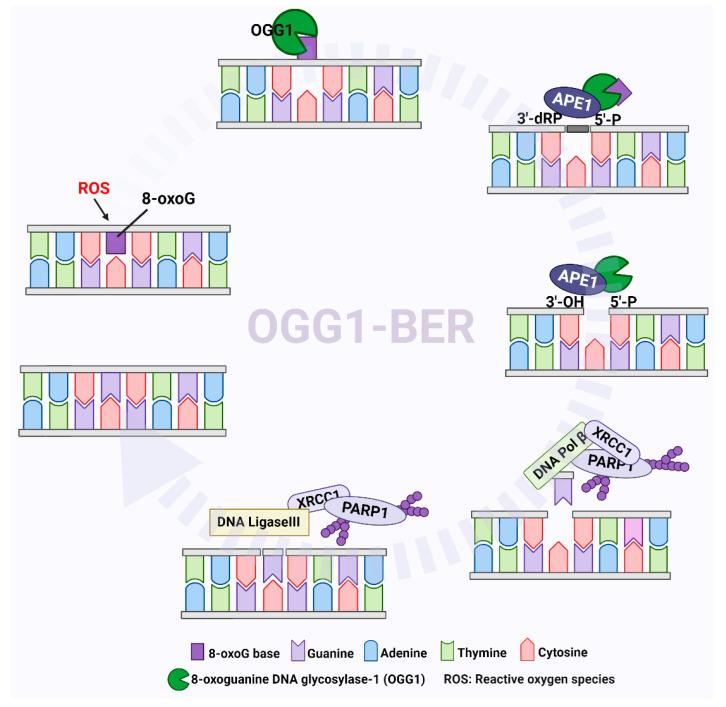
Tumorigenesis is highly correlated with the accumulation of mutations. The abundant and extensive DNA oxidation product, 8-Oxoguanine (8-oxoG), can cause mutations if it is not repaired by 8-oxoG repair systems. Therefore, the accumulation of 8-oxoG plays an essential role in tumorigenesis. To avoid the accumulation of 8-oxoG in the genome, base excision repair (BER), initiated by 8-oxoguanine DNA glycosylase1 (OGG1), is responsible for the removal of genomic 8-oxoG. It has been proven that 8-oxoG levels are significantly elevated in cancer cells compared with cells of normal tissues, and the induction of DNA damage by some antitumor drugs involves direct or indirect interference with BER, especially through inducing the production and accumulation of reactive oxygen species (ROS), which can lead to tumor cell death. In addition, the absence of the core components of BER can result in embryonic or early post-natal lethality in mice. Therefore, targeting 8-oxoG repair systems with inhibitors is a promising avenue for tumor therapy. In this study, we summarize the impact of 8-oxoG accumulation on tumorigenesis and the current status of cancer therapy approaches exploiting 8-oxoG repair enzyme targeting, as well as possible synergistic lethality strategies involving exogenous ROS-inducing agents.
肿瘤发生与突变的积累高度相关。大量广泛存在的 DNA 氧化产物 8-氧鸟嘌呤(8-oxoG)如果不能被 8-氧鸟嘌呤修复系统修复,就会导致突变。因此,8-oxoG 的积累在肿瘤发生中起着至关重要的作用。为了避免基因组中 8-oxoG 的积累,碱基切除修复(BER)由 8-氧鸟嘌呤 DNA 糖基化酶 1(OGG1)启动,负责去除基因组中的 8-oxoG。已经证明,与正常组织的细胞相比,癌细胞中的 8-oxoG 水平显著升高,一些抗肿瘤药物通过直接或间接干扰 BER 诱导 DNA 损伤,特别是通过诱导活性氧(ROS)的产生和积累,从而导致肿瘤细胞死亡。此外,BER 的核心成分缺失会导致小鼠胚胎或早期产后死亡。因此,用抑制剂靶向 8-oxoG 修复系统是肿瘤治疗的一种有前途的方法。在本研究中,我们总结了 8-oxoG 积累对肿瘤发生的影响,以及利用 8-oxoG 修复酶靶向的癌症治疗方法的现状,以及涉及外源性 ROS 诱导剂的可能协同致死性策略。


 Zotero 插件