
炎症衰老的 DARC 方面:趋化因子 Duffy 抗原受体 (DARC/ACKR1) 作为高危亚人群衰老、免疫衰老和乳腺癌发生的潜在生物标志物。
The DARC Side of Inflamm-Aging: Duffy Antigen Receptor for Chemokines (DARC/ACKR1) as a Potential Biomarker of Aging, Immunosenescence, and Breast Oncogenesis among High-Risk Subpopulations.
机构信息
Department of Population Science, City of Hope Comprehensive Cancer Center, Duarte, CA 91010, USA.
Department of Science, Rowland Hall, Salt Lake City, UT 84102, USA.
出版信息
Cells. 2022 Nov 29;11(23):3818. doi: 10.3390/cells11233818.
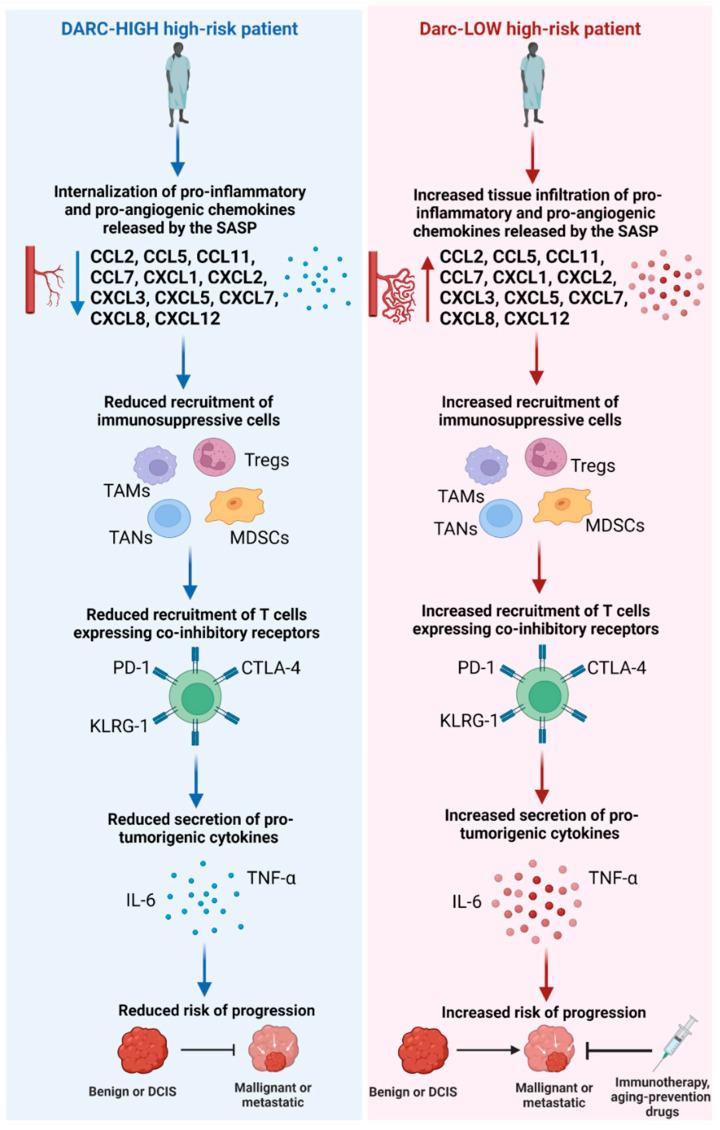
The proclivity of certain pre-malignant and pre-invasive breast lesions to progress while others do not continues to perplex clinicians. Clinicians remain at a crossroads with effectively managing the high-risk patient subpopulation owing to the paucity of biomarkers that can adequately risk-stratify and inform clinical decisions that circumvent unnecessary administration of cytotoxic and invasive treatments. The immune system mounts the most important line of defense against tumorigenesis and progression. Unfortunately, this defense declines or "ages" over time-a phenomenon known as immunosenescence. This results in "inflamm-aging" or the excessive infiltration of pro-inflammatory chemokines, which alters the leukocyte composition of the tissue microenvironment, and concomitant immunoediting of these leukocytes to diminish their antitumor immune functions. Collectively, these effects can foster the sequelae of neoplastic transformation and progression. The erythrocyte cell antigen, Duffy antigen receptor for chemokines(DARC/ACKR1), binds and internalizes chemokines to maintain homeostatic levels and modulate leukocyte trafficking. A negative DARC status is highly prevalent among subpopulations of West African genetic ancestry, who are at higher risk of developing breast cancer and disease progression at a younger age. However, the role of DARC in accelerated inflamm-aging and malignant transformation remains underexplored. Herein, we review compelling evidence suggesting that DARC may be protective against inflamm-aging and, therefore, reduce the risk of a high-risk lesion progressing to malignancy. We also discuss evidence supporting that immunotherapeutic intervention-based on DARC status-among high-risk subpopulations may evade malignant transformation and progression. A closer look into this unique role of DARC could glean deeper insight into the immune response profile of individual high-risk patients and their predisposition to progress as well as guide the administration of more "cyto-friendly" immunotherapeutic intervention to potentially "turn back the clock" on inflamm-aging-mediated oncogenesis and progression.
某些癌前和侵袭前乳腺病变有进展倾向,而另一些则没有,这一现象一直困扰着临床医生。由于缺乏能够充分进行风险分层并为避免不必要的细胞毒性和侵袭性治疗提供信息的生物标志物,临床医生在有效管理高危患者亚群方面仍处于十字路口。免疫系统是对抗肿瘤发生和进展的最重要防线。不幸的是,这种防御会随着时间的推移而下降或“衰老”——这一现象被称为免疫衰老。这导致“炎症衰老”或促炎趋化因子的过度浸润,改变组织微环境中的白细胞组成,并伴随这些白细胞的免疫编辑,以降低其抗肿瘤免疫功能。这些效应共同促进了肿瘤转化和进展的后果。红细胞抗原、趋化因子受体 Duffy(DARC/ACKR1)结合并内化趋化因子,以维持体内平衡水平并调节白细胞迁移。西非人遗传背景的亚群中,DARC 呈阴性状态的比例很高,他们患乳腺癌和疾病年轻化进展的风险更高。然而,DARC 在加速炎症衰老和恶性转化中的作用仍未得到充分探索。在此,我们综述了令人信服的证据,表明 DARC 可能对炎症衰老具有保护作用,从而降低高危病变进展为恶性肿瘤的风险。我们还讨论了支持基于 DARC 状态的免疫治疗干预在高危亚群中可能避免恶性转化和进展的证据。更深入地研究 DARC 的这一独特作用,可以深入了解个体高危患者的免疫反应特征及其进展倾向,并指导更“细胞友好”的免疫治疗干预的管理,以潜在地“扭转时钟”,防止炎症衰老介导的肿瘤发生和进展。
 Zotero 插件