
新型聚羟基烷酸酯的生产方法及其在生物医学和工业中的创新应用。
Novel Production Methods of Polyhydroxyalkanoates and Their Innovative Uses in Biomedicine and Industry.
机构信息
School of Medical Technology, Faculty of Medicine, University of Valparaiso, Campus San Felipe, Camino la Troya S/N & El Convento, Circunvalación Ote, San Felipe 2173310, Chile.
Centro de Investigación Interdisciplinario en Salud Territorial del Valle de Aconcagua (CIISTE), San Felipe 2173310, Chile.
出版信息
Molecules. 2022 Nov 30;27(23):8351. doi: 10.3390/molecules27238351.
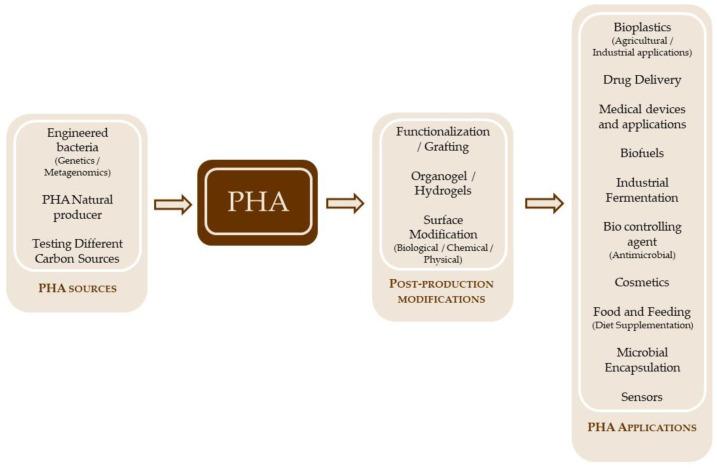
Polyhydroxyalkanoate (PHA), a biodegradable polymer obtained from microorganisms and plants, have been widely used in biomedical applications and devices, such as sutures, cardiac valves, bone scaffold, and drug delivery of compounds with pharmaceutical interests, as well as in food packaging. This review focuses on the use of polyhydroxyalkanoates beyond the most common uses, aiming to inform about the potential uses of the biopolymer as a biosensor, cosmetics, drug delivery, flame retardancy, and electrospinning, among other interesting uses. The novel applications are based on the production and composition of the polymer, which can be modified by genetic engineering, a semi-synthetic approach, by changing feeding carbon sources and/or supplement addition, among others. The future of PHA is promising, and despite its production costs being higher than petroleum-based plastics, tools given by synthetic biology, bioinformatics, and machine learning, among others, have allowed for great production yields, monomer and polymer functionalization, stability, and versatility, a key feature to increase the uses of this interesting family of polymers.
聚羟基脂肪酸酯(PHA)是一种可生物降解的聚合物,可从微生物和植物中获得,已广泛应用于生物医学应用和设备中,如缝合线、心脏瓣膜、骨支架以及具有药物应用的化合物的药物输送,也应用于食品包装。本综述重点介绍了聚羟基脂肪酸酯的用途,除了最常见的用途之外,还旨在介绍该生物聚合物作为生物传感器、化妆品、药物输送、阻燃和静电纺丝等其他有趣用途的潜在用途。新的应用基于聚合物的生产和组成,通过遗传工程、半合成方法、改变进料碳源和/或补充添加等方式,可以对其进行修饰。PHA 的未来前景广阔,尽管其生产成本高于石油基塑料,但合成生物学、生物信息学和机器学习等工具的出现,极大地提高了生产产量、单体和聚合物的功能化、稳定性和多功能性,这是增加这种有趣的聚合物家族用途的关键特征。
 Zotero 插件