
沙特阿拉伯阿西尔地区皮肤科患者使用补充和替代药物的情况
The Prevalence of Complementary and Alternative Medications Use Among Dermatology Patients in Aseer Region, Saudi Arabia.
作者信息
Al-Atif Hend M, Al-Ghamdi Hasan S, Alzubaidi Waad Abdulaziz, Alnaem Nejad Mubasher, Qahtani Saad Hussain
机构信息
Department of Internal Medicine, College of Medicine, King Khalid University, Abha City, Kingdom of Saudi Arabia.
Internal Medicine Department, Division of Dermatology, Faculty of medicine, Albaha University, Albaha City, Kingdom of Saudi Arabia.
出版信息
Clin Cosmet Investig Dermatol. 2022 Dec 6;15:2607-2615. doi: 10.2147/CCID.S381199. eCollection 2022.
PURPOSE
The utilization rate of complementary and alternative medication (CAM) is on the rise, especially for the general population. Despite the lack of scientific support, CAM has been used for decades and is more often used among chronic patients. This research examines the prevalence of CAM use in dermatology patients in the area of Aseer, Saudi Arabia.
MATERIALS AND METHODS
This research was done using a descriptive hospital-based cross-sectional survey among adults who attended the dermatological clinics at the major hospitals in the Aseer area of Southern Saudi Arabia. The dermatology outpatients were approached individually and were asked to fill out a survey about their usage of CAM therapies in the preceding year. The questionnaire included questions on patients' socio-demographic data and clinical data on their dermatological condition, including duration and the effect on their daily life. The occurrence and pattern of CAM use and the type of CAM utilized were also examined.
RESULTS
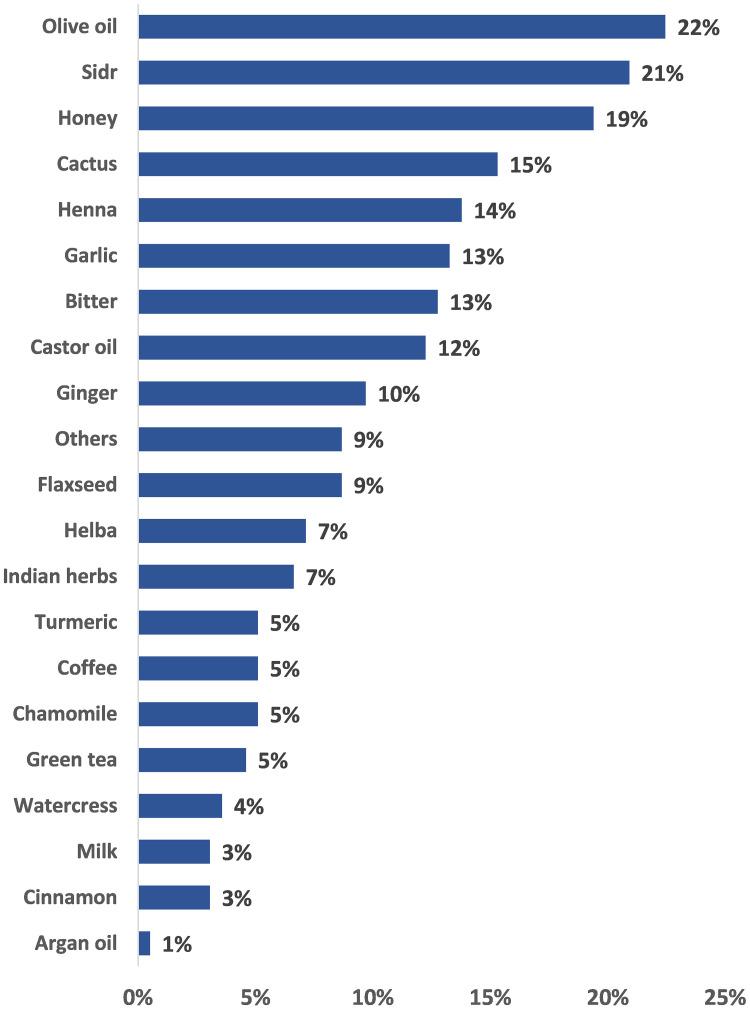
353 dermatological patients filled out the study questionnaire. Patients varied in age from 18 to above 60 years, with an average of 26.1 ± 12.9 years. 203 (57.5%) patients were females. 120 (34%) of the study patients reported using folk medicine with doctor medication for their dermatological disorder, 84 (23.8%) used folk medicine and stopped using medications prescribed by a doctor, while 149 (42.2%) never used folk medicine. The most used CAM was olive oil (22%), followed by (21%), honey (19%), cactus (15%), henna (14%), and garlic (13%).
CONCLUSION
More than half of the participants in this study used CAM, with nearly 1 out of 5 patients not using the medications prescribed by their physicians. Females with long-lasting diseases were the main users who reported using a variety of CAMs. Satisfactory results were experienced by nearly half of the patients.
目的
补充和替代药物(CAM)的使用率正在上升,尤其是在普通人群中。尽管缺乏科学支持,但CAM已被使用数十年,并且在慢性病患者中使用更为频繁。本研究调查了沙特阿拉伯阿西尔地区皮肤科患者使用CAM的情况。
材料与方法
本研究采用基于医院的描述性横断面调查,对象为沙特阿拉伯南部阿西尔地区各大医院皮肤科诊所的成年患者。皮肤科门诊患者被单独询问,并被要求填写一份关于他们上一年使用CAM疗法的调查问卷。问卷包括患者的社会人口统计学数据以及皮肤病状况的临床数据,包括病程及其对日常生活的影响。还调查了CAM的使用情况和模式以及所使用的CAM类型。
结果
353名皮肤科患者填写了研究问卷。患者年龄从18岁到60岁以上不等,平均年龄为26.1±12.9岁。203名(57.5%)患者为女性。120名(34%)研究患者报告在治疗皮肤病时将民间药物与医生开的药一起使用,84名(23.8%)使用民间药物并停止使用医生开的药,而149名(42.2%)从未使用过民间药物。最常用的CAM是橄榄油(22%),其次是[此处原文缺失内容](21%)、蜂蜜(19%)、仙人掌(15%)、指甲花(14%)和大蒜(13%)。
结论
本研究中超过一半的参与者使用CAM,近五分之一的患者未使用医生开的药。患有长期疾病的女性是报告使用多种CAM的主要人群。近一半的患者取得了满意的效果。

 Zotero 插件