
2022 年 1 月至 2 月在中国浙江杭州发生的 SARS-CoV-2 奥密克戎变异株感染的传播动力学。
Transmission dynamics of SARS-CoV-2 Omicron variant infections in Hangzhou, Zhejiang, China, January-February 2022.
机构信息
WHO Collaborating Centre for Infectious Disease Epidemiology and Control, School of Public Health, Li Ka Shing Faculty of Medicine, The University of Hong Kong, Hong Kong Special Administrative Region, China.
Hangzhou Center for Disease Control and Prevention, Hangzhou, Zhejiang, China.
出版信息
Int J Infect Dis. 2023 Jan;126:132-135. doi: 10.1016/j.ijid.2022.10.033. Epub 2022 Oct 28.
OBJECTIVES
We aimed to explore the transmission dynamics of the Omicron BA.1.1 variant in an outbreak in China.
METHODS
We constructed 113 transmission pairs based on the time of exposure and symptom onset for identified infectors and infectees, using the epidemiological data collected during an outbreak in Hangzhou, Zhejiang province, China, between January and February 2022. The key epidemiological parameters were estimated.
RESULTS
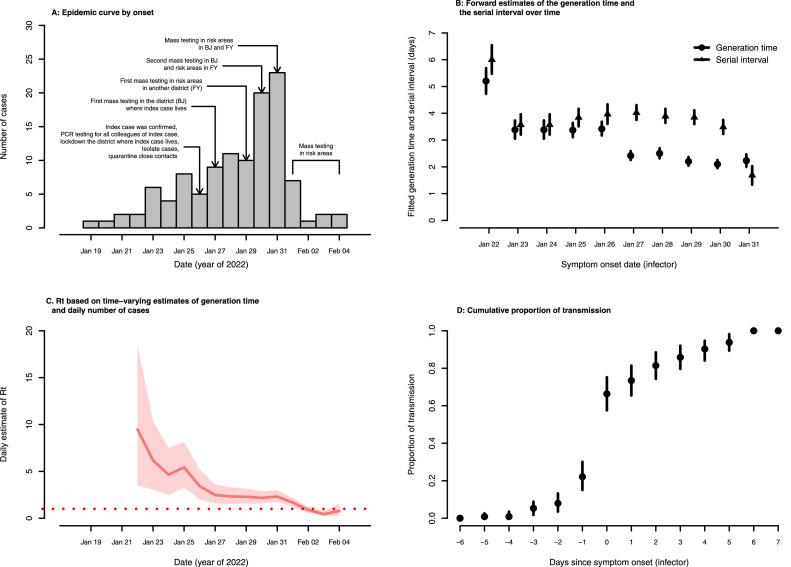
The mean estimates of the incubation period and latent period distributions were 3.8 days (95% credible interval: 3.5, 4.1) and 3.1 days (2.8, 3.5), respectively. The overall transmission risk peaked at symptom onset, and we estimated that 33.6% (24.8, 42.5) of transmission occurred before symptom onset. The forward generation time decreased from 5.2 days (4.7, 5.7) at the start of the outbreak to 2.2 days (2.0, 2.5) by the end. Allowing this variation over time in the generation time distribution, we estimated that the reproduction number dropped rapidly from 9.5 (3.5, 18.4) to 0.8 (0.3, 1.5) over the outbreak.
CONCLUSION
Shorter incubation period and latent period were estimated for the Omicron BA.1.1 variant. Stringent public health measures prevented a large epidemic by reducing transmission, as indicated by the shortened generation time.
目的
我们旨在探索奥密克戎 BA.1.1 变异株在中国暴发疫情中的传播动力学。
方法
我们根据 2022 年 1 月至 2 月在中国浙江省杭州市暴发疫情期间收集的流行病学数据,基于感染者和被感染者暴露和症状出现的时间,构建了 113 对传播对。估计了关键的流行病学参数。
结果
潜伏期和潜伏期中位数分布的平均估计值分别为 3.8 天(95%可信区间:3.5,4.1)和 3.1 天(2.8,3.5)。总体传播风险在症状出现时达到峰值,我们估计有 33.6%(24.8,42.5)的传播发生在症状出现之前。发病间隔时间从疫情开始时的 5.2 天(4.7,5.7)缩短到疫情结束时的 2.2 天(2.0,2.5)。考虑到发病间隔时间随时间的变化,我们估计繁殖数从疫情开始时的 9.5(3.5,18.4)迅速下降到 0.8(0.3,1.5)。
结论
对于奥密克戎 BA.1.1 变异株,潜伏期和潜伏期中位数的估计值较短。严格的公共卫生措施通过减少传播,从而缩短发病间隔时间,阻止了疫情的大规模暴发。
 Zotero 插件