
剪接因子缺陷使造血干细胞和祖细胞对STAT3抑制敏感。
Splicing factor deficits render hematopoietic stem and progenitor cells sensitive to STAT3 inhibition.
作者信息
Potts Kathryn S, Cameron Rosannah C, Metidji Amina, Ghazale Noura, Wallace LaShanale, Leal-Cervantes Ana I, Palumbo Reid, Barajas Juan Martin, Gupta Varun, Aluri Srinivas, Pradhan Kith, Myers Jacquelyn A, McKinstry Mia, Bai Xiaoying, Choudhary Gaurav S, Shastri Aditi, Verma Amit, Obeng Esther A, Bowman Teresa V
机构信息
Department of Developmental and Molecular Biology, Albert Einstein College of Medicine, Bronx, NY 10461, USA; Gottesman Institute for Stem Cell Biology and Regenerative Medicine, Albert Einstein College of Medicine, Bronx, NY 10461, USA.
Department of Oncology, St. Jude's Children Research Hospital, Memphis, TN 38105, USA.
出版信息
Cell Rep. 2022 Dec 13;41(11):111825. doi: 10.1016/j.celrep.2022.111825.
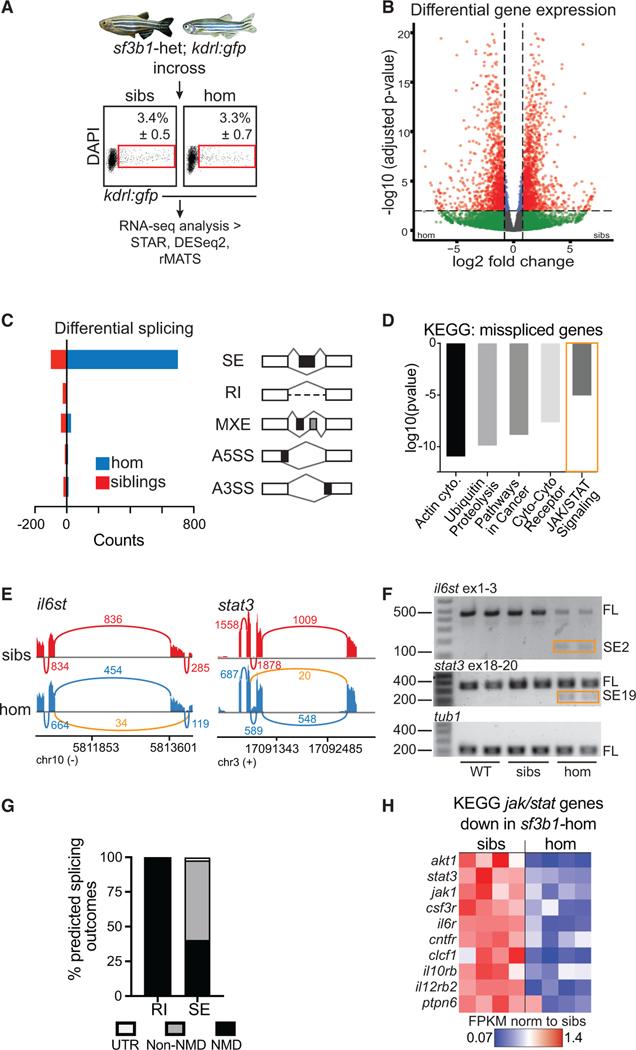
Hematopoietic stem and progenitor cells (HSPCs) sustain lifelong hematopoiesis. Mutations of pre-mRNA splicing machinery, especially splicing factor 3b, subunit 1 (SF3B1), are early lesions found in malignancies arising from HSPC dysfunction. However, why splicing factor deficits contribute to HSPC defects remains incompletely understood. Using zebrafish, we show that HSPC formation in sf3b1 homozygous mutants is dependent on STAT3 activation. Clinically, mutations in SF3B1 are heterozygous; thus, we explored if targeting STAT3 could be a vulnerability in these cells. We show that SF3B1 heterozygosity confers heightened sensitivity to STAT3 inhibition in zebrafish, mouse, and human HSPCs. Cells carrying mutations in other splicing factors or treated with splicing modulators are also more sensitive to STAT3 inhibition. Mechanistically, we illustrate that STAT3 inhibition exacerbates aberrant splicing in SF3B1 mutant cells. Our findings reveal a conserved vulnerability of splicing factor mutant HSPCs that could allow for their selective targeting in hematologic malignancies.
造血干细胞和祖细胞(HSPCs)维持终身造血。前体mRNA剪接机制的突变,尤其是剪接因子3b亚基1(SF3B1)的突变,是在HSPC功能障碍引发的恶性肿瘤中发现的早期病变。然而,剪接因子缺陷为何会导致HSPC缺陷仍未完全清楚。利用斑马鱼,我们发现sf3b1纯合突变体中的HSPC形成依赖于STAT3激活。临床上,SF3B1的突变是杂合的;因此,我们探究了靶向STAT3是否会成为这些细胞的一个薄弱点。我们发现,SF3B1杂合性使斑马鱼、小鼠和人类HSPCs对STAT3抑制更加敏感。携带其他剪接因子突变或用剪接调节剂处理的细胞对STAT3抑制也更敏感。从机制上来说,我们证明STAT3抑制会加剧SF3B1突变细胞中的异常剪接。我们的研究结果揭示了剪接因子突变的HSPCs存在保守的薄弱点,这可能使其在血液系统恶性肿瘤中能够被选择性靶向。



 Zotero 插件