
利用表面等离子体散射显微镜对外泌体进行无标记成像和生物标志物分析。
Label-free imaging and biomarker analysis of exosomes with plasmonic scattering microscopy.
作者信息
Zhang Pengfei, Jiang Jiapei, Zhou Xinyu, Kolay Jayeeta, Wang Rui, Wan Zijian, Wang Shaopeng
机构信息
Biodesign Center for Bioelectronics and Biosensors, Arizona State University Tempe Arizona 85287 USA
Beijing National Laboratory for Molecular Sciences, Key Laboratory of Analytical Chemistry for Living Biosystems, Institute of Chemistry, Chinese Academy of Sciences Beijing, 100190 China.
出版信息
Chem Sci. 2022 Oct 12;13(43):12760-12768. doi: 10.1039/d2sc05191e. eCollection 2022 Nov 9.
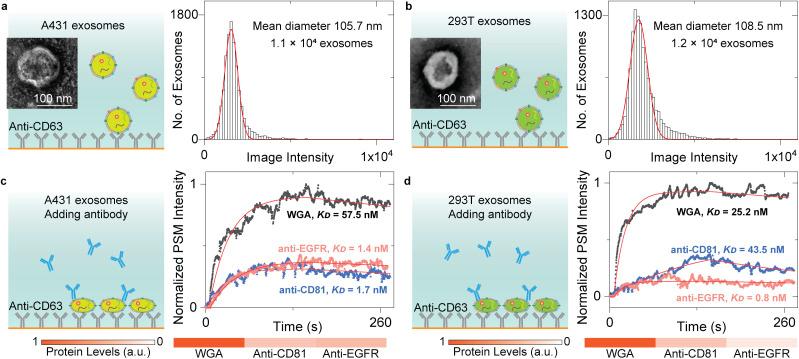
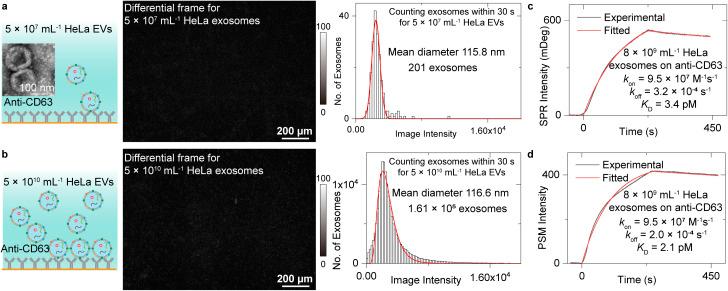
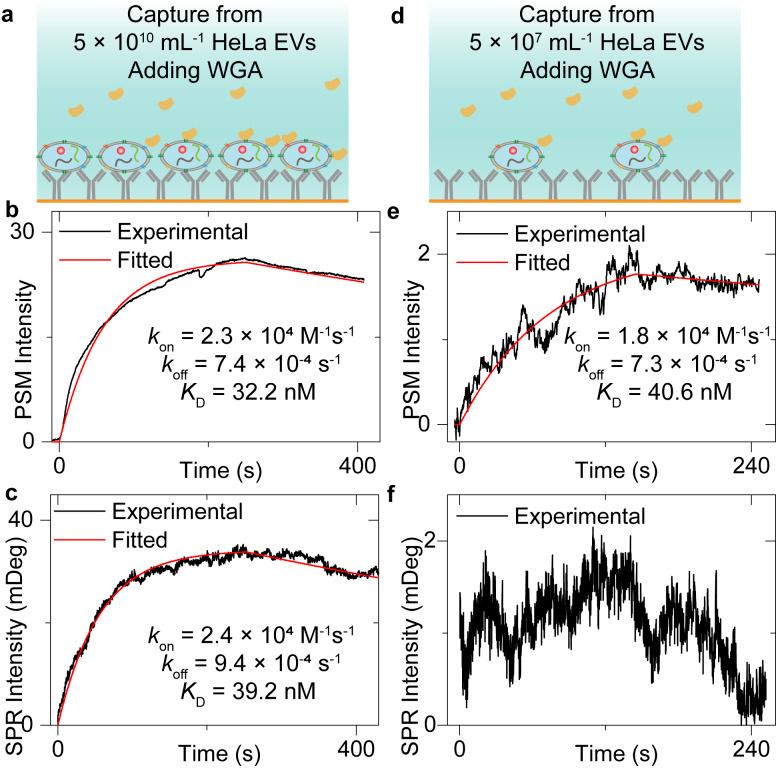
Exosome analysis is a promising tool for clinical and biological research applications. However, detection and biomarker quantification of exosomes is technically challenging because they are small and highly heterogeneous. Here, we report an optical approach for imaging exosomes and quantifying their protein markers without labels using plasmonic scattering microscopy (PSM). PSM can provide improved spatial resolution and distortion-free image compared to conventional surface plasmon resonance (SPR) microscopy, with the signal-to-noise ratio similar to objective coupled surface plasmon resonance (SPR) microscopy, and millimeter-scale field of view as a prism-coupled SPR system, thus allowing exosome size distribution analysis with high throughput. In addition, PSM retains the high specificity and surface sensitivity of the SPR sensors and thus allows selection of exosomes from extracellular vesicles with antibody-modified sensor surfaces and analyzing binding kinetics between antibody and the surface protein biomarkers on the captured exosomes. Finally, the PSM can be easily constructed on a popular prism-coupled SPR system with commercially available components. Thus, it may provide an economical and powerful tool for clinical exosome analysis and exploration of fundamental issues such as exosome biomarker binding properties.
外泌体分析是临床和生物学研究应用中一种很有前景的工具。然而,外泌体的检测和生物标志物定量在技术上具有挑战性,因为它们体积小且高度异质。在此,我们报告一种光学方法,用于使用表面等离子体散射显微镜(PSM)对未标记的外泌体进行成像并定量其蛋白质标志物。与传统的表面等离子体共振(SPR)显微镜相比,PSM可以提供更高的空间分辨率和无失真图像,其信噪比与物镜耦合表面等离子体共振(SPR)显微镜相似,并且作为棱镜耦合SPR系统具有毫米级视野,从而允许高通量分析外泌体大小分布。此外,PSM保留了SPR传感器的高特异性和表面敏感性,因此可以通过抗体修饰的传感器表面从细胞外囊泡中选择外泌体,并分析抗体与捕获的外泌体上的表面蛋白质生物标志物之间的结合动力学。最后,PSM可以很容易地在具有商用组件的流行棱镜耦合SPR系统上构建。因此,它可能为临床外泌体分析以及探索外泌体生物标志物结合特性等基本问题提供一种经济且强大的工具。

 Zotero 插件