
合成细胞因子电路将 T 细胞驱入免疫排斥肿瘤中。
Synthetic cytokine circuits that drive T cells into immune-excluded tumors.
机构信息
Cell Design Institute; University of California San Francisco, San Francisco, CA 94158, USA.
Department of Medicine, University of California San Francisco; San Francisco, CA 94158, USA.
出版信息
Science. 2022 Dec 16;378(6625):eaba1624. doi: 10.1126/science.aba1624.
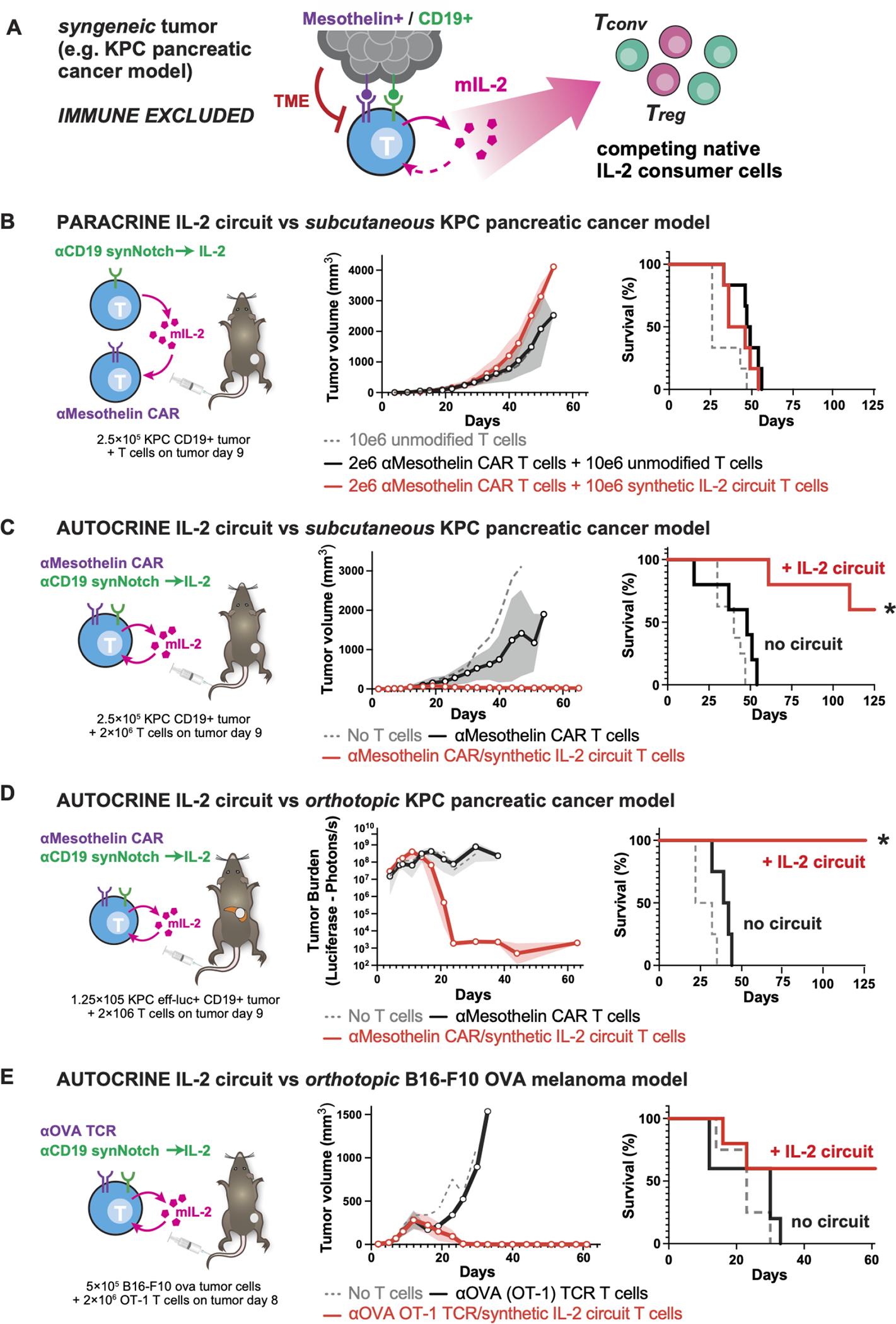
Chimeric antigen receptor (CAR) T cells are ineffective against solid tumors with immunosuppressive microenvironments. To overcome suppression, we engineered circuits in which tumor-specific synNotch receptors locally induce production of the cytokine IL-2. These circuits potently enhance CAR T cell infiltration and clearance of immune-excluded tumors, without systemic toxicity. The most effective IL-2 induction circuit acts in an autocrine and T cell receptor (TCR)- or CAR-independent manner, bypassing suppression mechanisms including consumption of IL-2 or inhibition of TCR signaling. These engineered cells establish a foothold in the target tumors, with synthetic Notch-induced IL-2 production enabling initiation of CAR-mediated T cell expansion and cell killing. Thus, it is possible to reconstitute synthetic T cell circuits that activate the outputs ultimately required for an antitumor response, but in a manner that evades key points of tumor suppression.
嵌合抗原受体 (CAR) T 细胞对于具有免疫抑制微环境的实体瘤无效。为了克服抑制,我们设计了一种电路,其中肿瘤特异性 synNotch 受体局部诱导细胞因子 IL-2 的产生。这些电路强烈增强了 CAR T 细胞的浸润和免疫排斥肿瘤的清除,而没有全身毒性。最有效的 IL-2 诱导电路以自分泌和 T 细胞受体 (TCR) 或 CAR 独立的方式起作用,绕过包括 IL-2 消耗或 TCR 信号抑制在内的抑制机制。这些工程细胞在靶肿瘤中立足,合成 Notch 诱导的 IL-2 产生使 CAR 介导的 T 细胞扩增和细胞杀伤得以启动。因此,有可能重新构建合成 T 细胞电路,激活最终对抗肿瘤反应所需的输出,但以逃避肿瘤抑制关键点的方式。




 Zotero 插件