
细胞外基质:骨骼肌干细胞微环境中的“砖块与灰浆”
Extracellular matrix: Brick and mortar in the skeletal muscle stem cell niche.
作者信息
Schüler Svenja C, Liu Yuguo, Dumontier Simon, Grandbois Michel, Le Moal Emmeran, Cornelison Ddw, Bentzinger C Florian
机构信息
Département de Pharmacologie-Physiologie, Faculté de Médecine et des Sciences de la Santé, Institut de Pharmacologie de Sherbrooke, Centre de Recherche du Centre Hospitalier Universitaire de Sherbrooke, Université de Sherbrooke, Sherbrooke, QC, Canada.
Division of Biological Sciences Christopher S. Bond Life Sciences Center, University of Missouri, Columbia, MO, United States.
出版信息
Front Cell Dev Biol. 2022 Nov 29;10:1056523. doi: 10.3389/fcell.2022.1056523. eCollection 2022.
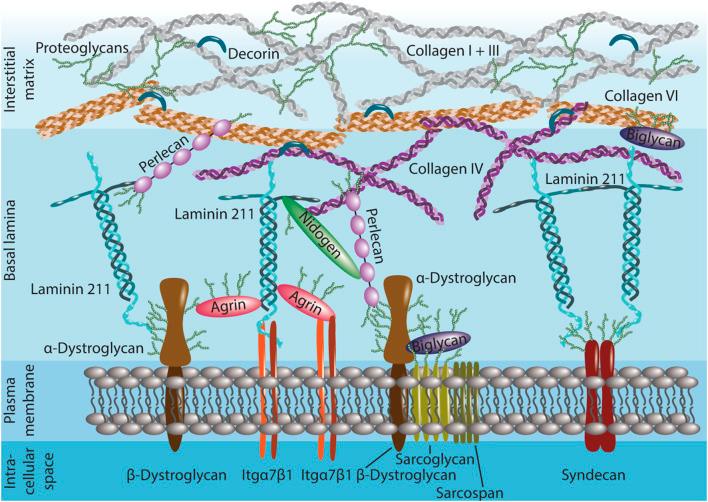
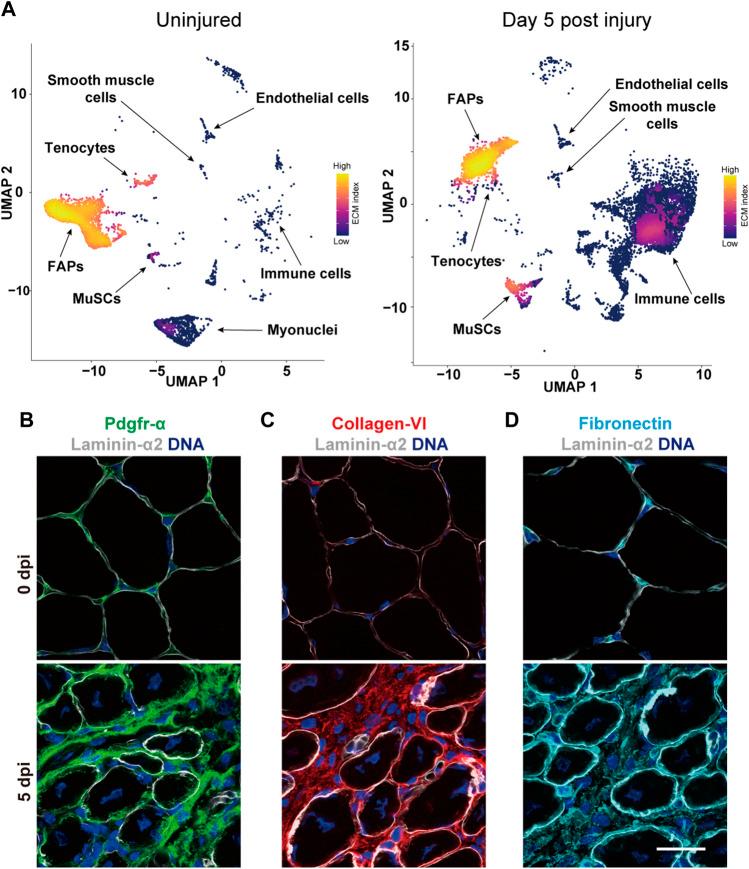
The extracellular matrix (ECM) is an interconnected macromolecular scaffold occupying the space between cells. Amongst other functions, the ECM provides structural support to tissues and serves as a microenvironmental niche that conveys regulatory signals to cells. Cell-matrix adhesions, which link the ECM to the cytoskeleton, are dynamic multi-protein complexes containing surface receptors and intracellular effectors that control various downstream pathways. In skeletal muscle, the most abundant tissue of the body, each individual muscle fiber and its associated muscle stem cells (MuSCs) are surrounded by a layer of ECM referred to as the basal lamina. The core scaffold of the basal lamina consists of self-assembling polymeric laminins and a network of collagens that tether proteoglycans, which provide lateral crosslinking, establish collateral associations with cell surface receptors, and serve as a sink and reservoir for growth factors. Skeletal muscle also contains the fibrillar collagenous interstitial ECM that plays an important role in determining tissue elasticity, connects the basal laminae to each other, and contains matrix secreting mesenchymal fibroblast-like cell types and blood vessels. During skeletal muscle regeneration fibroblast-like cell populations expand and contribute to the transitional fibronectin-rich regenerative matrix that instructs angiogenesis and MuSC function. Here, we provide a comprehensive overview of the role of the skeletal muscle ECM in health and disease and outline its role in orchestrating tissue regeneration and MuSC function.
细胞外基质(ECM)是一种相互连接的大分子支架,占据细胞之间的空间。在其他功能中,ECM为组织提供结构支持,并作为向细胞传递调节信号的微环境生态位。细胞-基质粘附将ECM与细胞骨架相连,是动态的多蛋白复合物,包含控制各种下游途径的表面受体和细胞内效应器。在人体最丰富的组织骨骼肌中,每根肌纤维及其相关的肌肉干细胞(MuSCs)都被一层称为基膜的ECM所包围。基膜的核心支架由自组装的聚合层粘连蛋白和胶原蛋白网络组成,这些胶原蛋白束缚蛋白聚糖,蛋白聚糖提供侧向交联,与细胞表面受体建立旁侧关联,并作为生长因子的汇集处和储存库。骨骼肌还含有纤维状胶原间质ECM,它在决定组织弹性、将基膜相互连接以及包含分泌基质的间充质成纤维细胞样细胞类型和血管方面发挥重要作用。在骨骼肌再生过程中,成纤维细胞样细胞群体扩增并促成富含纤连蛋白的过渡性再生基质,该基质指导血管生成和MuSC功能。在这里,我们全面概述了骨骼肌ECM在健康和疾病中的作用,并概述了其在协调组织再生和MuSC功能中的作用。



 Zotero 插件