
孕期母体叶酸和叶酸补充剂的摄入与男性生育力标志物:基于人群的队列研究。
Maternal intake of folate and folic acid during pregnancy and markers of male fecundity: A population-based cohort study.
机构信息
Department of Public Health, Research Unit for Epidemiology, Aarhus University, Aarhus C, Denmark.
Department of Clinical Genetics, Aarhus University Hospital, Aarhus N, Denmark.
出版信息
Andrology. 2023 Mar;11(3):537-550. doi: 10.1111/andr.13364. Epub 2022 Dec 26.
BACKGROUND
Poor male fecundity is of concern, and a prenatal origin has been proposed. Folate, a methyl donor involved in DNA methylation, is essential for normal fetal development by regulating gene expression during different periods of fetal development. Thus, prenatal exposure to low maternal folate intake might have a programing function of the developing reproductive organs.
OBJECTIVES
To examine the association between maternal intake of folate from diet and folic acid from supplements during pregnancy and markers of fecundity in young men.
MATERIALS AND METHODS
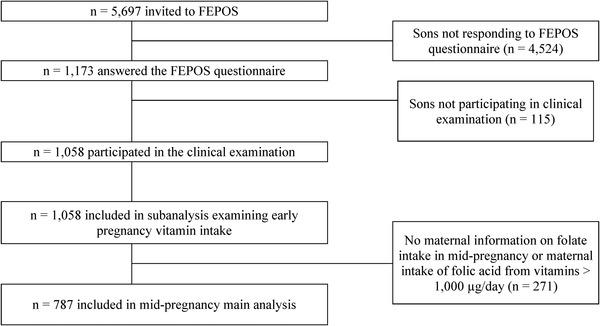
We conducted a follow-up study using a Danish mother-son cohort of 787 young men born 1998-2000. Percentage differences in semen characteristics, testes volume, and reproductive hormone levels were analyzed according to total folate calculated as dietary folate equivalents from diet and supplements in midpregnancy, using multivariable negative binomial regression models. Total folate was analyzed in quintiles, continuous per standard deviation decrease (SD: 318 μg/day) and as restricted cubic splines.
RESULTS
Low maternal intake of total folate was associated with lower total sperm count (-5% (95% confidence intervals [CI]: -11%; 2%)), a lower proportion of non-progressive and immotile spermatozoa (-5% [95% CI: -8%; -3%]), and lower testes volume (-4% [95% CI: -6%; -2%]) per SD decrease in total folate intake. Spline plots supported these findings.
DISCUSSION
The finding of a lower proportion of non-progressive and immotile spermatozoa, and hence a higher proportion of motile spermatozoa, in men of mothers with a lower intake of total folate in midpregnancy was surprising and may be a chance finding.
CONCLUSION
Lower maternal intake of total folate in midpregnancy was associated with lower sperm count and lower testes volume, however, also with a lower proportion of non-progressive and immotile spermatozoa in adult men. Whether this actually affects the ability to obtain a pregnancy warrants further investigation.
背景
男性生育能力差令人担忧,有人提出其可能与胎儿期起源有关。叶酸作为一种参与 DNA 甲基化的甲基供体,对于正常的胎儿发育至关重要,它可以通过调节胎儿发育不同阶段的基因表达来发挥作用。因此,胎儿期母亲叶酸摄入不足可能会对发育中的生殖器官产生编程作用。
目的
探究妊娠期间母体饮食和补充剂中叶酸的摄入量与年轻男性生育能力标志物之间的关系。
材料和方法
我们使用丹麦的一项母子队列研究进行了一项随访研究,该研究纳入了 1998-2000 年出生的 787 名年轻男性。采用多变量负二项回归模型,根据妊娠中期饮食和补充剂中总叶酸(计算为饮食叶酸当量),分析精液特征、睾丸体积和生殖激素水平的百分比差异。总叶酸采用五分位数、连续每标准差下降(SD:318μg/天)和限制立方样条进行分析。
结果
母体总叶酸摄入量低与总精子数减少(-5%(95%置信区间 [CI]:-11%;2%])、非前向运动和不动精子比例降低(-5%[95% CI:-8%;-3%])和睾丸体积减少(-4%[95% CI:-6%;-2%])有关,SD 下降时总叶酸摄入量每减少一个标准差。样条图支持这些发现。
讨论
妊娠中期母亲总叶酸摄入量低的男性非前向运动和不动精子比例降低,即前向运动精子比例升高,这一结果令人惊讶,可能是偶然发现。
结论
妊娠中期母体总叶酸摄入量低与精子计数和睾丸体积降低有关,但也与成年男性非前向运动和不动精子比例降低有关。这是否会实际影响获得妊娠的能力,需要进一步研究。


 Zotero 插件