
从人粪便中分离的 8 株阿克曼氏菌的重新分类及阿克曼氏菌属 Massiliensis sp. nov. 和 Candidatus Akkermansia timonensis 的描述。
Reclassification of eight Akkermansia muciniphila strains and description of Akkermansia massiliensis sp. nov. and Candidatus Akkermansia timonensis, isolated from human feces.
机构信息
MEPHI, IHU Méditerranée Infection, Aix Marseille University, 19-21 Boulevard Jean Moulin, 13005, Marseille, France.
IHU-Méditerranée Infection, Marseille, France.
出版信息
Sci Rep. 2022 Dec 16;12(1):21747. doi: 10.1038/s41598-022-25873-0.
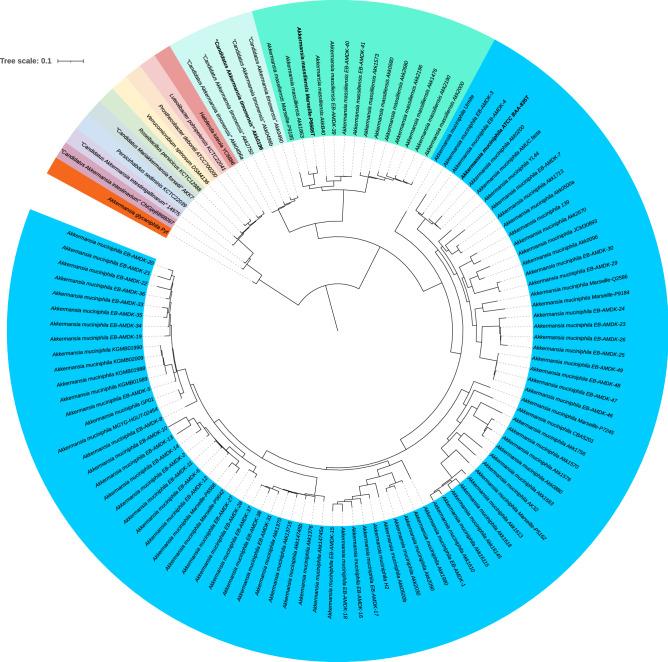
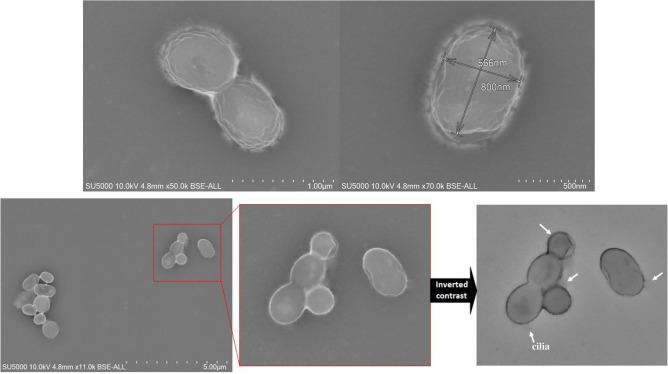
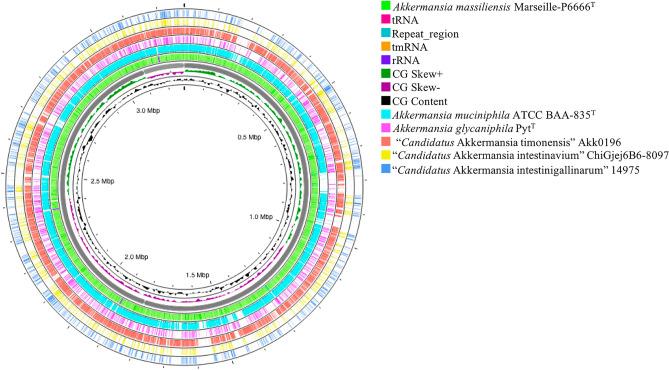
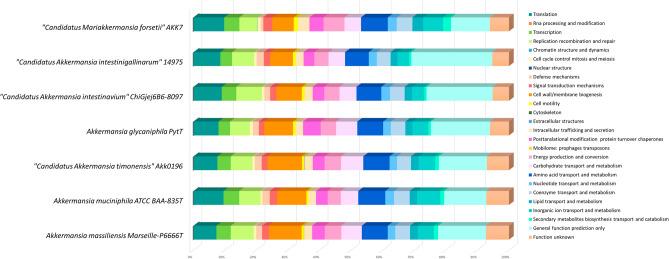
Akkermansia muciniphila is a human intestinal tract bacterium that plays an important role in the mucus layer renewal. Several studies have demonstrated that it is a modulator for gut homeostasis and a probiotic for human health. The Akkermansia genus contains two species with standing in nomenclature but their genomic diversity remains unclear. In this study, eight new Akkermansia sp. strains were isolated from the human gut. Using the digital DNA-DNA hybridization (dDDH), average nucleotide identity (ANI) and core genome-based phylogenetic analysis applied to 104 A. muciniphila whole genomes sequences, strains were reclassified into three clusters. Cluster I groups A. muciniphila strains (including strain ATCC BAA-835 as type strain), whereas clusters II and III represent two new species. A member of cluster II, strain Marseille-P6666 differed from A. muciniphila strain ATCC BAA-835 and from A. glycaniphila strain Pyt in its ability to grow in microaerophilic atmosphere up to 42 °C, to assimilate various carbon sources and to produce acids from a several compounds. The major fatty acids of strain Marseille-P6666 were 12-methyl-tetradecanoic and pentadecanoic acids. The DNA G + C content of strain Marseille-P6666 was 57.8%. On the basis of these properties, we propose the name A. massiliensis sp. nov. for members of cluster II, with strain Marseille-P6666 (= CSUR P6666 = CECT 30548) as type strain. We also propose the name "Candidatus Akkermansia timonensis" sp. nov. for the members of cluster III, which contains only uncultivated strains, strain Akk0196 being the type strain.
黏蛋白阿克曼氏菌是一种人类肠道细菌,在黏液层更新中发挥重要作用。多项研究表明,它是肠道内稳态的调节剂,也是人类健康的益生菌。阿克曼氏菌属包含两个具有命名地位的种,但它们的基因组多样性仍不清楚。在这项研究中,从人类肠道中分离出了 8 株新的黏蛋白阿克曼氏菌。使用数字 DNA-DNA 杂交(dDDH)、平均核苷酸同一性(ANI)和基于核心基因组的系统发育分析,对 104 株黏蛋白阿克曼氏菌全基因组序列进行分析,菌株被重新分类为 3 个群。群 I 聚集了黏蛋白阿克曼氏菌菌株(包括 ATCC BAA-835 株作为模式株),而群 II 和群 III 则代表了两个新种。群 II 的一个成员,即马赛 P6666 株,与黏蛋白阿克曼氏菌 ATCC BAA-835 株和 Pyt 黏蛋白阿克曼氏菌在能够在微需氧环境中生长(最高可达 42°C)、同化各种碳源以及从几种化合物中产生酸的能力上有所不同。马赛 P6666 株的主要脂肪酸是 12-甲基十四烷酸和十五烷酸。马赛 P6666 株的 DNA G+C 含量为 57.8%。基于这些特性,我们建议将群 II 的成员命名为阿克曼氏菌马塞利斯尼斯,马赛 P6666 株(=CSUR P6666=CECT 30548)为模式株。我们还建议将群 III 的成员命名为“Candidatus Akkermansia timonensis”,因为它们只包含未培养的菌株,其中 Akk0196 株为模式株。
 Zotero 插件