
靶向 USP10 诱导食管鳞癌细胞中致癌性 ANLN 的降解。
Targeting USP10 induces degradation of oncogenic ANLN in esophageal squamous cell carcinoma.
机构信息
The Key Laboratory of Molecular Biology for High Cancer Incidence Coastal Chaoshan Area, Department of Biochemistry and Molecular Biology, Shantou University Medical College, Shantou, Guangdong, PR China.
Guangdong Provincial Key Laboratory of Infectious Diseases and Molecular Immunopathology, Institute of Oncologic Pathology, Shantou University Medical College, Shantou, Guangdong, PR China.
出版信息
Cell Death Differ. 2023 Feb;30(2):527-543. doi: 10.1038/s41418-022-01104-x. Epub 2022 Dec 16.
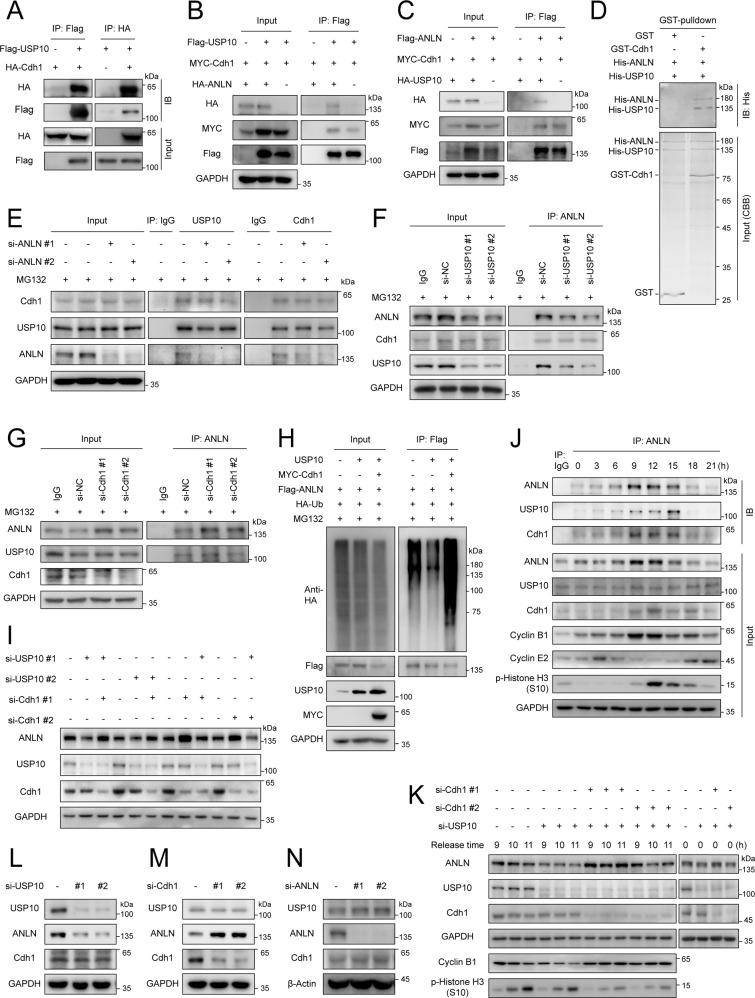
Anillin (ANLN) is a mitosis-related protein that promotes contractile ring formation and cytokinesis, but its cell cycle-dependent degradation mechanisms in cancer cells remain unclear. Here, we show that high expression of ANLN promotes cytokinesis and proliferation in esophageal squamous cell carcinoma (ESCC) cells and is associated with poor prognosis in ESCC patients. Furthermore, the findings of the study showed that the deubiquitinating enzyme USP10 interacts with ANLN and positively regulates ANLN protein levels. USP10 removes the K11- and K63-linked ubiquitin chains of ANLN through its deubiquitinase activity and prevents ANLN ubiquitin-mediated degradation. Importantly, USP10 promotes contractile ring assembly at the cytokinetic furrow as well as cytokinesis by stabilizing ANLN. Interestingly, USP10 and the E3 ubiquitin ligase APC/C co-activator Cdh1 formed a functional complex with ANLN in a non-competitive manner to balance ANLN protein levels. In addition, the macrolide compound FW-04-806 (F806), a natural compound with potential for treating ESCC, inhibited the mitosis of ESCC cells by targeting USP10 and promoting ANLN degradation. F806 selectively targeted USP10 and inhibited its catalytic activity but did not affect the binding of Cdh1 to ANLN and alters the balance of the USP10-Cdh1-ANLN complex. Additionally, USP10 expression was positively correlated with ANLN level and poor prognosis of ESCC patients. Overall, targeting the USP10-ANLN axis can effectively inhibit ESCC cell-cycle progression.
肌动蛋白结合蛋白(Anillin,ANLN)是一种与有丝分裂相关的蛋白,可促进收缩环的形成和胞质分裂,但在癌细胞中其细胞周期依赖性降解机制尚不清楚。本研究表明,高表达的 ANLN 可促进食管鳞状细胞癌(ESCC)细胞的胞质分裂和增殖,并与 ESCC 患者的不良预后相关。此外,研究结果表明去泛素化酶 USP10 与 ANLN 相互作用,并正向调节 ANLN 蛋白水平。USP10 通过其去泛素酶活性去除 ANLN 的 K11 和 K63 连接的泛素链,防止 ANLN 泛素介导的降解。重要的是,USP10 通过稳定 ANLN 促进收缩环在胞质分裂沟处的组装和胞质分裂。有趣的是,USP10 和 E3 泛素连接酶 APC/C 共激活因子 Cdh1 以非竞争性方式与 ANLN 形成功能性复合物,以平衡 ANLN 蛋白水平。此外,大环内酯类化合物 FW-04-806(F806)是一种具有治疗 ESCC 潜力的天然化合物,通过靶向 USP10 并促进 ANLN 降解来抑制 ESCC 细胞的有丝分裂。F806 选择性靶向 USP10 并抑制其催化活性,但不影响 Cdh1 与 ANLN 的结合,改变 USP10-Cdh1-ANLN 复合物的平衡。此外,USP10 表达与 ANLN 水平和 ESCC 患者的不良预后呈正相关。总之,靶向 USP10-ANLN 轴可有效抑制 ESCC 细胞周期进程。




 Zotero 插件