
用于从合成水样和实际水样中选择性去除阴离子和阳离子染料的多功能三元NLP/ZnO@l-半胱氨酸-PANI生物纳米复合材料
Multifunctional Ternary NLP/ZnO@l-cysteine--PANI Bionanocomposites for the Selective Removal of Anionic and Cationic Dyes from Synthetic and Real Water Samples.
作者信息
Bir Ritu, Tanweer Mohd Saquib, Singh Meenakshi, Alam Masood
机构信息
Department of Chemistry, Galgotias University, Gautam Buddh Nagar, Noida203201, Uttar Pradesh, India.
Environmental Science Research Lab, Department of Applied Sciences & Humanities, Faculty of Engineering & Technology, Jamia Millia Islamia, New Delhi110025, India.
出版信息
ACS Omega. 2022 Nov 30;7(49):44836-44850. doi: 10.1021/acsomega.2c04936. eCollection 2022 Dec 13.
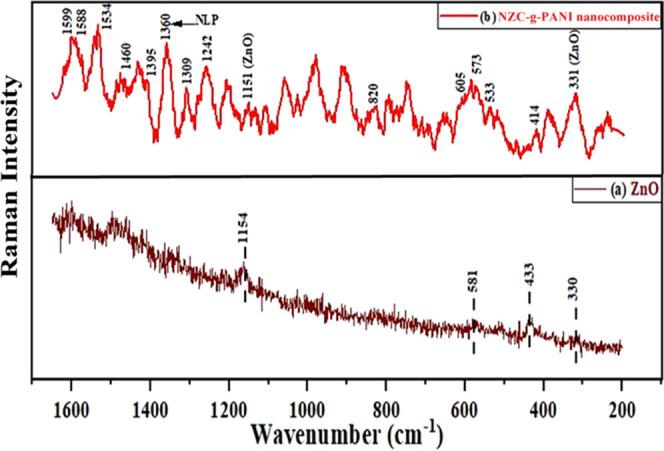
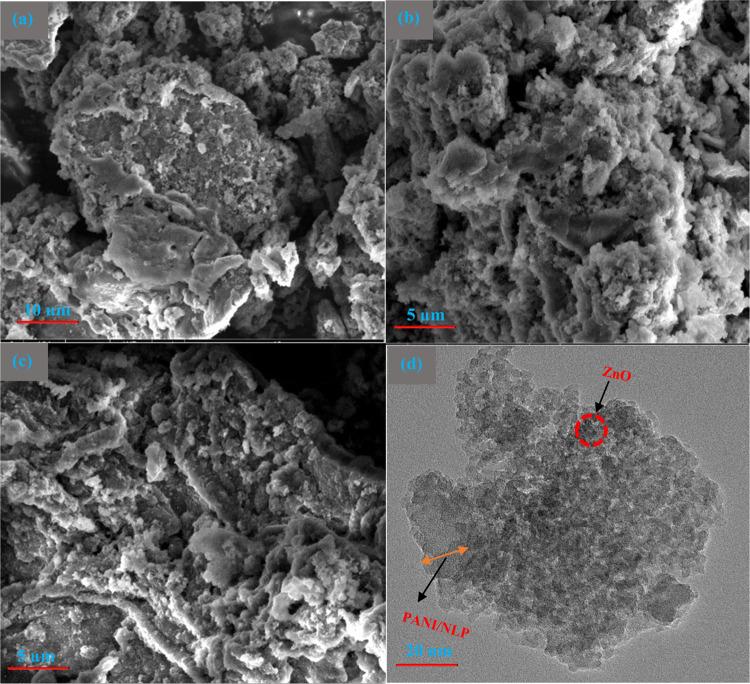
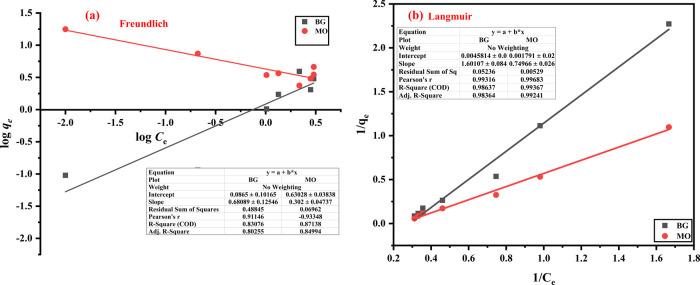
The development of competent adsorbents based on agro-waste materials with multifunctional groups and porosity for the removal of toxic dyes from aqueous solutions is still a challenge. Herein, a bionanocomposite made up of neem leaf powder (NLP), zinc oxide (ZnO), and amino acid (l-cysteine)-functionalized polyaniline (PANI), namely, NLP/ZnO@l-cysteine--PANI (NZC--PANI), has been prepared by an in situ polymerization method. The as-prepared bionanocomposite was tested for the adsorptive removal of three anionic dyes, namely, methyl orange (MO), amido black 10B (AB 10B), and eriochrome black T (EBT), as well as three cationic dyes, namely, brilliant green (BG), crystal violet (CV), and methylene blue (MB), from synthetic aqueous medium. The morphological and structural characteristics of the NZC--PANI nanocomposite were examined with the help of HR field emission scanning electron microscopy (FESEM), transmission electron microscopy (TEM), X-ray diffraction (XRD), Fourier transform infrared (FTIR), and Raman spectroscopy. FTIR and Raman studies show that the formulated NZC--PANI have an ample number of functional moieties such as carboxyl (-COOH), hydroxyl (-OH), amines (-NH), and imines (-N=), thus demonstrating outstanding dye removal capacity. C-S linkage helps to attach l-cysteine with polyaniline. Moreover, the predominance of chemisorption via ionic/pi-pi interaction and hydrogen bonding between the NZC--PANI nanocomposite and dyes (BG and MO) has been realized by FTIR and fitting of kinetics data to the PSO model. For both BG and MO dyes, the biosorption isotherm was precisely accounted for by the Langmuir isotherm with values of up to 218.27 mg g for BG at pH 6 and 558.34 mg g for MO at pH 1. Additionally, thermodynamic studies revealed the endothermic and spontaneous nature of adsorption. NZC--PANI showed six successive regeneration cycles for cationic (MO: from 96.3 to 90.4%) and anionic (BG: from 94.7 to 88.7%) dyes. Also, batch adsorption operations were validated to demonstrate dye biosorption from real wastewater, such as tap water, river water, and laundry wastewater. Overall, this study indicates that the prepared NZC--PANI biosorbent could be used as an effective adsorbent for the removal of various types of anionic as well as cationic dyes from different aqueous solutions.
开发基于具有多功能基团和孔隙率的农业废弃物材料的高效吸附剂,用于从水溶液中去除有毒染料仍然是一项挑战。在此,通过原位聚合法制备了一种由印楝叶粉(NLP)、氧化锌(ZnO)和氨基酸(L-半胱氨酸)功能化聚苯胺(PANI)组成的生物纳米复合材料,即NLP/ZnO@L-半胱氨酸-PANI(NZC-PANI)。对所制备的生物纳米复合材料进行了测试,以从合成水介质中吸附去除三种阴离子染料,即甲基橙(MO)、氨基黑10B(AB 10B)和铬黑T(EBT),以及三种阳离子染料,即亮绿(BG)、结晶紫(CV)和亚甲基蓝(MB)。借助高分辨率场发射扫描电子显微镜(FESEM)、透射电子显微镜(TEM)、X射线衍射(XRD)、傅里叶变换红外光谱(FTIR)和拉曼光谱对NZC-PANI纳米复合材料的形态和结构特征进行了研究。FTIR和拉曼研究表明,所制备的NZC-PANI具有大量的官能团,如羧基(-COOH)、羟基(-OH)、胺基(-NH)和亚胺基(-N=),从而显示出出色的染料去除能力。C-S键有助于将L-半胱氨酸与聚苯胺连接。此外,通过FTIR以及将动力学数据拟合到PSO模型,实现了NZC-PANI纳米复合材料与染料(BG和MO)之间通过离子/π-π相互作用和氢键进行的化学吸附占主导地位。对于BG和MO染料,Langmuir等温线精确地描述了生物吸附等温线,在pH值为6时,BG的吸附量高达218.27 mg/g,在pH值为1时,MO的吸附量高达558.34 mg/g。此外,热力学研究揭示了吸附的吸热和自发性质。NZC-PANI对阳离子(MO:从96.3%降至90.4%)和阴离子(BG:从94.7%降至88.7%)染料显示出六个连续的再生循环。此外,还通过批量吸附操作验证了从实际废水(如自来水、河水和洗衣废水)中对染料的生物吸附。总体而言,这项研究表明,所制备的NZC-PANI生物吸附剂可作为一种有效的吸附剂,用于从不同水溶液中去除各种类型的阴离子和阳离子染料。






 Zotero 插件