
青春期对免疫系统的影响:与多发性硬化症的关联。
Effect of puberty on the immune system: Relevance to multiple sclerosis.
作者信息
Ucciferri Carmen C, Dunn Shannon E
机构信息
Department of Immunology, The University of Toronto, Toronto, ON, Canada.
Keenan Research Centre for Biomedical Science of St. Michael's Hospital, Toronto, ON, Canada.
出版信息
Front Pediatr. 2022 Dec 2;10:1059083. doi: 10.3389/fped.2022.1059083. eCollection 2022.
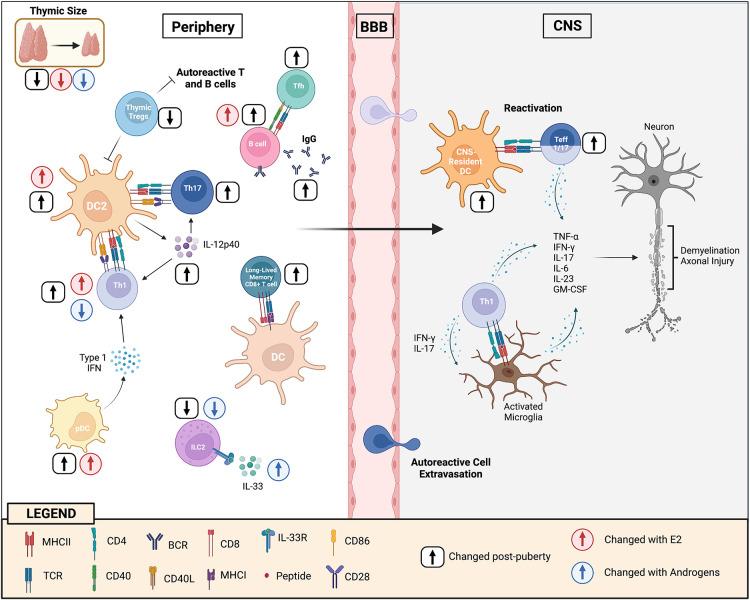
Puberty is a dynamic period marked by changing levels of sex hormones, the development of secondary sexual characteristics and reproductive maturity. This period has profound effects on various organ systems, including the immune system. The critical changes that occur in the immune system during pubertal onset have been shown to have implications for autoimmune conditions, including Multiple Sclerosis (MS). MS is rare prior to puberty but can manifest in children after puberty. This disease also has a clear female preponderance that only arises following pubertal onset, highlighting a potential role for sex hormones in autoimmunity. Early onset of puberty has also been shown to be a risk factor for MS. The purpose of this review is to overview the evidence that puberty regulates MS susceptibility and disease activity. Given that there is a paucity of studies that directly evaluate the effects of puberty on the immune system, we also discuss how the immune system is different in children and mice of pre- vs. post-pubertal ages and describe how gonadal hormones may regulate these immune mechanisms. We present evidence that puberty enhances the expression of co-stimulatory molecules and cytokine production by type 2 dendritic cells (DC2s) and plasmacytoid dendritic cells (pDCs), increases T helper 1 (Th1), Th17, and T follicular helper immunity, and promotes immunoglobulin (Ig)G antibody production. Overall, this review highlights how the immune system undergoes a functional maturation during puberty, which has the potential to explain the higher prevalence of MS and other autoimmune diseases seen in adolescence.
青春期是一个动态时期,其特征是性激素水平变化、第二性征发育和生殖成熟。这一时期对包括免疫系统在内的各种器官系统都有深远影响。青春期开始时免疫系统发生的关键变化已被证明与自身免疫性疾病有关,包括多发性硬化症(MS)。MS在青春期前很少见,但在青春期后的儿童中可能会出现。这种疾病在女性中也明显占优势,且这种优势仅在青春期开始后才出现,这突出了性激素在自身免疫中的潜在作用。青春期早发也已被证明是MS的一个危险因素。本综述的目的是概述青春期调节MS易感性和疾病活动的证据。鉴于直接评估青春期对免疫系统影响的研究很少,我们还将讨论青春期前和青春期后儿童及小鼠免疫系统的差异,并描述性腺激素如何调节这些免疫机制。我们提供的证据表明,青春期可增强2型树突状细胞(DC2s)和浆细胞样树突状细胞(pDCs)的共刺激分子表达和细胞因子产生,增加辅助性T细胞1(Th1)、Th17和滤泡辅助性T细胞免疫,并促进免疫球蛋白(Ig)G抗体产生。总体而言,本综述强调了免疫系统在青春期如何经历功能成熟,这有可能解释在青少年中MS和其他自身免疫性疾病的较高患病率。
 Zotero 插件