
解析气温和湿度对耐力运动的影响。
Delineating the impacts of air temperature and humidity for endurance exercise.
机构信息
School of Physical Education, Sport and Exercise Sciences, University of Otago, Dunedin, New Zealand.
Cardiff School of Sport and Health Sciences, Cardiff Metropolitan University, Cardiff, UK.
出版信息
Exp Physiol. 2023 Feb;108(2):207-220. doi: 10.1113/EP090969. Epub 2022 Dec 20.
NEW FINDINGS
What is the central question of this study? What are the independent effects of air temperature and humidity on performance, physiological and perceptual responses during endurance exercise? What is the main finding and its importance? When examined independently, elevated air temperature increased heat strain and impaired aerobic exercise performance, but to a lesser extent than has been reported previously. These findings highlight the importance of absolute humidity relative to temperature when exercising or working under severe heat stress.
ABSTRACT
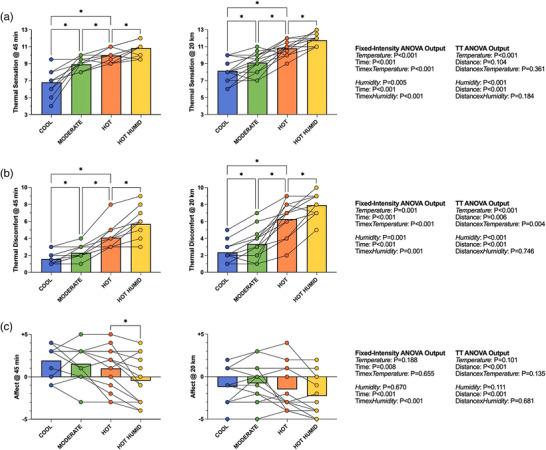
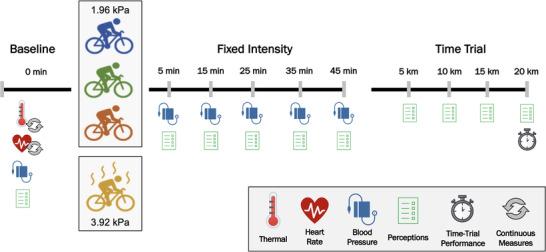
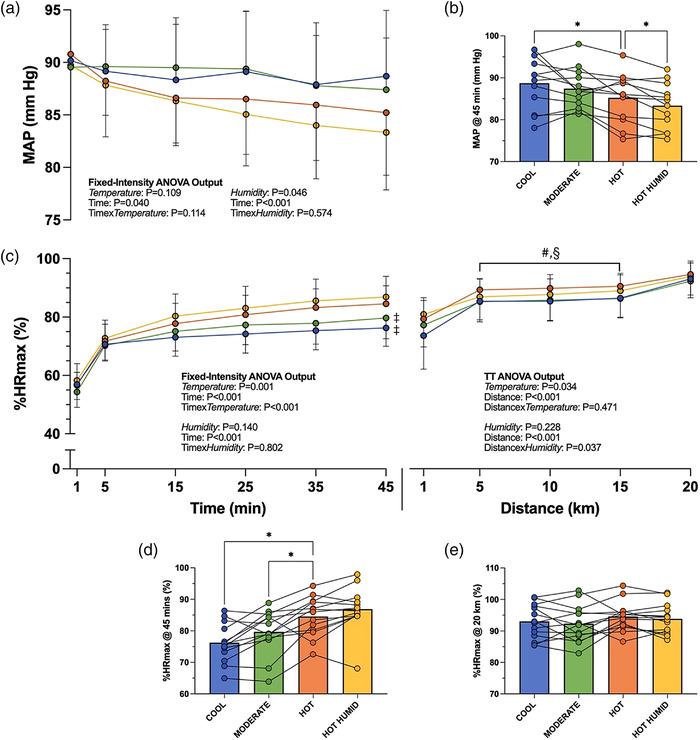
Many studies have reported that ambient heat stress increases physiological and perceptual strain and impairs endurance exercise, but effects of air temperature per se remain almost unexamined. Most studies have used matched relative humidity, thereby exponentially increasing absolute humidity (water content in air) concurrently with temperature. Absolute (not relative) humidity governs evaporative rate and is more important at higher work rates and air temperatures. Therefore, we examined the independent effects of air temperature and humidity on performance, thermal, cardiovascular and perceptual measures during endurance exercise. Utilizing a crossover design, 14 trained participants (7 females) completed 45 min fixed-intensity cycling (70% ) followed by a 20-km time trial in each of four environments: three air temperatures at matched absolute humidity (Cool, 18°C; Moderate, 27°C; and Hot, 36°C; at 1.96 kPa, air velocity ∼4.5 m/s), and one at elevated humidity (Hot Humid, 36°C at 3.92 kPa). Warmer air caused warmer skin (0.5°C/°C; P < 0.001), higher heart rate (1 bpm/°C; P < 0.001), sweat rate (0.04 l/h/°C; P < 0.001) and thermal perceptions during fixed-intensity exercise, but minimally affected core temperature (<0.01°C/°C; P = 0.053). Time-trial performance was comparable between Cool and Moderate (95% CI: -1.4, 5.9%; P = 0.263), but 3.6-6% slower in Hot (95% CI: ±2.4%; P ≤ 0.006). Elevated humidity increased core temperature (P < 0.001), perceived temperature and discomfort but not skin temperature or heart rate, and reduced mean blood pressure (P = 0.046) during fixed-intensity exercise. Elevated humidity impaired time-trial performance by 3.4% (95% CI: ±2.2%; P = 0.006). In conclusion, these findings quantify the importance of absolute humidity alongside air temperature when exercising under severe heat stress.
新发现
这项研究的核心问题是什么?空气温度和湿度对耐力运动中的表现、生理和感知反应有哪些独立影响?主要发现及其重要性是什么?当单独检查时,升高的空气温度会增加热应激并损害有氧运动表现,但程度低于以前的报告。这些发现强调了在剧烈热应激下进行运动或工作时,绝对湿度相对于温度的重要性。
摘要
许多研究报告称,环境热应激会增加生理和感知压力并损害耐力运动,但空气温度本身的影响几乎没有被研究过。大多数研究使用匹配的相对湿度,从而使绝对湿度(空气中的水分含量)随温度呈指数级增加。绝对(而不是相对)湿度决定蒸发率,在较高的工作率和空气温度下更为重要。因此,我们研究了空气温度和湿度对耐力运动中表现、热、心血管和感知测量的独立影响。利用交叉设计,14 名训练有素的参与者(7 名女性)在四种环境中的每一种环境中完成 45 分钟的固定强度自行车运动(凉爽,18°C;中等,27°C;炎热,36°C;在 1.96kPa 下,空气速度约为 4.5m/s),然后在一个环境中进行 20 公里计时赛炎热潮湿,36°C 时为 3.92kPa)。较暖的空气导致皮肤温度升高(0.5°C/°C;P<0.001)、心率升高(1bpm/°C;P<0.001)、出汗率升高(0.04l/h/°C;P<0.001),在固定强度运动期间的热感觉更高,但核心温度的影响最小(<0.01°C/°C;P=0.053)。凉爽和中等环境下的计时赛性能相当(95%置信区间:-1.4,5.9%;P=0.263),但炎热环境下的速度慢 3.6-6%(95%置信区间:±2.4%;P≤0.006)。高湿度会增加核心温度(P<0.001)、感知温度和不适,但不会增加皮肤温度或心率,并降低固定强度运动期间的平均血压(P=0.046)。高湿度使计时赛表现降低了 3.4%(95%置信区间:±2.2%;P=0.006)。总之,这些发现量化了当在剧烈热应激下运动时,空气温度和绝对湿度的重要性。



 Zotero 插件