
接种 COVID-19 疫苗与接种者的月经周期变化。
COVID-19 vaccination and changes in the menstrual cycle among vaccinated persons.
机构信息
Department of Epidemiology and Biostatistics, Mel and Enid Zuckerman College of Public Health, University of Arizona; Department of Obstetrics and Gynecology, College of Medicine-Tucson, University of Arizona; University of Arizona Cancer Center, University of Arizona.
Department of Epidemiology and Biostatistics, Mel and Enid Zuckerman College of Public Health, University of Arizona.
出版信息
Fertil Steril. 2023 Mar;119(3):392-400. doi: 10.1016/j.fertnstert.2022.12.023. Epub 2022 Dec 17.
OBJECTIVE
To describe the characteristics of people who experience changes to their menstrual cycle after COVID-19 vaccination.
DESIGN
Longitudinal study.
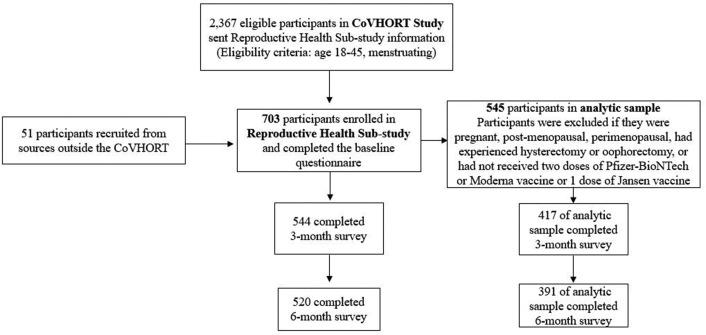
PATIENT(S): We recruited a volunteer sample with and without a history of SARS-CoV-2 infection who enrolled in the Arizona COVID-19 Cohort (CoVHORT) study and participated in a reproductive sub-cohort who were pre-menopausal, not pregnant, and had received a COVID-19 vaccine in 2021 (n = 545).
EXPOSURE(S): Demographic and reproductive characteristics were collected via self-reports.
MAIN OUTCOME MEASURE(S): Information on self-reported changes in the menstrual cycle after COVID-19 vaccination was collected from May 2021 to December 2021. We looked at demographic and reproductive characteristics as predictors of menstrual cycle change.
RESULT(S): The majority of our vaccinated sample received the Pfizer-BioNTech vaccine (58%), and were 26-35 years old (51%), non-Hispanic (84%), and White (88%). Approximately 25% of vaccinated participants reported a change in their menstrual cycle after vaccination; the majority reported changes after their second dose (56%) as compared with their first (18%) and third (14%) doses. The most commonly reported changes were irregular menstruation (43%), increased premenstrual symptoms (34%), increased menstrual pain or cramps (30%), and abnormally heavy or prolonged bleeding (31%). High self-reported perceived stress levels compared with low perceived stress (OR, 2.22; 95% CI 1.12-4.37) and greater body mass index (OR, 1.04; 95% CI 1.00-1.07) were associated with greater odds of experiencing the menstrual cycle changes after the vaccination. Participants having a history of SARS-CoV-2 infection were less likely to report changes in their menstrual cycle after vaccination compared with the participants with no history of SARS-CoV-2 infection (OR, 0.58; 95% CI 0.32-1.04).
CONCLUSION(S): Among vaccinated participants, approximately 25% of them reported predominantly temporary changes in the menstrual cycle, however, we are unable to determine whether these changes are due to normal cycle variability. The COVID-19 vaccines are safe and effective for everyone, including pregnant people and people trying to conceive; hence, these findings should not discourage vaccination.
目的
描述接种 COVID-19 疫苗后月经周期发生变化的人群特征。
设计
纵向研究。
患者
我们招募了志愿者样本,包括有和没有 SARS-CoV-2 感染史的志愿者,他们参加了亚利桑那州 COVID-19 队列(CoVHORT)研究,并参与了生殖亚组,这些志愿者处于绝经前、非妊娠状态,并在 2021 年接种了 COVID-19 疫苗(n=545)。
暴露
通过自我报告收集人口统计学和生殖特征。
主要观察指标
从 2021 年 5 月到 2021 年 12 月,收集了关于接种 COVID-19 疫苗后月经周期变化的自我报告信息。我们研究了人口统计学和生殖特征作为月经周期变化的预测因素。
结果
我们接种疫苗的样本中,大多数人接种了辉瑞-生物技术公司的疫苗(58%),年龄在 26-35 岁(51%),非西班牙裔(84%),白种人(88%)。大约 25%的接种疫苗的参与者报告接种疫苗后月经周期发生变化;大多数人在接种第二剂疫苗后(56%),而不是第一剂(18%)和第三剂(14%)报告变化。最常见的变化是月经不规律(43%)、经前症状加重(34%)、月经疼痛或痉挛加重(30%)以及异常大量或经期延长(31%)。与低感知压力相比,高感知压力(比值比,2.22;95%置信区间,1.12-4.37)和更高的体重指数(比值比,1.04;95%置信区间,1.00-1.07)与接种疫苗后月经周期变化的可能性更大相关。与没有 SARS-CoV-2 感染史的参与者相比,有 SARS-CoV-2 感染史的参与者报告接种疫苗后月经周期变化的可能性较低(比值比,0.58;95%置信区间,0.32-1.04)。
结论
在接种疫苗的参与者中,大约 25%的人报告月经周期发生了主要是暂时的变化,但我们无法确定这些变化是否是由于正常周期的变化。COVID-19 疫苗对所有人都是安全有效的,包括孕妇和想要怀孕的人;因此,这些发现不应阻止接种疫苗。
 Zotero 插件