
ANK2 作为一种新型的免疫检查点抑制剂预测生物标志物及其与肺腺癌抗肿瘤免疫的相关性。
ANK2 as a novel predictive biomarker for immune checkpoint inhibitors and its correlation with antitumor immunity in lung adenocarcinoma.
机构信息
Department of Medical Oncology, Qilu Hospital of Shandong University, 107 Wenhuaxi Road, Jinan, 250012, Shandong, China.
出版信息
BMC Pulm Med. 2022 Dec 20;22(1):483. doi: 10.1186/s12890-022-02279-2.
BACKGROUND
Immune checkpoint inhibitors (ICIs) have been shown to significantly improve the survival of patients with advanced lung adenocarcinoma (LUAD). However, only limited proportion of patients could benefit from ICIs. Novel biomarkers with strong predictability are needed for clinicians to maximize the efficacy of ICIs. Our study aimed to identify potential biomarkers predicting ICIs efficacy in LUAD.
METHODS
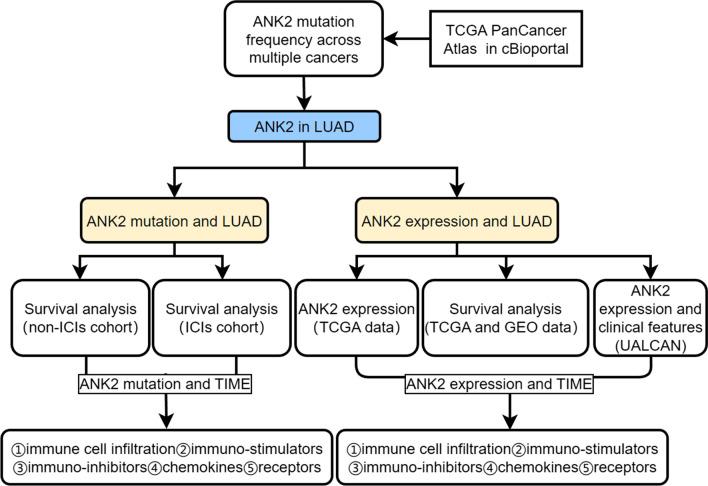
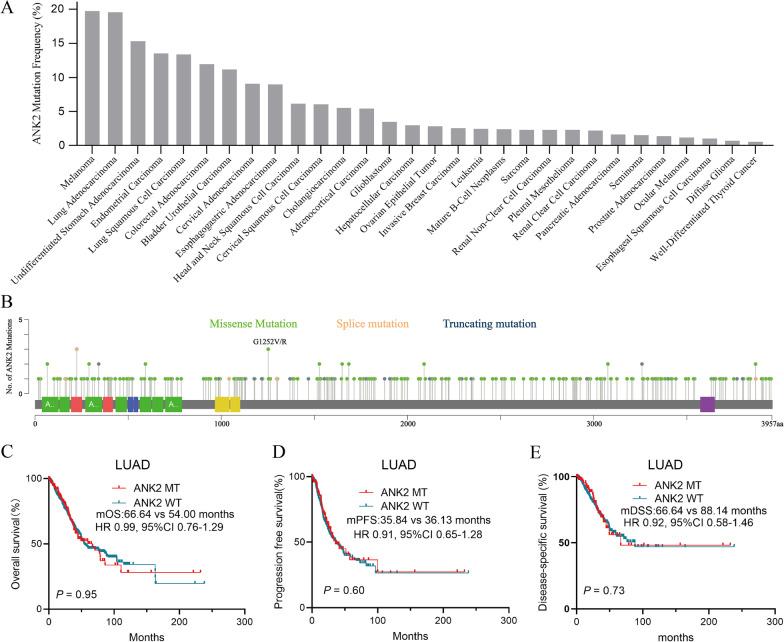
The Cancer Genome Atlas (TCGA) PanCancer Atlas studies in cBioportal were used to evaluate the mutation frequency of ANK2 across multiple cancers. Clinical and mutational data for LUAD from ICIs-treated cohorts (Hellmann et al. and Rizvi et al.) were collected to explore the correlation between ANK2 mutation and clinical outcomes. In addition, the relationship between ANK2 expression and clinical outcomes was analyzed using LUAD data from TCGA and Gene Expression Omnibus. Furthermore, the impact of ANK2 mutation and expression on the tumor immune microenvironment of LUAD was analyzed using TCGA and TISIDB databases.
RESULTS
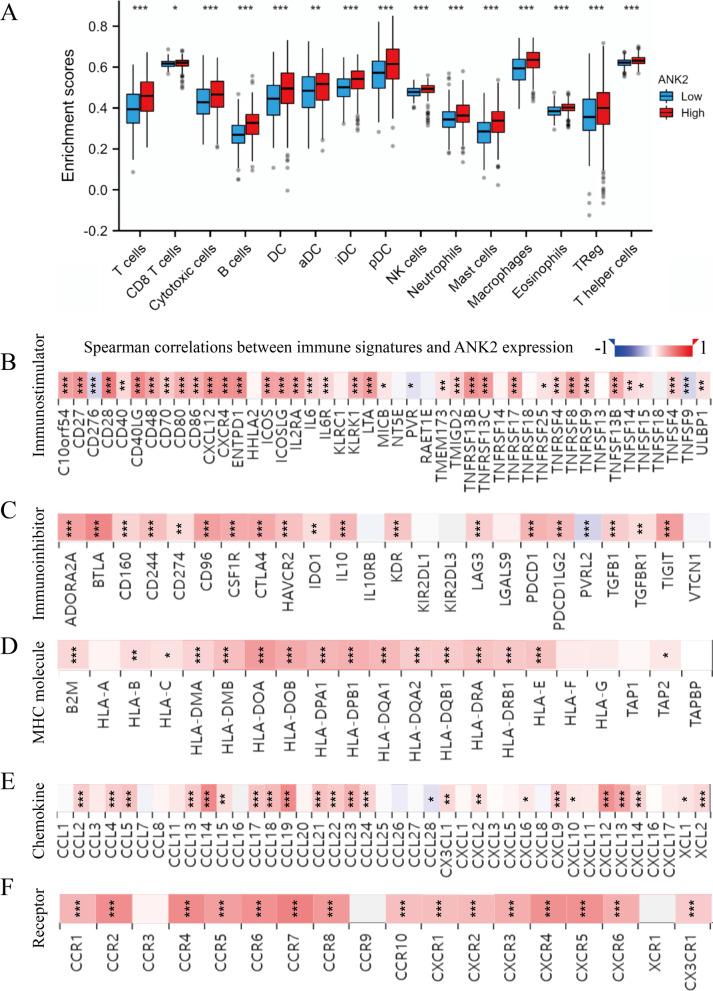
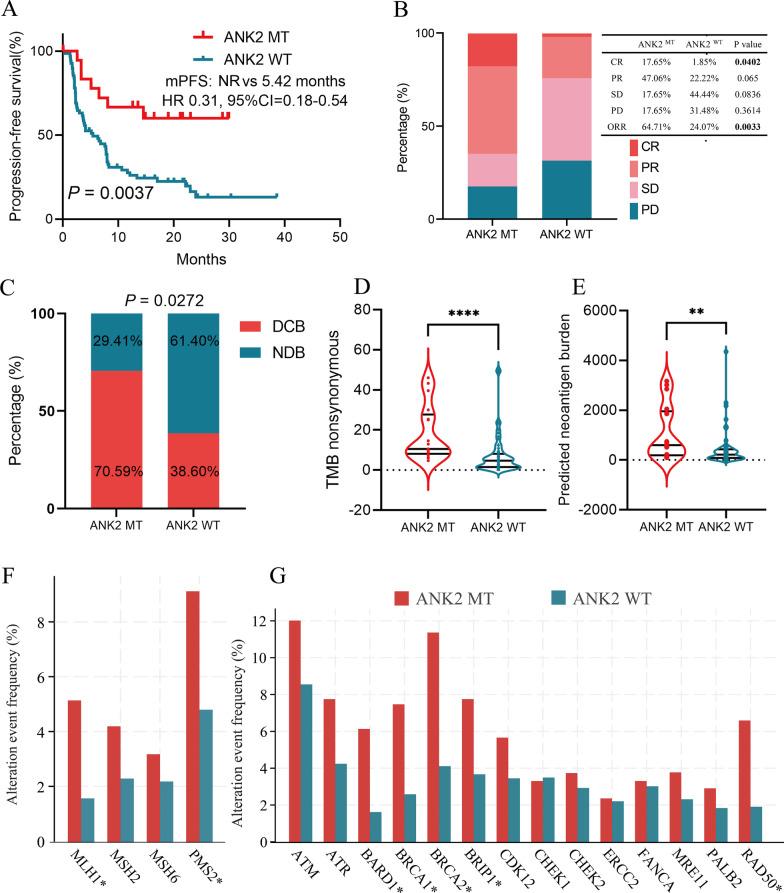
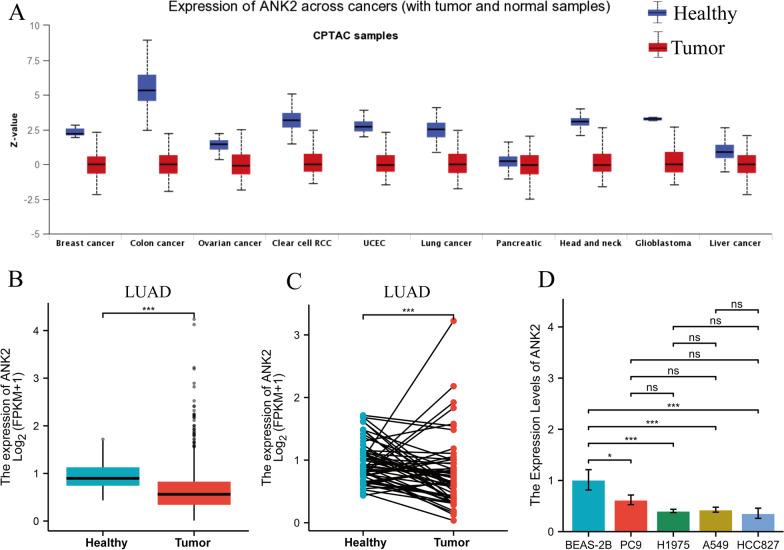
Patients with ANK2 mutation benefited more from ICIs. In ICIs-treated cohort, prolonged progression-free survival (PFS) (median PFS: NR (not reached) vs. 5.42 months, HR (hazard ratio) 0.31, 95% CI 0.18-0.54; P = 0.0037), improved complete response rate (17.65% vs. 1.85%, P = 0.0402), and improved objective response rate (64.71% vs. 24.07%, P = 0.0033) were observed in LUAD patients with ANK2 mutation compared to their wild-type counterparts. Regarding ANK2 expression, it was observed that ANK2 expression was decreased in LUAD (P < 0.05) and a higher level of ANK2 expression was associated with longer overall survival (HR 0.69, 95% CI 0.52-0.92; P = 0.012) in TCGA LUAD cohort. Moreover, ANK2 mutation or higher ANK2 expression correlated with enhanced antitumor immunity and "hot" tumor microenvironment in LUAD, which could be potential mechanisms that ANK2 mutation facilitated ICIs therapy and patients with higher ANK2 expression survived longer.
CONCLUSION
Our findings suggest that ANK2 mutation or increased ANK2 expression may serve as a favorable biomarker for the efficacy of ICIs in patients with LUAD.
背景
免疫检查点抑制剂(ICIs)已被证明可显著改善晚期肺腺癌(LUAD)患者的生存。然而,只有有限比例的患者可以从 ICI 中受益。临床医生需要具有强大预测性的新型生物标志物,以最大限度地提高 ICI 的疗效。我们的研究旨在确定预测 LUAD 中 ICI 疗效的潜在生物标志物。
方法
使用 cBioportal 中的癌症基因组图谱(TCGA)泛癌图谱研究评估 ANK2 在多种癌症中的突变频率。收集接受 ICI 治疗的 LUAD 队列(Hellmann 等人和 Rizvi 等人)的临床和突变数据,以探讨 ANK2 突变与临床结局之间的相关性。此外,使用 TCGA 和基因表达综合数据库分析 ANK2 表达与临床结局之间的关系。此外,使用 TCGA 和 TISIDB 数据库分析 ANK2 突变和表达对 LUAD 肿瘤免疫微环境的影响。
结果
ANK2 突变的患者从 ICI 中获益更多。在 ICI 治疗的队列中,与野生型相比,ANK2 突变的 LUAD 患者的无进展生存期(PFS)延长(中位 PFS:NR(未达到)与 5.42 个月,HR(风险比)0.31,95%CI 0.18-0.54;P=0.0037),完全缓解率提高(17.65%与 1.85%,P=0.0402),客观缓解率提高(64.71%与 24.07%,P=0.0033)。关于 ANK2 表达,观察到 LUAD 中 ANK2 表达降低(P<0.05),较高的 ANK2 表达水平与 TCGA LUAD 队列的总生存期延长相关(HR 0.69,95%CI 0.52-0.92;P=0.012)。此外,ANK2 突变或较高的 ANK2 表达与 LUAD 中的抗肿瘤免疫增强和“热”肿瘤微环境相关,这可能是 ANK2 突变促进 ICI 治疗和 ANK2 表达较高的患者生存时间延长的潜在机制。
结论
我们的研究结果表明,ANK2 突变或表达增加可能是 LUAD 患者 ICI 疗效的有利生物标志物。


 Zotero 插件