
不同级别非药物干预措施对中国广州手足口病的影响。
Effects of different levels of non-pharmaceutical interventions on hand, foot and mouth disease in Guangzhou, China.
机构信息
Department of Epidemiology, School of Public Health, Guangdong Provincial Key Laboratory of Tropical Disease Research), Southern Medical University, Baiyun District, Nos.1023-1063, Shatai South Road, Guangzhou, 510515, China.
Guangzhou Center for Disease Control and Prevention, Guangzhou City, 510440, Guangdong, China.
出版信息
BMC Public Health. 2022 Dec 20;22(1):2398. doi: 10.1186/s12889-022-14850-x.
BACKGROUND
Non-pharmaceutical interventions (NPIs) against coronavirus disease 2019 (COVID-19) may have suppressed the transmission of other infectious diseases. This study aimed to evaluate the impact of different degrees of NPIs during the COVID-19 pandemic on hand, foot and mouth disease (HFMD) in Guangzhou, China.
METHODS
Weekly reported HFMD cases and pathogens information during 2015-2021 in Guangzhou were collected from the China National Notifiable Disease Reporting System. The observed number of HFMD cases in 2020 and 2021 was compared to the average level in the same period during 2015-2019. Then, an interrupted time-series segmented regression analysis was applied to estimate the impact of NPIs on HFMD, such as social distancing, suspension of schools, community management and mask wearing. The effects across different subgroups stratified by gender, children groups and enterovirus subtype of HFMD were also examined.
RESULTS
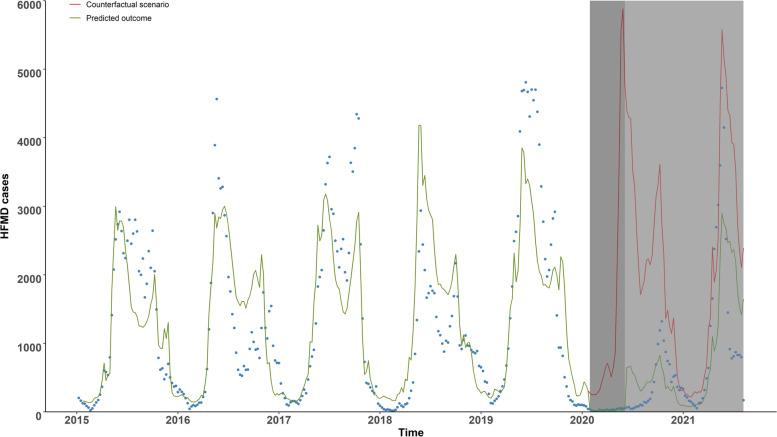
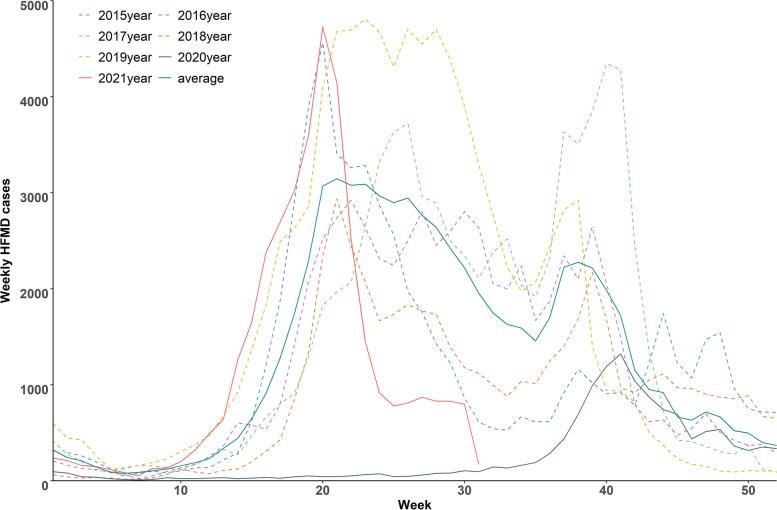
A total of 13,224 and 36,353 HFMD cases were reported in 2020 and 2021, which decreased by 80.80% and 15.06% respectively compared with the average number of cases in the same period during 2015-2019. A significant drop in the number of HFMD cases during time when strict NPIs were applied (relative change: 69.07% [95% confidence interval (CI): 68.84%-69.30%]). The HFMD incidence rebounded to historical levels in 2021 as the lockdown eased. The slightest reduction of HFMD cases was found among children at kindergartens or childcare centres among the three children groups (children at kindergartens or childcare centres: 55.50% [95% CI: 54.96%-56.03%]; children living at home: 72.64% [95% CI: 72.38%-72.89%]; others: 74.06% [95% CI: 73.19%-74.91%]).
CONCLUSIONS
The strong NPIs during the COVID-19 epidemic may have a significant beneficial effect on mitigating HFMD. However, the incidence of HFMD rebounded as the NPIs became less stringent. Authorities should consider applying these NPIs during HFMD outbreaks and strengthening personal hygiene in routine prevention.
背景
针对 2019 年冠状病毒病(COVID-19)的非药物干预(NPIs)可能抑制了其他传染病的传播。本研究旨在评估 COVID-19 大流行期间不同程度的 NPIs 对中国广州手足口病(HFMD)的影响。
方法
从中国国家法定传染病报告系统中收集了 2015-2021 年广州每周报告的 HFMD 病例和病原体信息。比较了 2020 年和 2021 年观察到的 HFMD 病例数与 2015-2019 年同期的平均水平。然后,应用中断时间序列分段回归分析来估计 NPIs(如社交距离、学校停课、社区管理和戴口罩)对 HFMD 的影响。还按性别、儿童组和 HFMD 的肠道病毒亚型对不同亚组进行了分层,并检验了这些亚组的影响。
结果
2020 年和 2021 年共报告了 13224 例和 36353 例 HFMD 病例,与 2015-2019 年同期的平均病例数相比,分别下降了 80.80%和 15.06%。在严格实施 NPIs 期间,HFMD 病例数量显著下降(相对变化:69.07%[95%置信区间(CI):68.84%-69.30%])。随着封锁的放松,HFMD 发病率在 2021 年反弹至历史水平。在三个儿童组中,幼儿园或托儿所的儿童的 HFMD 病例减少幅度最小(幼儿园或托儿所的儿童:55.50%[95%CI:54.96%-56.03%];居家儿童:72.64%[95%CI:72.38%-72.89%];其他儿童:74.06%[95%CI:73.19%-74.91%])。
结论
COVID-19 大流行期间强有力的 NPIs 可能对减轻 HFMD 有显著的有益影响。然而,随着 NPIs 的放宽,HFMD 的发病率出现反弹。当局在 HFMD 爆发期间应考虑实施这些 NPIs,并加强日常预防中的个人卫生。

 Zotero 插件