
溶剂极性可重构的荧光4-哌嗪基-芳基-1,8-萘二甲酰亚胺冠醚逻辑门
Solvent-polarity reconfigurable fluorescent 4-piperazino--aryl-1,8-naphthalimide crown ether logic gates.
作者信息
Gauci Gabriel, Magri David C
机构信息
Department of Chemistry, Faculty of Science, University of Malta Msida MSD 2080 Malta
出版信息
RSC Adv. 2022 Dec 9;12(54):35270-35278. doi: 10.1039/d2ra07568g. eCollection 2022 Dec 6.
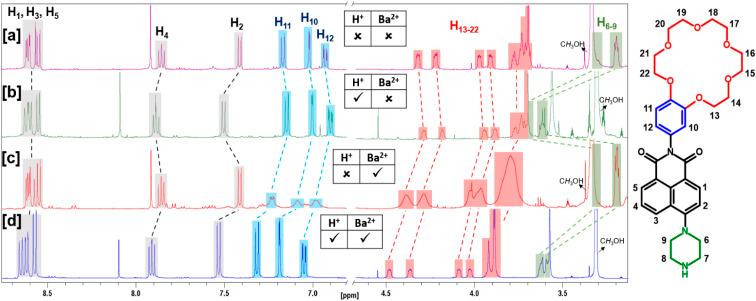
Four compounds 1-4 were designed and synthesised, comprising a 4-amino--aryl-1,8-naphthalimide fluorophore, a piperazine receptor, and an aryl group, as fluorescent logic gates. At the imide position, the substituent is phenyl (1), 1,2-dimethoxyphenyl (2), benzo-15-crown-5 (3), or benzo-18-crown-6 (4). Molecules 1 and 2 are constructed according to a fluorophore-spacer-receptor format, while 3 and 4 are engineered according to a receptor-spacer-fluorophore-spacer-receptor format based on photoinduced electron transfer and internal charge transfer mechanisms. The compounds were studied in water, water/methanol mixtures of different ratios, and methanol by UV-visible absorption and steady-state fluorescence spectroscopy, as a function of pH, metal ions and solvent polarity. The excited state of 1-4 is 8.4 ± 0.2 in water, 7.6 ± 0.1 in 1 : 1 (v/v) water/methanol, and 7.1 ± 0.3 in methanol. The of 3 in water is 0.92 and the and of 4 in water are 2.3 and 2.9. H NMR data in DO and CDOD confirm H interaction at the piperazine moiety, and Na and Ba binding at the benzo-15-crown-5 and benzo-18-crown-6 moieties of 3 and 4. By altering the solvent polarity, the fluorescent logic gates can be reconfigured between TRANSFER logic and AND logic. Molecules with polarity reconfigurable logic could be useful tools for probing the microenvironment of cellular membranes and protein interfaces.
设计并合成了四种化合物1-4,它们包含一个4-氨基-芳基-1,8-萘二甲酰亚胺荧光团、一个哌嗪受体和一个芳基,作为荧光逻辑门。在酰亚胺位置,取代基分别为苯基(1)、1,2-二甲氧基苯基(2)、苯并-15-冠-5(3)或苯并-18-冠-6(4)。分子1和2按照荧光团-间隔基-受体的形式构建,而3和4则根据光诱导电子转移和内电荷转移机制,按照受体-间隔基-荧光团-间隔基-受体的形式设计。通过紫外可见吸收光谱和稳态荧光光谱,研究了这些化合物在水、不同比例的水/甲醇混合物以及甲醇中的情况,考察了其作为pH、金属离子和溶剂极性的函数关系。1-4在水中的激发态为8.4±0.2,在1:1(v/v)水/甲醇中为7.6±0.1,在甲醇中为7.1±0.3。3在水中的量子产率为0.92,4在水中的量子产率分别为2.3和2.9。在D₂O和CD₃OD中的¹H NMR数据证实了在哌嗪部分存在H相互作用,以及在3和4的苯并-15-冠-5和苯并-18-冠-6部分存在Na和Ba结合。通过改变溶剂极性,荧光逻辑门可以在转移逻辑和与逻辑之间重新配置。具有极性可重构逻辑的分子可能是探测细胞膜和蛋白质界面微环境的有用工具。


 Zotero 插件