
慢性肾脏病患者骨质疏松症的诊断与治疗:奥地利骨与矿物质研究学会(ÖGKM)、奥地利物理与康复医学学会(ÖGPMR)及奥地利肾脏病学会(ÖGN)联合指南
[Diagnosis and treatment of osteoporosis in patients with chronic kidney disease : Joint guidelines of the Austrian Society for Bone and Mineral Research (ÖGKM), the Austrian Society of Physical and Rehabilitation Medicine (ÖGPMR) and the Austrian Society of Nephrology (ÖGN)].
作者信息
Cejka Daniel, Wakolbinger-Habel Robert, Zitt Emanuel, Fahrleitner-Pammer Astrid, Amrein Karin, Dimai Hans Peter, Muschitz Christian
机构信息
Abteilung für Innere Medizin III, Nieren- und Hochdruckerkrankungen, Transplantationsmedizin, Rheumatologie, Akutgeriatrie, Ordensklinikum Linz - Krankenhaus der Elisabethinen, Fadingerstr. 1, 4020, Linz, Österreich.
Department of Physical and Rehabilitation Medicine (PRM), Vienna Healthcare Group - Clinic Donaustadt, Langobardenstr. 122, 1220, Wien, Österreich.
出版信息
Wien Med Wochenschr. 2023 Oct;173(13-14):299-318. doi: 10.1007/s10354-022-00989-0. Epub 2022 Dec 21.
DEFINITION AND EPIDEMIOLOGY
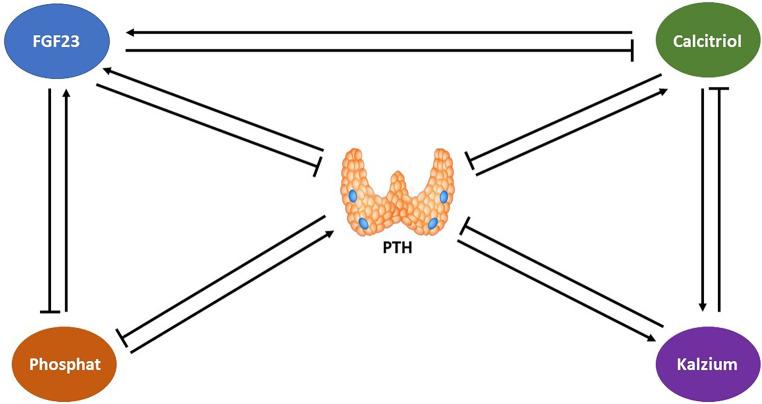
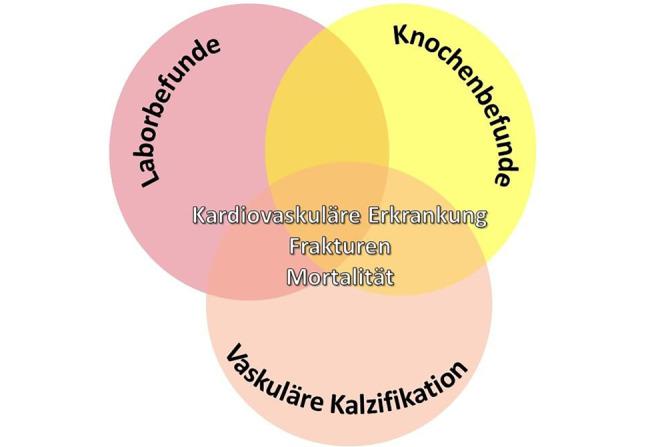
Chronic kidney disease (CKD): abnormalities of kidney structure or function, present for over 3 months. Staging of CKD is based on GFR and albuminuria (not graded). Osteoporosis: compromised bone strength (low bone mass, disturbance of microarchitecture) predisposing to fracture. By definition, osteoporosis is diagnosed if the bone mineral density T‑score is ≤ -2.5. Furthermore, osteoporosis is diagnosed if a low-trauma (inadequate trauma) fracture occurs, irrespective of the measured T‑score (not graded). The prevalence of osteoporosis, osteoporotic fractures and CKD is increasing worldwide (not graded). PATHOPHYSIOLOGY, DIAGNOSIS AND TREATMENT OF CHRONIC KIDNEY DISEASE-MINERAL AND BONE DISORDER (CKD-MBD): Definition of CKD-MBD: a systemic disorder of mineral and bone metabolism due to CKD manifested by either one or a combination of the following: abnormalities of calcium, phosphorus, PTH, or vitamin D metabolism; renal osteodystrophy; vascular calcification (not graded). Increased, normal or decreased bone turnover can be found in renal osteodystrophy (not graded). Depending on CKD stage, routine monitoring of calcium, phosphorus, alkaline phosphatase, PTH and 25-OH-vitamin D is recommended (2C). Recommendations for treatment of CKD-MBD: Avoid hypercalcemia (1C). In cases of hyperphosphatemia, lower phosphorus towards normal range (2C). Keep PTH within or slightly above normal range (2D). Vitamin D deficiency should be avoided and treated when diagnosed (1C).
DIAGNOSIS AND RISK STRATIFICATION OF OSTEOPOROSIS IN CKD
Densitometry (using dual X‑ray absorptiometry, DXA): low T‑score correlates with increased fracture risk across all stages of CKD (not graded). A decrease of the T‑score by 1 unit approximately doubles the risk for osteoporotic fracture (not graded). A T-score ≥ -2.5 does not exclude osteoporosis (not graded). Bone mineral density of the lumbar spine measured by DXA can be increased and therefore should not be used for the diagnosis or monitoring of osteoporosis in the presence of aortic calcification, osteophytes or vertebral fracture (not graded). FRAX can be used to aid fracture risk estimation in all stages of CKD (1C). Bone turnover markers can be measured in individual cases to monitor treatment (2D). Bone biopsy may be considered in individual cases, especially in patients with CKD G5 (eGFR < 15 ml/min/1.73 m) or CKD 5D (dialysis).
SPECIFIC TREATMENT OF OSTEOPOROSIS IN PATIENTS WITH CKD
Hypocalcemia should be treated and serum calcium normalized before initiating osteoporosis therapy (1C). CKD G1-G2 (eGFR ≥ 60 ml/min/1.73 m): treat osteoporosis as recommended for the general population (1A). CKD G3-G5D (eGFR < 60 ml/min/1.73 m to dialysis): treat CKD-MBD first before initiating osteoporosis treatment (2C). CKD G3 (eGFR 30-59 ml/min/1.73 m) with PTH within normal limits and osteoporotic fracture and/or high fracture risk according to FRAX: treat osteoporosis as recommended for the general population (2B). CKD G4-5 (eGFR < 30 ml/min/1.73 m) with osteoporotic fracture (secondary prevention): Individualized treatment of osteoporosis is recommended (2C). CKD G4-5 (eGFR < 30 ml/min/1.73 m) and high fracture risk (e.g. FRAX score > 20% for a major osteoporotic fracture or > 5% for hip fracture) but without prevalent osteoporotic fracture (primary prevention): treatment of osteoporosis may be considered and initiated individually (2D). CKD G4-5D (eGFR < 30 ml/min/1.73 m to dialysis): Calcium should be measured 1-2 weeks after initiation of antiresorptive therapy (1C).
PHYSICAL MEDICINE AND REHABILITATION
Resistance training prioritizing major muscle groups thrice weekly (1B). Aerobic exercise training for 40 min four times per week (1B). Coordination and balance exercises thrice weekly (1B). Flexibility exercise 3-7 times per week (1B).
定义与流行病学
慢性肾脏病(CKD):肾脏结构或功能异常,持续超过3个月。CKD分期基于肾小球滤过率(GFR)和蛋白尿(无分级)。骨质疏松症:骨强度受损(低骨量、微结构紊乱),易发生骨折。根据定义,若骨密度T值≤ -2.5,则诊断为骨质疏松症。此外,若发生低创伤(轻度创伤)骨折,无论测量的T值如何(无分级),也诊断为骨质疏松症。全球范围内,骨质疏松症、骨质疏松性骨折和CKD的患病率均在上升(无分级)。慢性肾脏病 - 矿物质和骨代谢紊乱(CKD - MBD)的病理生理学、诊断与治疗:CKD - MBD的定义:由CKD引起的矿物质和骨代谢的全身性紊乱,表现为以下一种或多种情况:钙、磷、甲状旁腺激素(PTH)或维生素D代谢异常;肾性骨营养不良;血管钙化(无分级)。肾性骨营养不良中可出现骨转换增加、正常或降低(无分级)。根据CKD分期,建议定期监测钙、磷、碱性磷酸酶、PTH和25 - 羟维生素D(2C)。CKD - MBD的治疗建议:避免高钙血症(1C)。对于高磷血症患者,将磷水平降至正常范围(2C)。使PTH维持在正常范围或略高于正常范围(2D)。应避免维生素D缺乏,确诊后进行治疗(1C)。
CKD患者骨质疏松症的诊断与风险分层:骨密度测定(使用双能X线吸收法,DXA):低T值与CKD各阶段骨折风险增加相关(无分级)。T值每降低1个单位,骨质疏松性骨折风险约增加一倍(无分级)。T值≥ -2.5并不能排除骨质疏松症(无分级)。在存在主动脉钙化、骨赘或椎体骨折的情况下,通过DXA测量的腰椎骨密度可能会升高,因此不应将其用于骨质疏松症的诊断或监测(无分级)。FRAX可用于评估CKD各阶段的骨折风险(1C)。个别情况下可测量骨转换标志物以监测治疗效果(2D)。个别情况下可考虑进行骨活检,尤其是CKD G5期(估算肾小球滤过率[eGFR]<15 ml/min/1.73 m²)或CKD 5D期(透析)患者。
CKD患者骨质疏松症的特异性治疗:在开始骨质疏松症治疗前,应治疗低钙血症并使血清钙水平正常化(1C)。CKD G1 - G2期(eGFR≥60 ml/min/1.73 m²):按照一般人群的建议治疗骨质疏松症(1A)。CKD G3 - G5D期(eGFR<60 ml/min/1.73 m²至透析):在开始骨质疏松症治疗前,先治疗CKD - MBD(2C)。CKD G3期(eGFR 30 - 59 ml/min/1.73 m²),PTH在正常范围内,且根据FRAX评估存在骨质疏松性骨折和/或高骨折风险:按照一般人群的建议治疗骨质疏松症(2B)。CKD G4 - 5期(eGFR<30 ml/min/1.73 m²),存在骨质疏松性骨折(二级预防):建议个体化治疗骨质疏松症(2C)。CKD G4 - 5期(eGFR<30 ml/min/1.73 m²),骨折风险高(例如,主要骨质疏松性骨折的FRAX评分>20%或髋部骨折的FRAX评分>5%)但无既往骨质疏松性骨折(一级预防):可考虑并个体化启动骨质疏松症治疗(2D)。CKD G4 - 5D期(eGFR<30 ml/min/1.73 m²至透析):在开始抗吸收治疗后1 - 2周应测量血钙(1C)。
物理医学与康复
每周三次对主要肌群进行抗阻训练(1B)。每周四次进行40分钟有氧运动训练(1B)。每周三次进行协调和平衡训练(1B)。每周3 - 7次进行柔韧性训练(1B)。
 Zotero 插件