
结核分枝杆菌感染中的免疫低反应性:分枝杆菌糖脂的作用。
Immunological hyporesponsiveness in tuberculosis: The role of mycobacterial glycolipids.
机构信息
Life and Health Sciences Research Institute, School of Medicine, University of Minho, Braga, Portugal.
Life and Health Sciences Research Institute/Biomaterials, Biodegradables and Biomimetics Research Group (ICVS/3B's), Portuguese (PT) Government Associate Laboratory, Braga, Portugal.
出版信息
Front Immunol. 2022 Dec 2;13:1035122. doi: 10.3389/fimmu.2022.1035122. eCollection 2022.
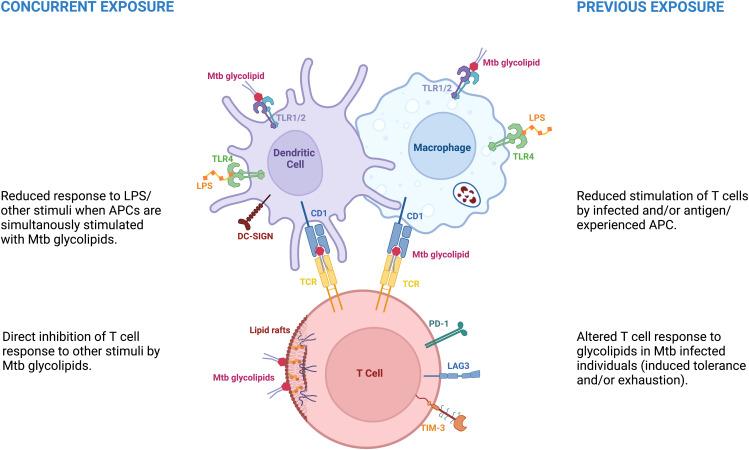
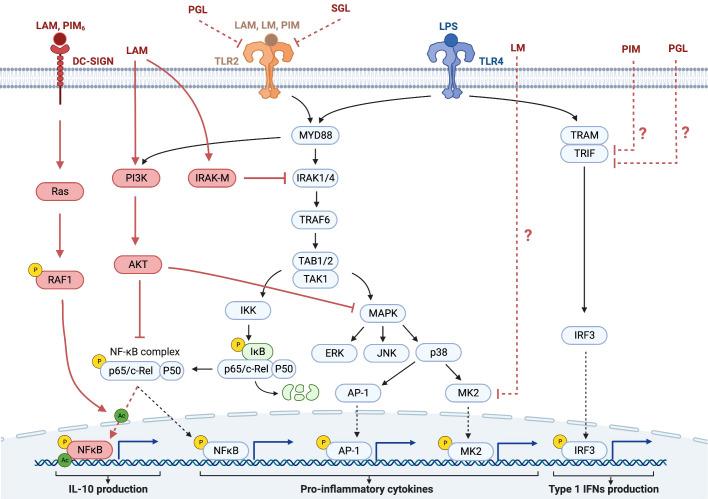
Glycolipids constitute a major part of the cell envelope of (Mtb). They are potent immunomodulatory molecules recognized by several immune receptors like pattern recognition receptors such as TLR2, DC-SIGN and Dectin-2 on antigen-presenting cells and by T cell receptors on T lymphocytes. The Mtb glycolipids lipoarabinomannan (LAM) and its biosynthetic relatives, phosphatidylinositol mannosides (PIMs) and lipomannan (LM), as well as other Mtb glycolipids, such as phenolic glycolipids and sulfoglycolipids have the ability to modulate the immune response, stimulating or inhibiting a pro-inflammatory response. We explore here the downmodulating effect of Mtb glycolipids. A great proportion of the studies used approaches although infection with Mtb might also lead to a dampening of myeloid cell and T cell responses to Mtb glycolipids. This dampened response has been explored with immune cells from peripheral blood from Mtb-infected individuals and in mouse models of infection. In addition to the dampening of the immune response caused by Mtb glycolipids, we discuss the hyporesponse to Mtb glycolipids caused by prolonged Mtb infection and/or exposure to Mtb antigens. Hyporesponse to LAM has been observed in myeloid cells from individuals with active and latent tuberculosis (TB). For some myeloid subsets, this effect is stronger in latent versus active TB. Since the immune response in individuals with latent TB represents a more protective profile compared to the one in patients with active TB, this suggests that downmodulation of myeloid cell functions by Mtb glycolipids may be beneficial for the host and protect against active TB disease. The mechanisms of this downmodulation, including tolerance through epigenetic modifications, are only partly explored.
糖脂构成了(Mtb)细胞包膜的主要部分。它们是具有免疫调节作用的分子,能够被几种免疫受体识别,如模式识别受体(如 TLR2、DC-SIGN 和 Dectin-2)和抗原呈递细胞上的 T 淋巴细胞受体,以及 T 淋巴细胞受体。Mtb 糖脂脂阿拉伯甘露聚糖(LAM)及其生物合成相关物,磷脂酰肌醇甘露糖苷(PIMs)和脂甘露聚糖(LM),以及其他 Mtb 糖脂,如酚糖脂和硫糖脂,具有调节免疫反应的能力,刺激或抑制促炎反应。我们在这里探讨 Mtb 糖脂的下调作用。尽管 Mtb 感染也可能导致骨髓细胞和 T 细胞对 Mtb 糖脂的反应减弱,但大部分研究都采用了这种方法。这种减弱的反应已经在 Mtb 感染个体的外周血免疫细胞和感染小鼠模型中进行了探索。除了 Mtb 糖脂引起的免疫反应减弱外,我们还讨论了由 Mtb 感染和/或暴露于 Mtb 抗原引起的对 Mtb 糖脂的低反应性。在活动性和潜伏性结核病(TB)个体的骨髓细胞中观察到对 LAM 的低反应性。对于一些骨髓细胞亚群,潜伏性 TB 中的这种效应强于活动性 TB。由于潜伏性 TB 个体的免疫反应代表了比活动性 TB 患者更具保护性的特征,这表明 Mtb 糖脂对骨髓细胞功能的下调可能对宿主有益,并可预防活动性 TB 疾病。这种下调的机制,包括通过表观遗传修饰产生的耐受性,仅部分得到了探索。


 Zotero 插件