
合成短阳离子抗菌肽对髓过氧化物酶催化活性的影响,降低其氧化能力。
Effects of Synthetic Short Cationic Antimicrobial Peptides on the Catalytic Activity of Myeloperoxidase, Reducing Its Oxidative Capacity.
作者信息
Vakhrusheva Tatyana V, Sokolov Alexey V, Moroz Grigoriy D, Kostevich Valeria A, Gorbunov Nikolay P, Smirnov Igor P, Grafskaia Ekaterina N, Latsis Ivan A, Panasenko Oleg M, Lazarev Vassili N
机构信息
Department of Biophysics, Federal Research and Clinical Center of Physical-Chemical Medicine of Federal Medical Biological Agency, 119435 Moscow, Russia.
Department of Molecular Genetics, Institute of Experimental Medicine, 197376 St. Petersburg, Russia.
出版信息
Antioxidants (Basel). 2022 Dec 7;11(12):2419. doi: 10.3390/antiox11122419.
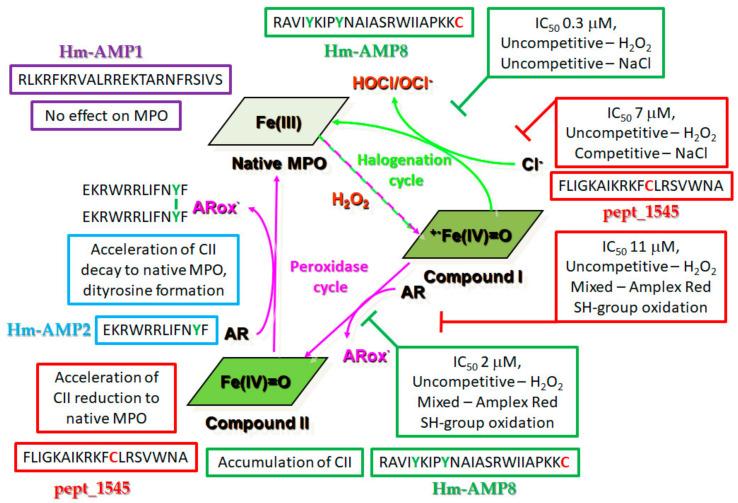
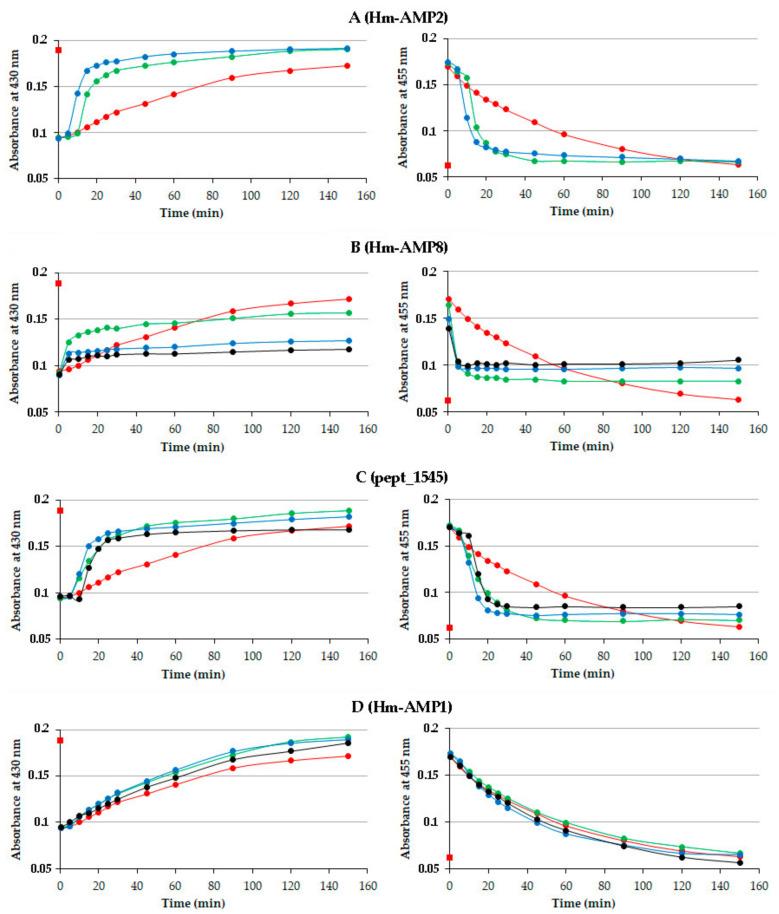
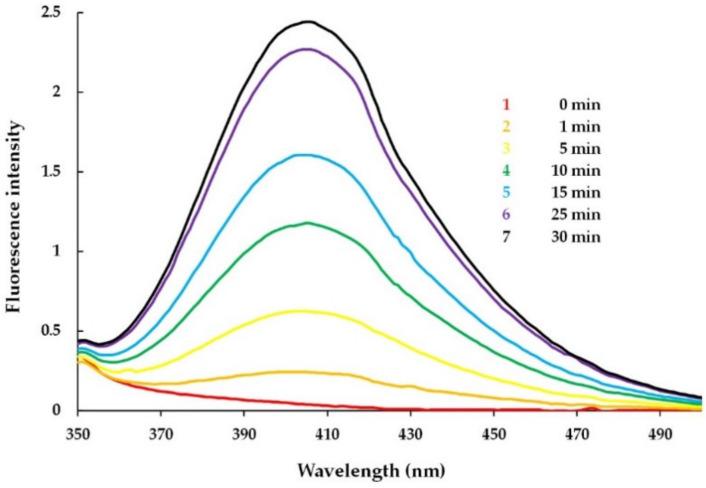
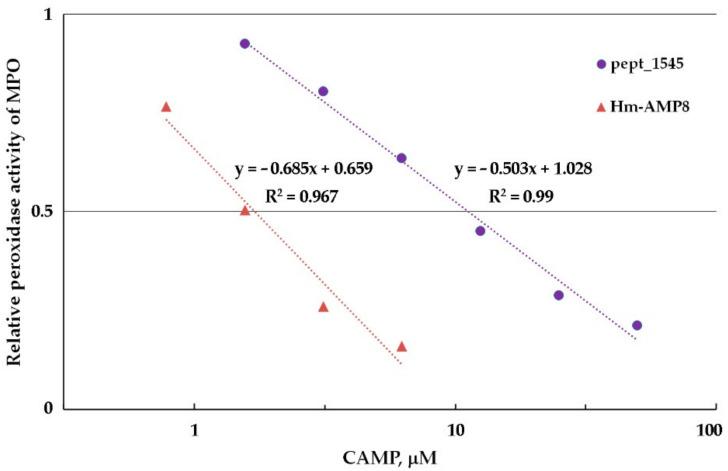
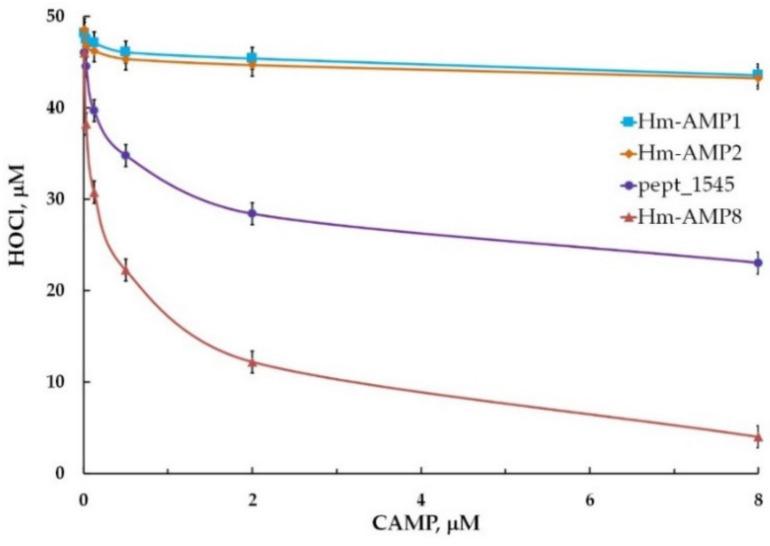
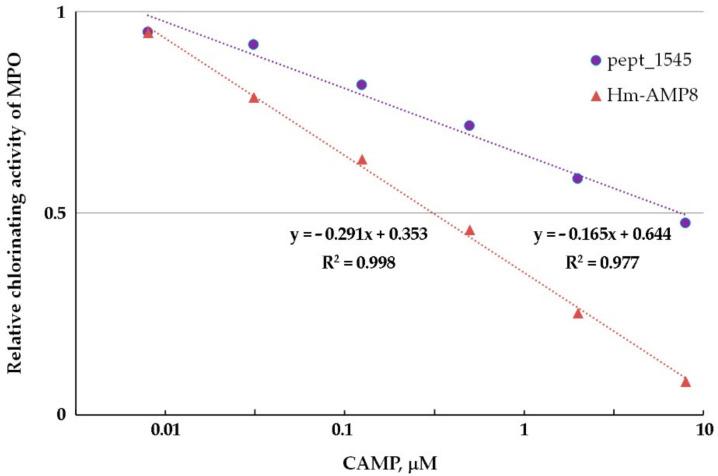
Cationic antimicrobial peptides (CAMPs) have gained attention as promising antimicrobial therapeutics causing lower or no bacterial resistance. Considerable achievements have been made in designing new CAMPs that are highly active as antimicrobials. However, there is a lack of research on their interaction with biologically important proteins. This study focused on CAMPs' effects on myeloperoxidase (MPO), an enzyme which is microbicidal and concomitantly damaging to host biomolecules and cells due to its ability to produce reactive oxygen and halogen species (ROS/RHS). Four CAMPs designed by us were employed. MPO catalytic activity was assessed by an absorbance spectra analysis and by measuring enzymatic activity using Amplex Red- and Celestine Blue B-based assays. The peptide Hm-AMP2 accelerated MPO turnover. Pept_1545 and Hm-AMP8 inhibited both the MPO chlorinating and peroxidase activities, with components of different inhibition types. Hm-AMP8 was a stronger inhibitor. Its K towards HO and Cl was 0.3-0.4 μM vs. 11-20 μM for pept_1545. Peptide tyrosine and cysteine residues were involved in the mechanisms of the observed effects. The results propose a possible dual role of CAMPs as both antimicrobial agents and agents that downregulate MPO activation, and suggest CAMPs as prototypes for the development of antioxidant compounds to prevent MPO-mediated ROS/RHS overproduction.
阳离子抗菌肽(CAMP)作为一种有望产生低耐药性或无耐药性的抗菌治疗剂而受到关注。在设计具有高抗菌活性的新型CAMP方面已经取得了相当大的成就。然而,关于它们与生物学上重要蛋白质相互作用的研究却很缺乏。本研究聚焦于CAMP对髓过氧化物酶(MPO)的影响,MPO是一种具有杀菌作用的酶,由于其产生活性氧和卤素物种(ROS/RHS)的能力,会对宿主生物分子和细胞造成损害。我们使用了自行设计的四种CAMP。通过吸光光谱分析以及使用基于Amplex Red和天青石蓝B的检测方法测量酶活性来评估MPO的催化活性。肽Hm-AMP2加速了MPO的周转。Pept_1545和Hm-AMP8抑制了MPO的氯化和过氧化物酶活性,具有不同类型的抑制成分。Hm-AMP8是一种更强的抑制剂。它对HO和Cl的K值为0.3 - 0.4 μM,而pept_1545为11 - 20 μM。肽的酪氨酸和半胱氨酸残基参与了观察到的效应机制。结果表明CAMP可能具有作为抗菌剂和下调MPO激活的双重作用,并表明CAMP可作为开发抗氧化化合物以防止MPO介导的ROS/RHS过量产生的原型。







 Zotero 插件