
靶向纳米药物重塑免疫抑制性肿瘤微环境以增强癌症免疫治疗。
Targeted nanomedicines remodeling immunosuppressive tumor microenvironment for enhanced cancer immunotherapy.
作者信息
Xu Yanyan, Xiong Jingyuan, Sun Xiyang, Gao Huile
机构信息
Key Laboratory of Drug-Targeting and Drug Delivery System of the Education Ministry, Sichuan Engineering Laboratory for Plant-Sourced Drug and Sichuan Research Center for Drug Precision Industrial Technology, West China School of Pharmacy, Sichuan University, Chengdu 610041, China.
Healthy Food Evaluation Research Center, West China School of Public Health and West China Fourth Hospital, Sichuan University, Chengdu 610041, China.
出版信息
Acta Pharm Sin B. 2022 Dec;12(12):4327-4347. doi: 10.1016/j.apsb.2022.11.001. Epub 2022 Nov 4.
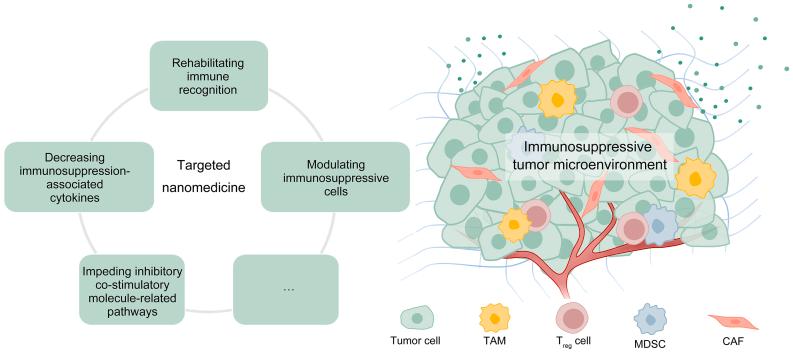
Cancer immunotherapy has significantly flourished and revolutionized the limited conventional tumor therapies, on account of its good safety and long-term memory ability. Discouragingly, low patient response rates and potential immune-related side effects make it rather challenging to literally bring immunotherapy from bench to bedside. However, it has become evident that, although the immunosuppressive tumor microenvironment (TME) plays a pivotal role in facilitating tumor progression and metastasis, it also provides various potential targets for remodeling the immunosuppressive TME, which can consequently bolster the effectiveness of antitumor response and tumor suppression. Additionally, the particular characteristics of TME, in turn, can be exploited as avenues for designing diverse precise targeting nanomedicines. In general, it is of urgent necessity to deliver nanomedicines for remodeling the immunosuppressive TME, thus improving the therapeutic outcomes and clinical translation prospects of immunotherapy. Herein, we will illustrate several formation mechanisms of immunosuppressive TME. More importantly, a variety of strategies concerning remodeling immunosuppressive TME and strengthening patients' immune systems, will be reviewed. Ultimately, we will discuss the existing obstacles and future perspectives in the development of antitumor immunotherapy. Hopefully, the thriving bloom of immunotherapy will bring vibrancy to further exploration of comprehensive cancer treatment.
癌症免疫疗法因其良好的安全性和长期记忆能力而蓬勃发展,并彻底改变了有限的传统肿瘤治疗方法。令人沮丧的是,患者低反应率和潜在的免疫相关副作用使得将免疫疗法真正从实验室应用到临床颇具挑战性。然而,显而易见的是,尽管免疫抑制性肿瘤微环境(TME)在促进肿瘤进展和转移中起关键作用,但它也为重塑免疫抑制性TME提供了各种潜在靶点,从而可以增强抗肿瘤反应和肿瘤抑制的有效性。此外,TME的特殊特性反过来可以用作设计各种精确靶向纳米药物的途径。总的来说,迫切需要递送纳米药物来重塑免疫抑制性TME,从而改善免疫疗法的治疗效果和临床转化前景。在此,我们将阐述免疫抑制性TME的几种形成机制。更重要的是,将综述有关重塑免疫抑制性TME和增强患者免疫系统的各种策略。最后,我们将讨论抗肿瘤免疫疗法发展中存在的障碍和未来前景。希望免疫疗法的蓬勃发展将为全面癌症治疗的进一步探索带来活力。




 Zotero 插件