
PD-1/PD-L1 抑制剂联合抗血管生成药物与化疗或不联合化疗对比 PD-1/PD-L1 抑制剂联合化疗作为晚期非小细胞肺癌二线或后线治疗的真实世界回顾性队列研究。
PD-1/PD-L1 inhibitors plus anti-angiogenic agents with or without chemotherapy versus PD-1/PD-L1 inhibitors plus chemotherapy as second or later-line treatment for patients with advanced non-small cell lung cancer: A real-world retrospective cohort study.
机构信息
Medical Oncology of Respiratory, Guangxi Cancer Hospital and Guangxi Medical University Affiliated Cancer Hospital, Nanning, China.
Department of Hepatobiliary Surgery, Key Laboratory of Early Prevention and Treatment for Regional High Frequency Tumor, Ministry of Education, Guangxi Cancer Hospital and Guangxi Medical University Affiliated Cancer Hospital, Nanning, China.
出版信息
Front Immunol. 2022 Dec 7;13:1059995. doi: 10.3389/fimmu.2022.1059995. eCollection 2022.
BACKGROUND
The aim of this study was to assessment the efficacy and safety of Programmed cell death protein 1 (PD-1)/Programmed cell death-Ligand protein 1 (PD-L1) inhibitors plus anti-angiogenic agents with or without chemotherapy versus PD-1/PD-L1 inhibitors plus chemotherapy as second or later-line treatment for patients with advanced non-small cell lung cancer.
METHODS
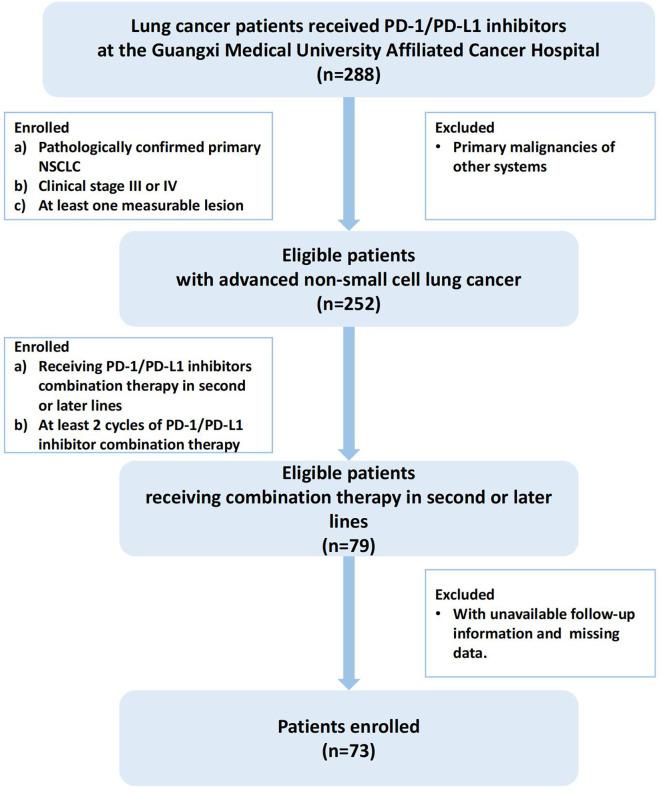
In this study, pre-treatment clinical and laboratory indicators from 73 patients with advanced non-small cell lung cancer were retrieved for retrospective analysis. According to the therapy regimes they received, the patients were separated into groups, PD-1/PD-L1 inhibitors plus chemotherapy group (PC group), PD-1/PD-L1 inhibitors plus anti-angiogenic agents' group (PA group), PD-1/PD-L1 inhibitors plus anti-angiogenic agents plus chemotherapy group (PAC group). Cox's proportional hazards regression model and Kaplan-Meier (KM) curves were used to assess the connection between treatment regimens and progression free survival (PFS) and overall survival (OS). In addition, the association of treatment regimens with the risk of disease progression and death was evaluated by subgroup analysis.
RESULTS
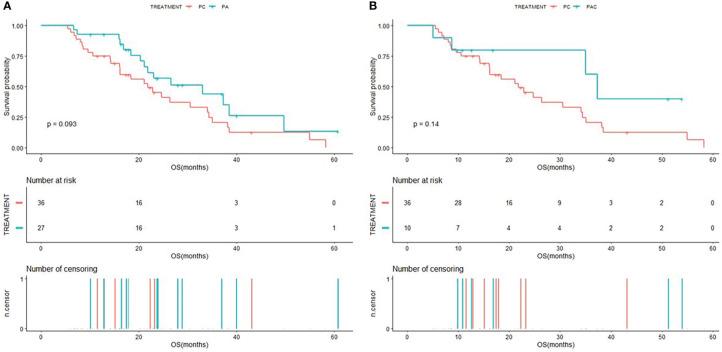
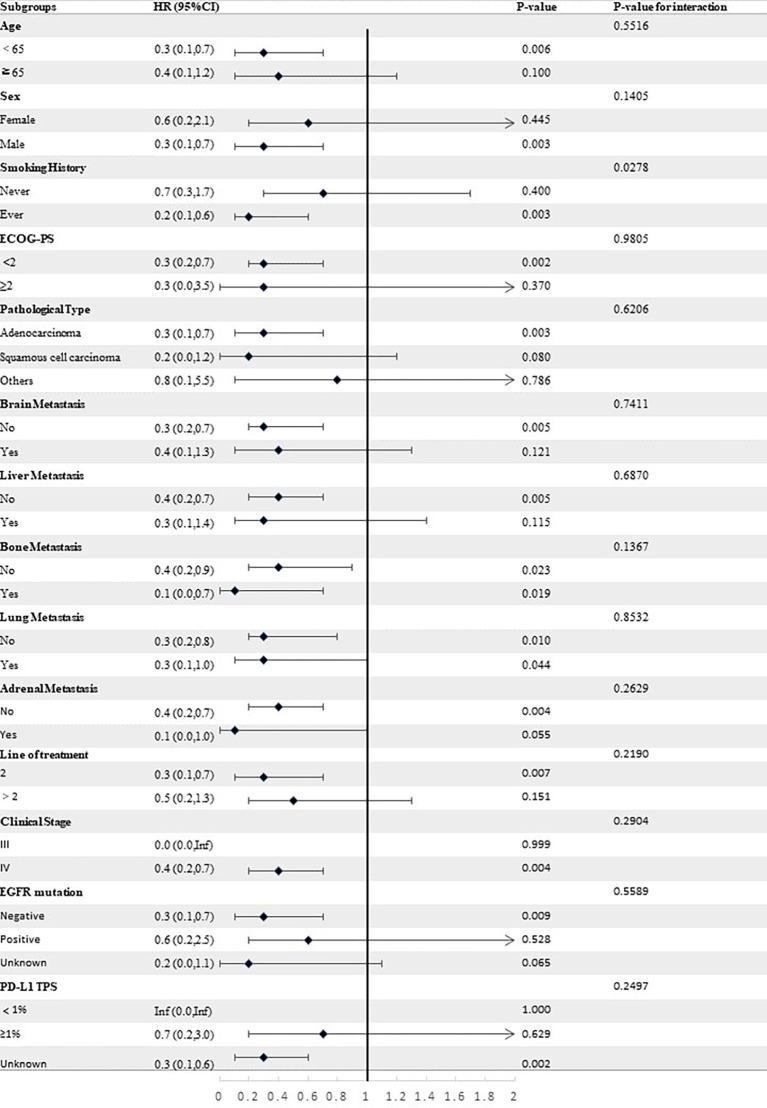
The average age of the enrolled patients was 58.2 ± 10.2 years and 75.3% were male. Multivariate analyses showed that patients in PA group (Disease progression: HR 0.4, P=0.005. Death: HR 0.4, P=0.024) and PAC group (Disease progression: HR 0.3, P=0.012. Death: HR 0.3, P=0.045) had a statistically significant lower hazard ratio (HR) for disease progression and death compared to patients in PC group. Kaplan-Meier analysis showed that patients in PA group (mPFS:7.5 vs.3.5, P=0.00052. mOS:33.1 vs.21.8, P=0.093) and PAC group (mPFS:5.1 vs.3.5, P=0.075. mOS:37.3 vs.21.8, P=0.14) had a longer PFS and OS compared to patients in PC group. In all the pre-defined subgroups, patients in PA and PAC groups showed a decreasing trend in the risk of disease progression and death in most subgroups. The patients in PA group (DCR:96.3% vs.58.3%, P=0.001) and PAC group (DCR:100% vs.58.3%, P=0.019) had a better disease control rate (DCR) than patients in PC group.
CONCLUSION
PD-1/PD-L1 inhibitors plus anti-angiogenic agents with or without chemotherapy were superior to PD-1/PD-L1 inhibitors plus chemotherapy as second or later-line treatment in patients with advanced non-small cell lung cancer.
背景
本研究旨在评估程序性死亡蛋白 1(PD-1)/程序性死亡配体蛋白 1(PD-L1)抑制剂联合抗血管生成药物联合或不联合化疗与 PD-1/PD-L1 抑制剂联合化疗作为晚期非小细胞肺癌二线或后线治疗的疗效和安全性。
方法
本研究回顾性分析了 73 例晚期非小细胞肺癌患者的治疗前临床和实验室指标。根据患者接受的治疗方案,将患者分为 PD-1/PD-L1 抑制剂联合化疗组(PC 组)、PD-1/PD-L1 抑制剂联合抗血管生成药物组(PA 组)、PD-1/PD-L1 抑制剂联合抗血管生成药物联合化疗组(PAC 组)。Cox 比例风险回归模型和 Kaplan-Meier(KM)曲线用于评估治疗方案与无进展生存期(PFS)和总生存期(OS)之间的关系。此外,通过亚组分析评估治疗方案与疾病进展和死亡风险的关系。
结果
入组患者的平均年龄为 58.2±10.2 岁,75.3%为男性。多变量分析显示,PA 组(疾病进展:HR0.4,P=0.005. 死亡:HR0.4,P=0.024)和 PAC 组(疾病进展:HR0.3,P=0.012. 死亡:HR0.3,P=0.045)的疾病进展和死亡风险显著低于 PC 组。KM 分析显示,PA 组(mPFS:7.5 vs.3.5,P=0.00052. mOS:33.1 vs.21.8,P=0.093)和 PAC 组(mPFS:5.1 vs.3.5,P=0.075. mOS:37.3 vs.21.8,P=0.14)的 PFS 和 OS 均长于 PC 组。在所有预先定义的亚组中,PA 和 PAC 组的大多数亚组中疾病进展和死亡的风险呈下降趋势。PA 组(DCR:96.3% vs.58.3%,P=0.001)和 PAC 组(DCR:100% vs.58.3%,P=0.019)的疾病控制率(DCR)均优于 PC 组。
结论
PD-1/PD-L1 抑制剂联合抗血管生成药物联合或不联合化疗作为晚期非小细胞肺癌二线或后线治疗优于 PD-1/PD-L1 抑制剂联合化疗。



 Zotero 插件