
巴西 2021 年至 2030 年归因于超重的非传染性疾病预计负担。
The projected burden of non-communicable diseases attributable to overweight in Brazil from 2021 to 2030.
机构信息
Center for Epidemiological Research in Nutrition and Public Health, University of São Paulo, São Paulo, Brazil.
Departamento de Medicina Preventiva, Escola Paulista de Medicina, Universidade Federal de São Paulo, São Paulo, Brazil.
出版信息
Sci Rep. 2022 Dec 28;12(1):22483. doi: 10.1038/s41598-022-26739-1.
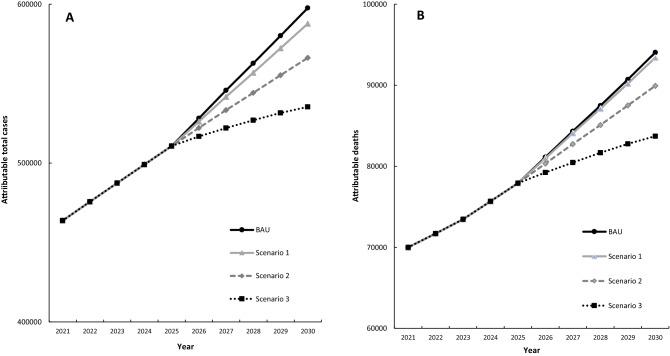
Although studies have quantified the current burden of diseases attributable to overweight and obesity in Brazil, none have estimated its burden in the future. The study aimed to estimate the potential impact of different scenarios of changes in the prevalence of overweight on non-communicable diseases (NCD) in the Brazilian adult population until 2030. We developed a multistate life table model including 11 body mass index (BMI) related diseases to estimate attributable NCDs cases and deaths under the following scenarios of changes in overweight over a 10-year simulation: (1) the continuity of the current trajectory of BMI increases, (2) reducing the rate of increase by half, (3) stopping future BMI increases, and (4) the reduction of the prevalence of overweight by 6.7%. In Brazil, if the current trends of BMI increase are maintained from 2021 to 2030, approximately 5.26 million incident cases and 808.6 thousand deaths from NCDs may occur due to overweight. If the annual increase in overweight was reduced by half until 2030, 1.1% of new NCD cases and 0.2% of deaths could be prevented (respectively, 29,600 cases and 1900 deaths). Alternatively, if the current prevalence of overweight is maintained, as set as a national goal in Brazil until 2030, the incident NCD cases and the deaths could be reduced by respectively 3.3% (92,900) and 1.5% (12,100) compared to continuation of current trends. If the prevalence of overweight is reduced by 6.7% until 2030, 6.5% (182,200) of NCD cases and 4.2% (33,900) of deaths could be prevented. The epidemiologic burden of overweight in Brazil tends to increase if bold policy interventions are not adopted in Brazil.
尽管已有研究量化了超重和肥胖导致的巴西疾病负担,但尚无研究对未来的疾病负担进行估计。本研究旨在估计超重患病率变化的不同情景对巴西成年人口非传染性疾病(NCD)的潜在影响,直至 2030 年。我们开发了一个多状态生命表模型,包含 11 种与体重指数(BMI)相关的疾病,以估计在 BMI 增加的当前轨迹持续、将增加率减半、停止未来 BMI 增加以及将超重患病率降低 6.7%的情况下,10 年模拟期间归因于 NCD 的病例和死亡数。在巴西,如果 2021 年至 2030 年期间 BMI 增加的趋势持续下去,由于超重可能会发生约 526 万例新的 NCD 病例和 80.86 万例死亡。如果到 2030 年将超重的年增长率降低一半,可预防 1.1%的新 NCD 病例和 0.2%的死亡(分别为 29600 例和 1900 例死亡)。或者,如果将目前超重的患病率维持到 2030 年,作为巴西的国家目标,与持续目前趋势相比,新的 NCD 病例和死亡数可分别减少 3.3%(92900 例)和 1.5%(12100 例)。如果到 2030 年将超重患病率降低 6.7%,可预防 6.5%(182200 例)的 NCD 病例和 4.2%(33900 例)的死亡。如果巴西不采取大胆的政策干预,巴西超重的流行病学负担可能会增加。
 Zotero 插件