
全表型关联分析:基于孟德尔随机化研究的脂肪酸水平的遗传预测因子。
Associations of genetically predicted fatty acid levels across the phenome: A mendelian randomisation study.
机构信息
Department of Epidemiology and Biostatistics, School of Public Health, Imperial College London, London, United Kingdom.
UK Dementia Research Institute, Imperial College London, London, United Kingdom.
出版信息
PLoS Med. 2022 Dec 29;19(12):e1004141. doi: 10.1371/journal.pmed.1004141. eCollection 2022 Dec.
BACKGROUND
Fatty acids are important dietary factors that have been extensively studied for their implication in health and disease. Evidence from epidemiological studies and randomised controlled trials on their role in cardiovascular, inflammatory, and other diseases remains inconsistent. The objective of this study was to assess whether genetically predicted fatty acid concentrations affect the risk of disease across a wide variety of clinical health outcomes.
METHODS AND FINDINGS
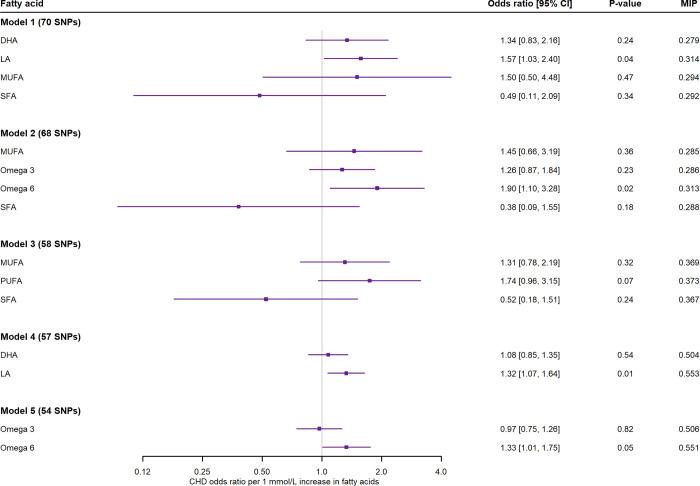
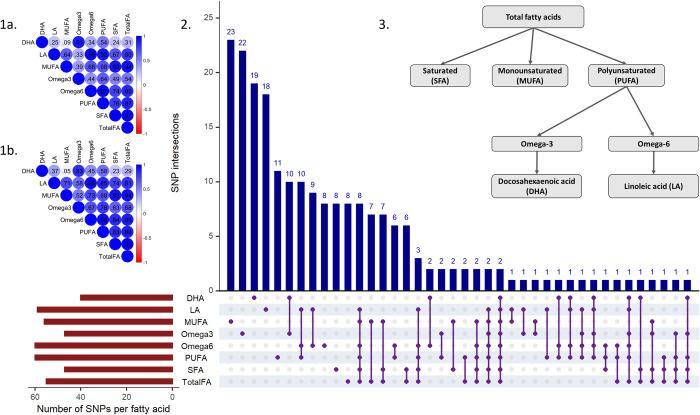
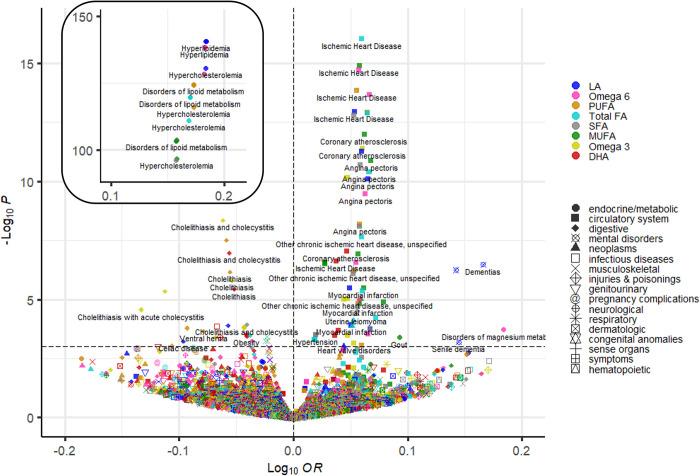
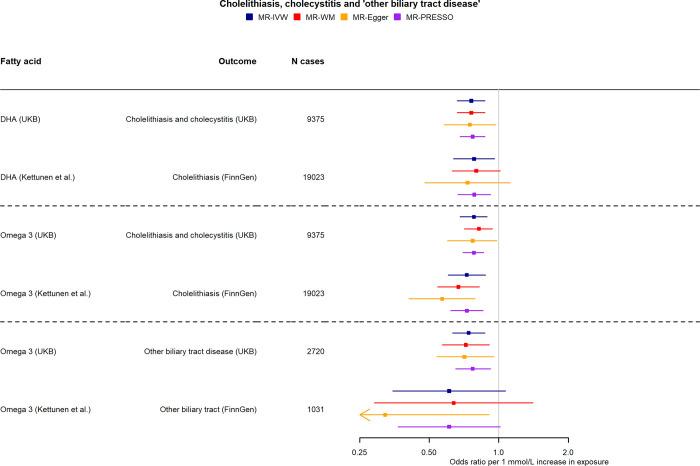
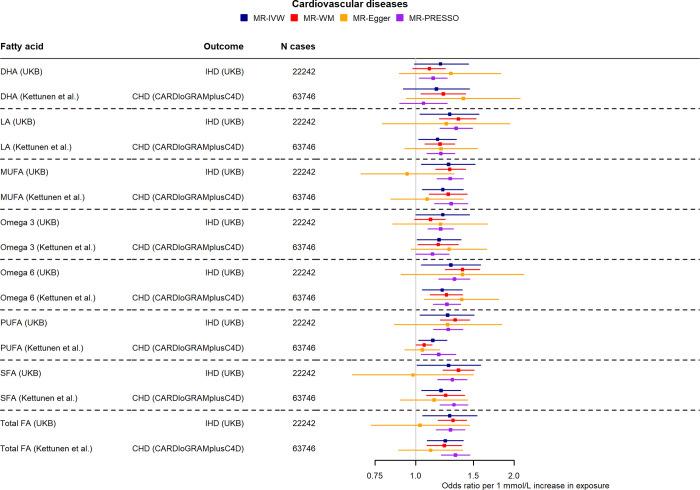
The UK Biobank (UKB) is a large study involving over 500,000 participants aged 40 to 69 years at recruitment from 2006 to 2010. We used summary-level data for 117,143 UKB samples (base dataset), to extract genetic associations of fatty acids, and individual-level data for 322,232 UKB participants (target dataset) to conduct our discovery analysis. We studied potentially causal relationships of circulating fatty acids with 845 clinical diagnoses, using mendelian randomisation (MR) approach, within a phenome-wide association study (PheWAS) framework. Regression models in PheWAS were adjusted for sex, age, and the first 10 genetic principal components. External summary statistics were used for replication. When several fatty acids were associated with a health outcome, multivariable MR and MR-Bayesian method averaging (MR-BMA) was applied to disentangle their causal role. Genetic predisposition to higher docosahexaenoic acid (DHA) was associated with cholelithiasis and cholecystitis (odds ratio per mmol/L: 0.76, 95% confidence interval: 0.66 to 0.87). This was supported in replication analysis (FinnGen study) and by the genetically predicted omega-3 fatty acids analyses. Genetically predicted linoleic acid (LA), omega-6, polyunsaturated fatty acids (PUFAs), and total fatty acids (total FAs) showed positive associations with cardiovascular outcomes with support from replication analysis. Finally, higher genetically predicted levels of DHA (0.83, 0.73 to 0.95) and omega-3 (0.83, 0.75 to 0.92) were found to have a protective effect on obesity, which was supported using body mass index (BMI) in the GIANT consortium as replication analysis. Multivariable MR analysis suggested a direct detrimental effect of LA (1.64, 1.07 to 2.50) and omega-6 fatty acids (1.81, 1.06 to 3.09) on coronary heart disease (CHD). MR-BMA prioritised LA and omega-6 fatty acids as the top risk factors for CHD. Although we present a range of sensitivity analyses to the address MR assumptions, horizontal pleiotropy may still bias the reported associations and further evaluation in clinical trials is needed.
CONCLUSIONS
Our study suggests potentially protective effects of circulating DHA and omega-3 concentrations on cholelithiasis and cholecystitis and on obesity, highlighting the need to further assess them as prevention treatments in clinical trials. Moreover, our findings do not support the supplementation of unsaturated fatty acids for cardiovascular disease prevention.
背景
脂肪酸是重要的膳食因素,其在健康和疾病方面的作用已经得到了广泛的研究。来自流行病学研究和随机对照试验的证据表明,它们在心血管、炎症和其他疾病中的作用仍然不一致。本研究的目的是评估遗传预测的脂肪酸浓度是否会影响各种临床健康结果的疾病风险。
方法和发现
英国生物银行(UKB)是一项大型研究,涉及 2006 年至 2010 年间招募的 500,000 多名年龄在 40 至 69 岁的参与者。我们使用来自 117,143 个 UKB 样本的汇总数据(基础数据集)提取脂肪酸的遗传关联,并使用 322,232 个 UKB 参与者的个体水平数据(目标数据集)进行我们的发现分析。我们使用孟德尔随机化(MR)方法,在表型全基因组关联研究(PheWAS)框架内,研究循环脂肪酸与 845 种临床诊断之间的潜在因果关系。PheWAS 中的回归模型调整了性别、年龄和前 10 个遗传主成分。使用外部汇总统计数据进行复制。当几种脂肪酸与健康结果相关时,应用多变量 MR 和 MR-Bayesian 方法平均(MR-BMA)来理清它们的因果作用。较高的二十二碳六烯酸(DHA)遗传易感性与胆石症和胆囊炎相关(每 mmol/L 的比值比:0.76,95%置信区间:0.66 至 0.87)。在复制分析(芬兰研究)和基于遗传预测的 omega-3 脂肪酸分析中支持这一结果。遗传预测的亚油酸(LA)、omega-6、多不饱和脂肪酸(PUFAs)和总脂肪酸(总 FAs)与心血管结局呈正相关,复制分析支持这一结果。最后,发现较高的遗传预测 DHA(0.83,0.73 至 0.95)和 omega-3(0.83,0.75 至 0.92)水平对肥胖具有保护作用,这一结果使用 GIANT 联盟中的体重指数(BMI)作为复制分析得到支持。多变量 MR 分析表明,LA(1.64,1.07 至 2.50)和 omega-6 脂肪酸(1.81,1.06 至 3.09)对冠心病(CHD)有直接的不良影响。MR-BMA 将 LA 和 omega-6 脂肪酸列为 CHD 的首要危险因素。尽管我们进行了一系列敏感性分析来解决 MR 假设问题,但水平性多效性仍可能会使报告的关联产生偏差,需要在临床试验中进一步评估。
结论
我们的研究表明循环 DHA 和 omega-3 浓度对胆石症和胆囊炎以及肥胖具有潜在的保护作用,这突出表明需要进一步在临床试验中评估它们作为预防治疗的效果。此外,我们的发现不支持补充不饱和脂肪酸来预防心血管疾病。


 Zotero 插件