
补充单宁酸对在地面平养42天的肉鸡生长性能、肠道健康、肉产量及肉质的影响。
Effects of tannic acid supplementation on growth performance, gut health, and meat production and quality of broiler chickens raised in floor pens for 42 days.
作者信息
Choi Janghan, Liu Guanchen, Goo Doyun, Wang Jinquan, Bowker Brain, Zhuang Hong, Kim Woo Kyun
机构信息
Department of Poultry Science, University of Georgia, Athens, GA, United States.
US National Poultry Research Center, USDA-ARS, Athens, GA, United States.
出版信息
Front Physiol. 2022 Dec 16;13:1082009. doi: 10.3389/fphys.2022.1082009. eCollection 2022.
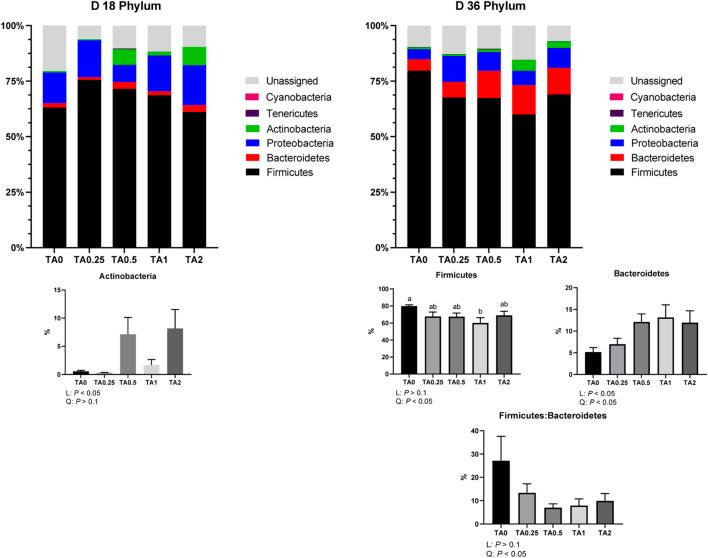
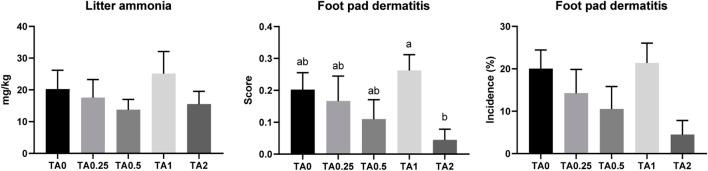
A study was conducted to investigate the effects of tannic acid (TA) supplementation on growth performance, gut health, antioxidant capacity, gut microbiota, and meat yield and quality in broilers raised for 42 days. A total of 700 one-day-old male broiler chickens (Cobb500) were allocated into 5 treatments with 7 replicates of 20 birds per pen. There were five treatments: 1) tannic acid 0 (TA0: basal diet without TA); 2) tannic acid 0.25 (TA0.25: basal diet+0.25 g/kg TA); 3) tannic acid 0.5 (TA0.5: basal diet+0.5 g/kg TA); 4) tannic acid 1 (TA1: basal diet+1 g/kg TA); and 5) tannic acid 2 (TA2: basal diet+2 g/kg TA). The dietary phases included starter (D 0 to 18; crumble feed), grower (D 18 to 28; pellet feed), and finisher (D 28 to 42; pellet feed). On D 18, the supplementation of TA linearly reduced body weight (BW) and average daily feed intake (ADFI) ( < 0.05), and on D 28, the supplementation of TA linearly reduced BW, average daily gain (ADG), and feed conversion ratio (FCR) ( < 0.05). Relative mRNA expression of genes related to mucin production (), tight junction proteins ( and ), and nutrient transporters ( and ) was linearly increased by the supplementation of TA ( < 0.05). The supplementation of TA tended to linearly increase the relative abundance of the family Enterobacteriaceae ( = 0.08) and quadratically increased the relative abundance of the families Lachnospiraceae and Ruminococcaceae in the cecal microbial communities ( < 0.05). On D 36, the ratio of the phyla Firmicutes and Bacteroidetes was quadratically reduced by the supplementation of TA ( < 0.05). On D 42, bone mineral density and the lean to fat ratio were linearly decreased by the supplementation of TA ( < 0.05). On D 43, total chilled carcass weight was linearly reduced ( < 0.05), and proportion of leg weight was increased by supplementation of TA ( < 0.05). The supplementation of TA linearly reduced pH of the breast meat ( < 0.05) and linearly increased redness (a*) ( < 0.05). Although the supplementation of TA positively influenced gut health and gut microbiota in the starter/grower phases, it negatively affected overall growth performance, bone health, and meat production in broilers on D 42.
进行了一项研究,以调查补充单宁酸(TA)对饲养42天的肉鸡生长性能、肠道健康、抗氧化能力、肠道微生物群以及肉产量和品质的影响。总共700只1日龄雄性肉鸡(科宝500)被分配到5种处理中,每栏20只鸡,共7个重复。有五种处理:1)单宁酸0(TA0:不含TA的基础日粮);2)单宁酸0.25(TA0.25:基础日粮+0.25 g/kg TA);3)单宁酸0.5(TA0.5:基础日粮+0.5 g/kg TA);4)单宁酸1(TA1:基础日粮+1 g/kg TA);5)单宁酸2(TA2:基础日粮+2 g/kg TA)。日粮阶段包括开食期(第0至18天;破碎料)、生长期(第18至28天;颗粒料)和育肥期(第28至42天;颗粒料)。在第18天,补充TA使体重(BW)和平均日采食量(ADFI)呈线性下降(P<0.05),在第28天,补充TA使BW、平均日增重(ADG)和饲料转化率(FCR)呈线性下降(P<0.05)。补充TA使与粘蛋白产生相关基因()、紧密连接蛋白(和)以及营养转运蛋白(和)的相对mRNA表达呈线性增加(P<0.05)。补充TA使盲肠微生物群落中肠杆菌科的相对丰度呈线性增加趋势(P = 0.08),使毛螺菌科和瘤胃球菌科的相对丰度呈二次增加(P<0.05)。在第36天,补充TA使厚壁菌门和拟杆菌门的比例呈二次下降(P<0.05)。在第42天,补充TA使骨矿物质密度和瘦肉与脂肪比例呈线性下降(P<0.05)。在第43天,总冷胴体重呈线性下降(P<0.05),补充TA使腿重比例增加(P<0.05)。补充TA使胸肉pH值呈线性下降(P<0.05),使红度(a*)呈线性增加(P<0.05)。虽然在开食期/生长期补充TA对肠道健康和肠道微生物群有积极影响,但在第42天时对肉鸡的整体生长性能、骨骼健康和肉产量有负面影响。


 Zotero 插件