
尼泊尔采用社会健康保险:一项混合研究。
Adopting social health insurance in Nepal: A mixed study.
机构信息
School of Health and Allied Sciences, Pokhara University, Pokhara, Nepal.
Department of Public Health, Indian Institute of Public Health Gandhinagar (IIPHG), Gandhinagar, India.
出版信息
Front Public Health. 2022 Dec 15;10:978732. doi: 10.3389/fpubh.2022.978732. eCollection 2022.
OBJECTIVE
The Social Health Insurance Program (SHIP) shares a major portion of social security, and is also key to Universal Health Coverage (UHC) and health equity. The Government of Nepal launched SHIP in the Fiscal Year 2015/16 for the first phase in three districts, on the principle of financial risk protection through prepayment and risk pooling in health care. Furthermore, the adoption of the program depends on the stakeholders' behaviors, mainly, the beneficiaries and the providers. Therefore, we aimed to explore and assess their perception and experiences regarding various factors acting on SHIP enrollment and adherence.
METHODS
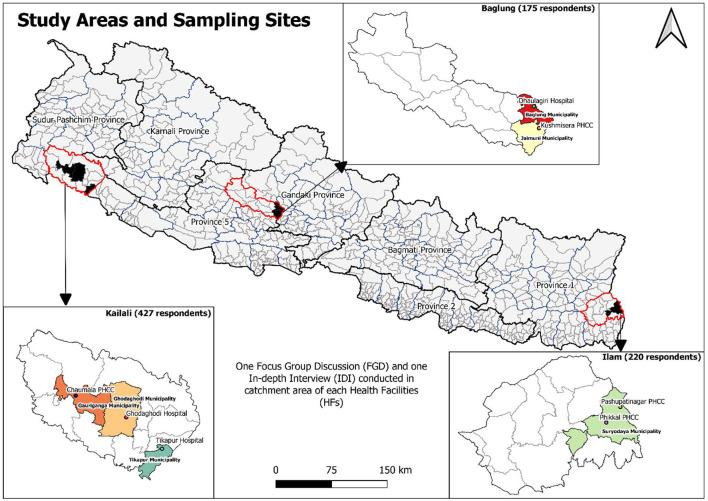
A cross-sectional, facility-based, concurrent mixed-methods study was carried out in seven health facilities in the Kailali, Baglung, and Ilam districts of Nepal. A total of 822 beneficiaries, sampled using probability proportional to size (PPS), attending health care institutions, were interviewed using a structured questionnaire for quantitative data. A total of seven focus group discussions (FGDs) and 12 in-depth interviews (IDIs), taken purposefully, were conducted with beneficiaries and service providers, using guidelines, respectively. Quantitative data were entered into Epi-data and analyzed with SPSS, MS-Excel, and Epitools, an online statistical calculator. Manual thematic analysis with predefined themes was carried out for qualitative data. Percentage, frequency, mean, and median were used to describe the variables, and the Chi-square test and binary logistic regression were used to infer the findings. We then combined the qualitative data from beneficiaries' and providers' perceptions, and experiences to explore different aspects of health insurance programs as well as to justify the quantitative findings.
RESULTS AND PROSPECTS
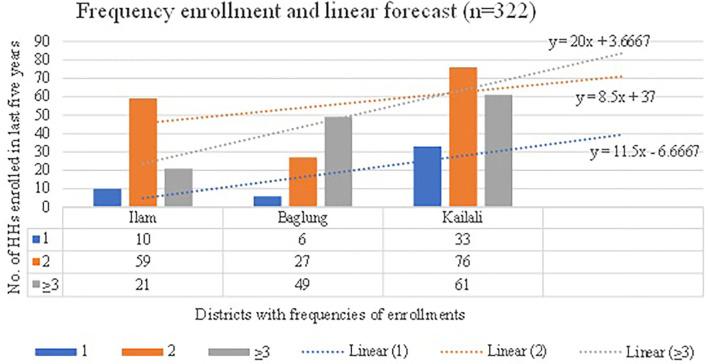
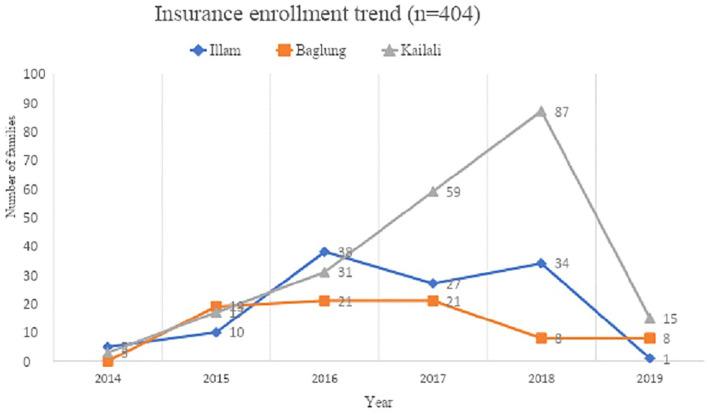
Of a total of 822 respondents (insured-404, uninsured-418), 370 (45%) were men. Families' median income was USD $65.96 (8.30-290.43). The perception of insurance premiums did not differ between the insured and uninsured groups ( = 0.53). Similarly, service utilization (OR = 220.4; 95% CI, 123.3-393.9) and accessibility (OR = 74.4; 95% CI, 42.5-130.6) were found to have high odds among the insured as compared to the uninsured respondents. Qualitative findings showed that the coverage and service quality were poor. Enrollment was gaining momentum despite nearly a one-tenth (9.1%) dropout rate. Moreover, different aspects, including provider-beneficiary communication, benefit packages, barriers, and ways to go, are discussed. Additionally, we also argue for some alternative health insurance schemes and strategies that may have possible implications in our contexts.
CONCLUSION
Although enrollment is encouraging, adherence is weak, with a considerable dropout rate and poor renewal. Patient management strategies and insurance education are recommended urgently. Furthermore, some alternate schemes and strategies may be considered.
目的
社会健康保险计划 (SHIP) 是社会保障的重要组成部分,也是全民健康覆盖 (UHC) 和健康公平的关键。尼泊尔政府在 2015/16 财年在三个地区推出了 SHIP,其原则是通过预付款和医疗保健中的风险共担来保护财务风险。此外,该计划的采用取决于利益相关者的行为,主要是受益人和提供者。因此,我们旨在探索和评估他们对影响 SHIP 参保和坚持的各种因素的看法和经验。
方法
在尼泊尔的卡利拉利、巴格隆和伊拉姆地区的 7 个卫生机构进行了一项基于横断面、基于设施的同期混合方法研究。使用概率比例与大小(PPS)抽样,对 822 名受益人参与医疗保健机构的受访者进行了访谈,使用结构化问卷收集定量数据。分别对受益人和服务提供者进行了 7 次焦点小组讨论(FGD)和 12 次深入访谈(IDI),并分别使用指南进行了访谈。定量数据输入 Epi-data 并使用 SPSS、MS-Excel 和在线统计计算器 Epitools 进行分析。使用预定义主题对定性数据进行手动主题分析。使用百分比、频率、平均值和中位数来描述变量,并使用卡方检验和二项逻辑回归来推断结果。然后,我们结合了受益人和提供者对保险计划的看法和经验,以探索医疗保险计划的不同方面,并为定量发现提供依据。
结果和前景
在总共 822 名受访者(参保者 404 名,未参保者 418 名)中,男性 370 名(45%)。家庭收入中位数为 65.96 美元(8.30-290.43)。参保组和未参保组对保险费的看法没有差异(=0.53)。同样,与未参保受访者相比,参保者的服务利用率(OR=220.4;95%CI,123.3-393.9)和可及性(OR=74.4;95%CI,42.5-130.6)都有很高的几率。定性研究结果表明,覆盖率和服务质量较差。尽管有近十分之一(9.1%)的人退出,但参保人数仍在增加。此外,还讨论了包括医患沟通、福利套餐、障碍和前进方向在内的不同方面。此外,我们还提出了一些可能对我们的环境产生影响的替代医疗保险计划和策略。
结论
尽管参保人数令人鼓舞,但坚持参保的情况却很薄弱,退保率相当高,续保率也很低。建议紧急采取患者管理策略和保险教育。此外,还可以考虑一些替代计划和策略。
 Zotero 插件