
抗逆转录病毒治疗开始后青少年和成年人机会性感染的发生率和预测因素:埃塞俄比亚一项为期 10 年的回顾性队列研究。
Incidence and predictors of opportunistic infections in adolescents and adults after the initiation of antiretroviral therapy: A 10-year retrospective cohort study in Ethiopia.
机构信息
School of Medicine, College of Health Sciences and Medicine, Wolaita Sodo University, Sodo, Ethiopia.
Department of Epidemiology and Biostatistics, College of Health Sciences and Medicine, Wolaita Sodo University, Sodo, Ethiopia.
出版信息
Front Public Health. 2022 Dec 15;10:1064859. doi: 10.3389/fpubh.2022.1064859. eCollection 2022.
BACKGROUND
Opportunistic infections (OIs) are the leading cause of morbidity and mortality in people living with the human immunodeficiency virus (PLHIV). However, there are few robust recent data on the rates of OIs and the risk factors that contribute to their occurrence. Therefore, the current study sought to determine the incidence of OIs and identify predictors among adolescents and adults after the initiation of antiretroviral therapy (ART) at Wolaita Sodo University Comprehensive Specialized Hospital (WSUCSH), Southern Ethiopia.
METHODS
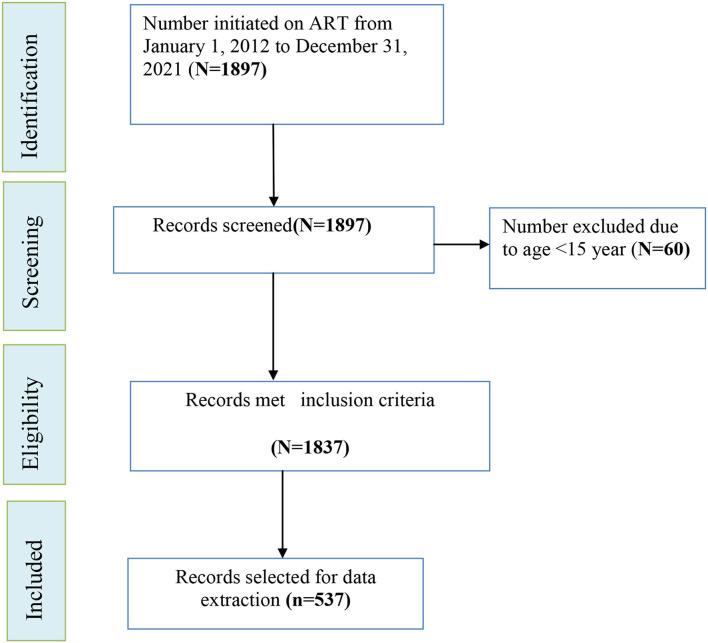
A retrospective cohort study design was employed. The study population was adolescents and adults who initiated ART between 1 January 2012 and 31 December 2021. A simple random sampling technique was used to select 537 participants' records. We reviewed the medical records of the sampled individuals from 1 May 2022 to 15 June 2022. KoboCollect version 2021.2.4 and STATA version 14.0 software were used for data collection and analysis, respectively. We calculated the incidence rate per 100 person-years of observation (PYO) with 95% confidence intervals (CIs) for the occurrence of any OIs. The Weibull regression model was fitted after the goodness-of-fit test for the Cox proportional hazard model was deemed inadequate. An adjusted hazard ratio (AHR) with 95% CI was used to identify a significant predictor of OIs. The statistical significance was made at a 5% significance level.
RESULTS
A total of 515 participants contributed to 1,829 person-years of risk, of whom 164 (31.84%) exhibited at least one OI. The overall incidence rate of OIs was 8.97 cases (95% CI: 7.69, 10.44) per 100 PYO. The independent predictors of OIs were being female [AHR: 1.65 (95% CI (1.15, 2.36), = 0.007)], individuals classified as World Health Organization (WHO) HIV clinical stage III [AHR: 1.98 (95% CI (1.12, 3.51), = 0.019)], individuals who did not take cotrimoxazole preventive therapy (CPT) [AHR: 2.58 (95% CI (1.62, 4.11), < 0.001)], mild malnutrition [AHR: 1.62 (95% CI (1.06, 2.54), = 0.035)], and poor adherence to ART [AHR: 4.21 (95% CI (2.39, 7.44), < 0.001)].
CONCLUSION
The rate of OIs after the initiation of ART was still high. Moreover, being female, not taking CPT, poor adherence to ART, mild malnutrition, and advanced HIV disease at presentation were found to increase the hazards of developing OIs.
背景
机会性感染(OIs)是导致人类免疫缺陷病毒(PLHIV)感染者发病和死亡的主要原因。然而,最近关于 OIs 发生率和导致其发生的风险因素的可靠数据很少。因此,本研究旨在确定在埃塞俄比亚南部沃尔塔-索多大学综合专科医院(WSUCSH)开始抗逆转录病毒治疗(ART)后,青少年和成年人中 OIs 的发生率,并确定其预测因素。
方法
采用回顾性队列研究设计。研究人群为 2012 年 1 月 1 日至 2021 年 12 月 31 日期间开始接受 ART 的青少年和成年人。采用简单随机抽样技术抽取 537 名参与者的记录。我们于 2022 年 5 月 1 日至 6 月 15 日期间对抽样个体的医疗记录进行了回顾。KoboCollect 版本 2021.2.4 和 STATA 版本 14.0 软件分别用于数据收集和分析。我们计算了每 100 人年观察(PYO)发生任何 OIs 的发生率,并计算了 95%置信区间(CI)。对 Cox 比例风险模型进行拟合后,进行了拟合优度检验,认为 Cox 比例风险模型不合适,因此拟合了威布尔回归模型。使用调整后的危险比(AHR)和 95%CI 来确定 OIs 的显著预测因素。在 5%的显著性水平上进行统计学检验。
结果
共有 515 名参与者贡献了 1829 人年的风险,其中 164 名(31.84%)至少发生了一次 OI。OIs 的总发生率为 8.97 例(95%CI:7.69,10.44)/100 PYO。OIs 的独立预测因素为女性(AHR:1.65 [95%CI(1.15,2.36)], = 0.007),世界卫生组织(WHO)HIV 临床分期为 III 期(AHR:1.98 [95%CI(1.12,3.51)], = 0.019),未接受复方磺胺甲噁唑预防治疗(CPT)(AHR:2.58 [95%CI(1.62,4.11)], < 0.001),轻度营养不良(AHR:1.62 [95%CI(1.06,2.54)], = 0.035),以及 ART 依从性差(AHR:4.21 [95%CI(2.39,7.44)], < 0.001)。
结论
ART 开始后 OIs 的发生率仍然很高。此外,女性、未接受 CPT、ART 依从性差、轻度营养不良和 HIV 疾病的初始阶段是导致 OIs 发生的危险因素。

 Zotero 插件