
慢性炎症和免疫抑制与全氟和多氟烷基物质 (PFAS) 暴露相关的系统证据图谱。
A systematic evidence map of chronic inflammation and immunosuppression related to per- and polyfluoroalkyl substance (PFAS) exposure.
机构信息
Division of Environmental Health Sciences, School of Public Health, University of California, Berkeley, CA, 94720, USA.
Division of Environmental Health Sciences, School of Public Health, University of California, Berkeley, CA, 94720, USA; Molecular Toxicology Interdepartmental Program, Fielding School of Public Health, University of California, Los Angeles, CA, 90095, USA.
出版信息
Environ Res. 2023 Mar 1;220:115188. doi: 10.1016/j.envres.2022.115188. Epub 2022 Dec 30.
BACKGROUND
The ability to induce chronic inflammation and immunosuppression are two key characteristics of carcinogens and important forms of immunotoxicity. The National Toxicology Program (NTP) evaluated the immunotoxicity of two per- and polyfluoroalkyl substances (PFASs), PFOA (perfluorooctanoic acid) and PFOS (perfluorooctane sulfonate), in 2016. However, the potential pro-inflammatory and immunosuppressive effects of other PFASs remain largely uncharacterized.
METHODS
We developed an expanded set of search terms pertaining to the chronic inflammatory and immunosuppressive effects of PFASs based on those of the International Agency for Research on Cancer (IARC) and NTP. To confirm searching effectiveness and scope, we compared our search term results with those of IARC and NTP for both PFASs and two other known carcinogens, chromium (VI) and benzene. Systematic evidence maps (SEMs) were also produced using Tableau to visualize the distribution of study numbers and types reporting immunotoxic effects and specific biomarkers elicited by PFAS exposures.
RESULTS
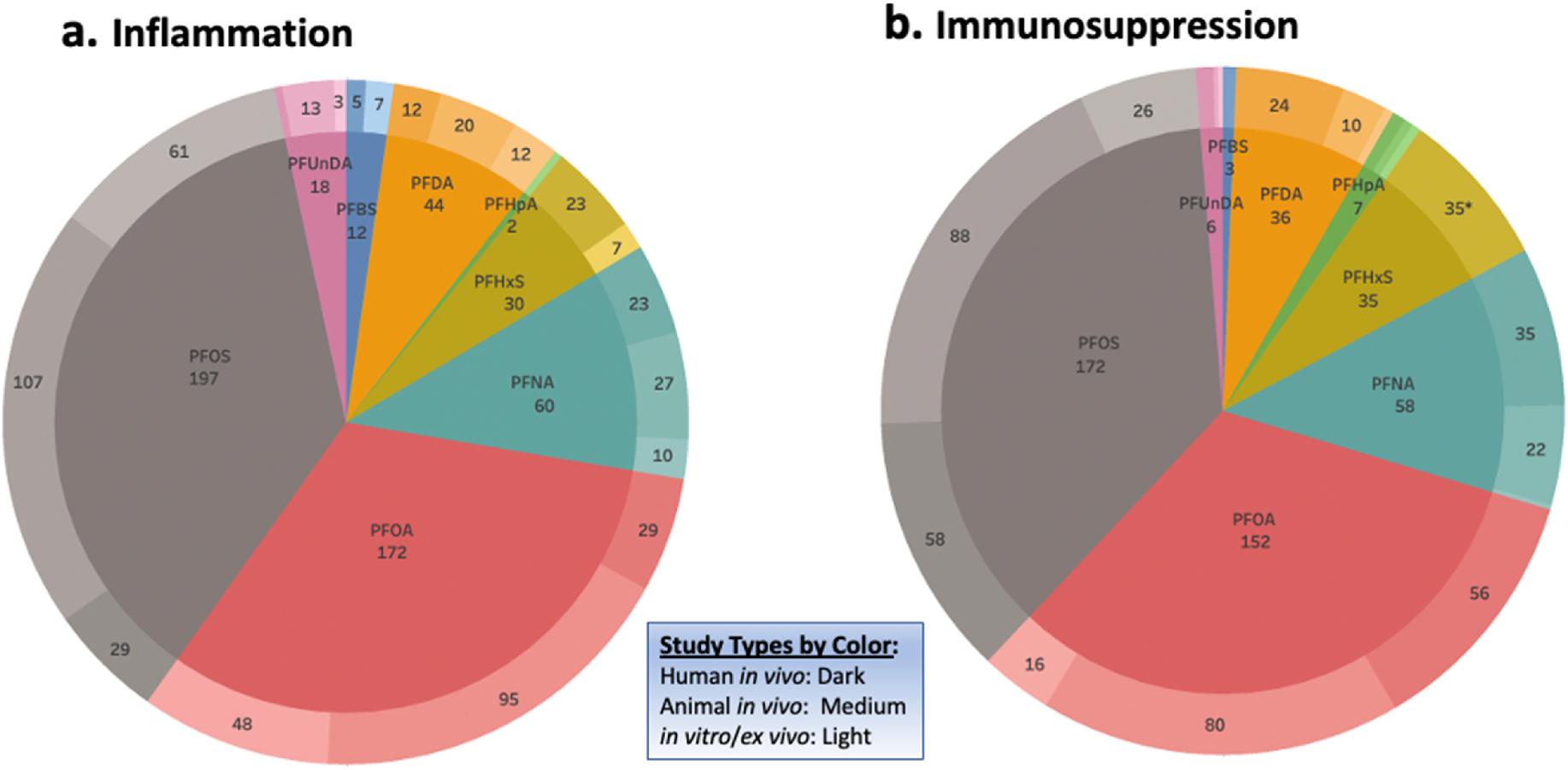
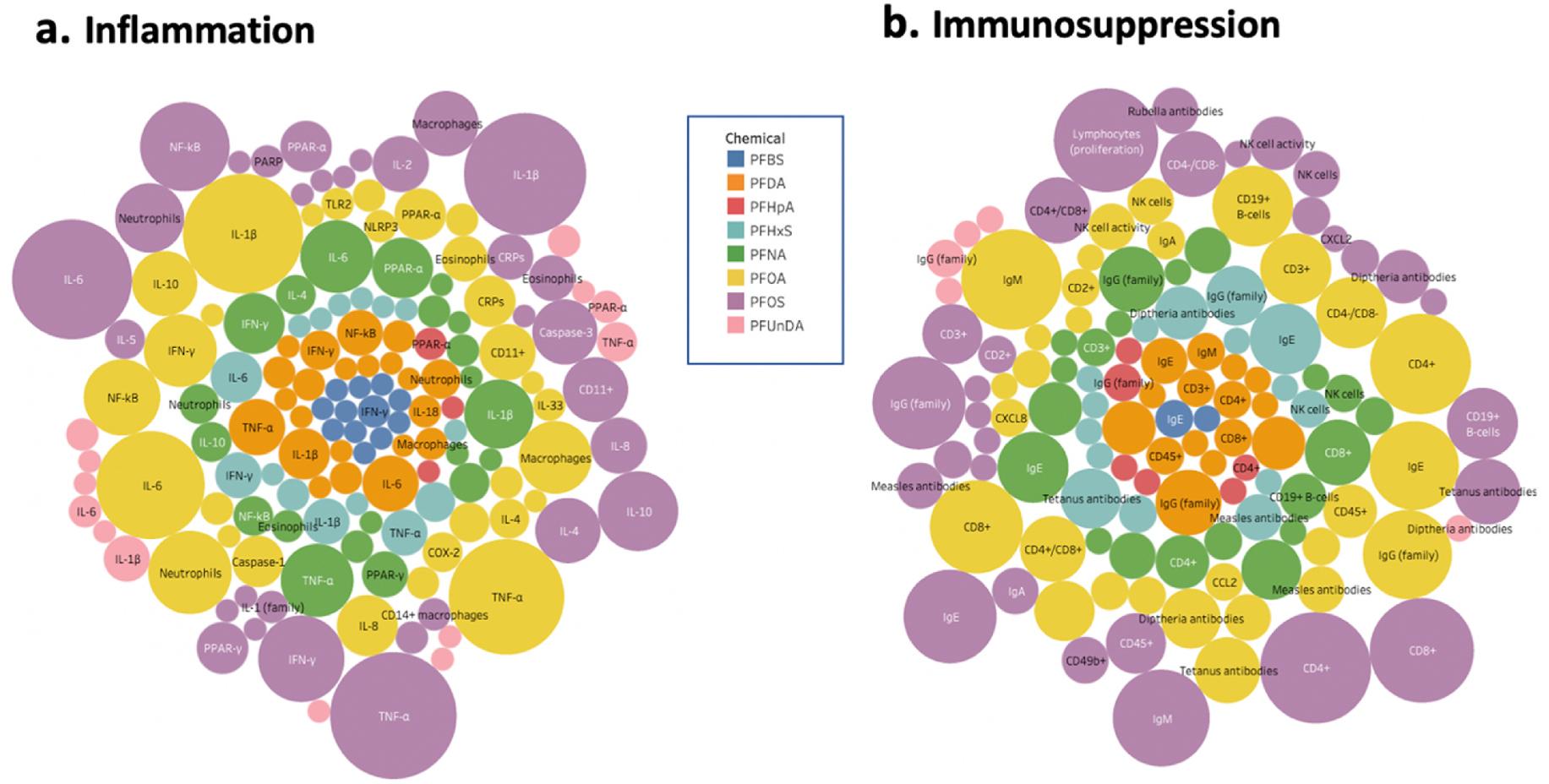
In total, 1155 PFAS studies were retrieved, of which 321 qualified for inclusion in our dataset. Using our search terms, we identified a greater number of relevant studies than those obtained using IARC and NTP's search terms. From the SEM findings, increased cytokine production strengthened an association between PFAS exposure and chronic inflammation, and decreased B-cell activation and altered levels of T-cell subtypes and immunoglobulins confirmed PFAS-induced immunosuppression.
CONCLUSION
Our SEM findings confirm that several PFASs commonly found in both in the environment, including those that are lesser-known, may induce immunosuppression and chronic inflammation, two key characteristics of carcinogens. This approach, including development of search terms, study screening process, data coding, and evidence mapping visualizations, can be applied to other key characteristics of chemical carcinogens.
背景
诱导慢性炎症和免疫抑制是致癌物质的两个关键特征,也是免疫毒性的重要形式。国家毒理学计划(NTP)于 2016 年评估了两种全氟和多氟烷基物质(PFAS),即 PFOA(全氟辛酸)和 PFOS(全氟辛烷磺酸)的免疫毒性。然而,其他 PFAS 的潜在促炎和免疫抑制作用在很大程度上仍未得到充分描述。
方法
我们根据国际癌症研究机构(IARC)和 NTP 的研究,针对 PFAS 的慢性炎症和免疫抑制作用,开发了一套扩展的搜索词。为了确认搜索的有效性和范围,我们将我们的搜索词结果与 IARC 和 NTP 的搜索词结果进行了比较,既包括 PFAS 也包括另外两种已知的致癌物质,即六价铬和苯。我们还使用 Tableau 生成了系统证据图谱(SEM),以可视化报告 PFAS 暴露引起的免疫毒性和特定生物标志物的研究数量和类型的分布。
结果
共检索到 1155 项 PFAS 研究,其中 321 项符合纳入我们数据集的标准。使用我们的搜索词,我们发现了比 IARC 和 NTP 的搜索词更多的相关研究。从 SEM 结果来看,细胞因子产生的增加加强了 PFAS 暴露与慢性炎症之间的关联,B 细胞激活减少以及 T 细胞亚型和免疫球蛋白水平的改变证实了 PFAS 诱导的免疫抑制。
结论
我们的 SEM 结果证实,几种在环境中常见的 PFAS,包括那些鲜为人知的 PFAS,可能会引起免疫抑制和慢性炎症,这是致癌物质的两个关键特征。这种方法,包括搜索词的开发、研究筛选过程、数据编码和证据图谱可视化,可以应用于其他化学致癌物质的关键特征。



 Zotero 插件