
基于遗传邻近性的 PCSK9 抑制与前列腺癌风险的关联:一项孟德尔随机化研究。
Association between genetically proxied PCSK9 inhibition and prostate cancer risk: A Mendelian randomisation study.
机构信息
Population Health Sciences, Bristol Medical School, University of Bristol, Bristol, United Kingdom.
Medical Research Council (MRC) Integrative Epidemiology Unit (IEU), University of Bristol, Bristol, United Kingdom.
出版信息
PLoS Med. 2023 Jan 3;20(1):e1003988. doi: 10.1371/journal.pmed.1003988. eCollection 2023 Jan.
BACKGROUND
Prostate cancer (PrCa) is the second most prevalent malignancy in men worldwide. Observational studies have linked the use of low-density lipoprotein cholesterol (LDL-c) lowering therapies with reduced risk of PrCa, which may potentially be attributable to confounding factors. In this study, we performed a drug target Mendelian randomisation (MR) analysis to evaluate the association of genetically proxied inhibition of LDL-c-lowering drug targets on risk of PrCa.
METHODS AND FINDINGS
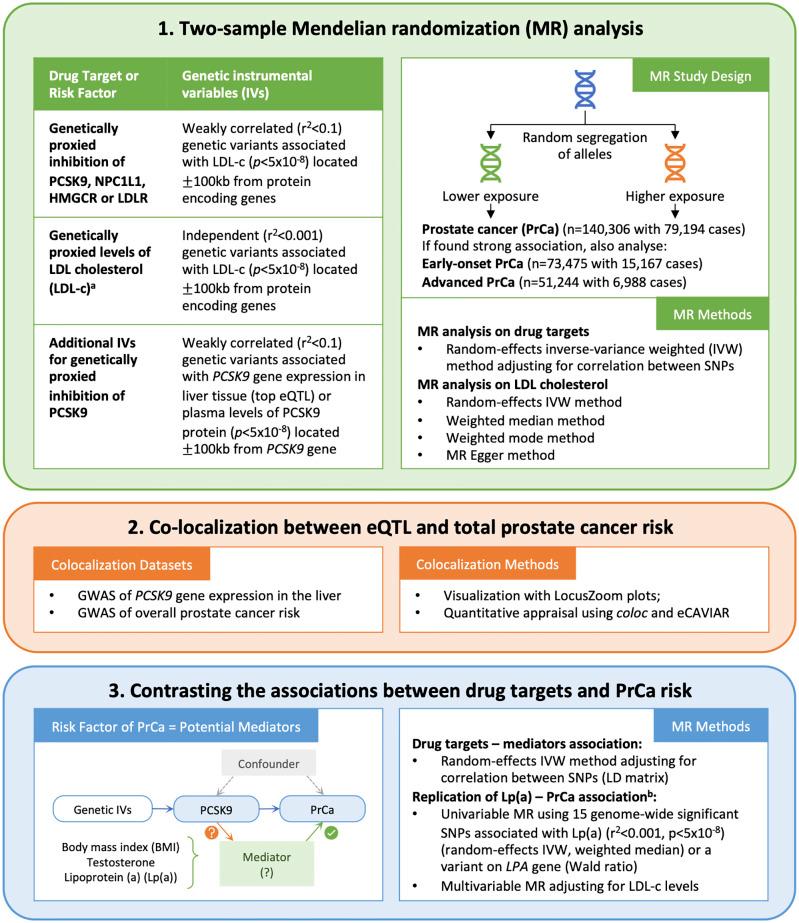
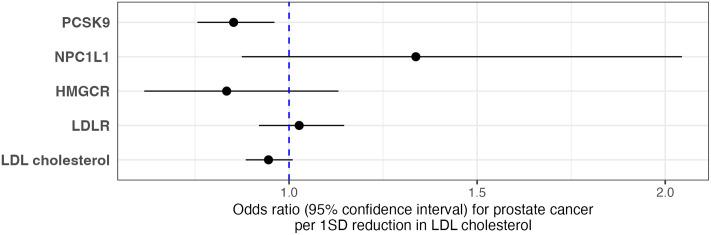
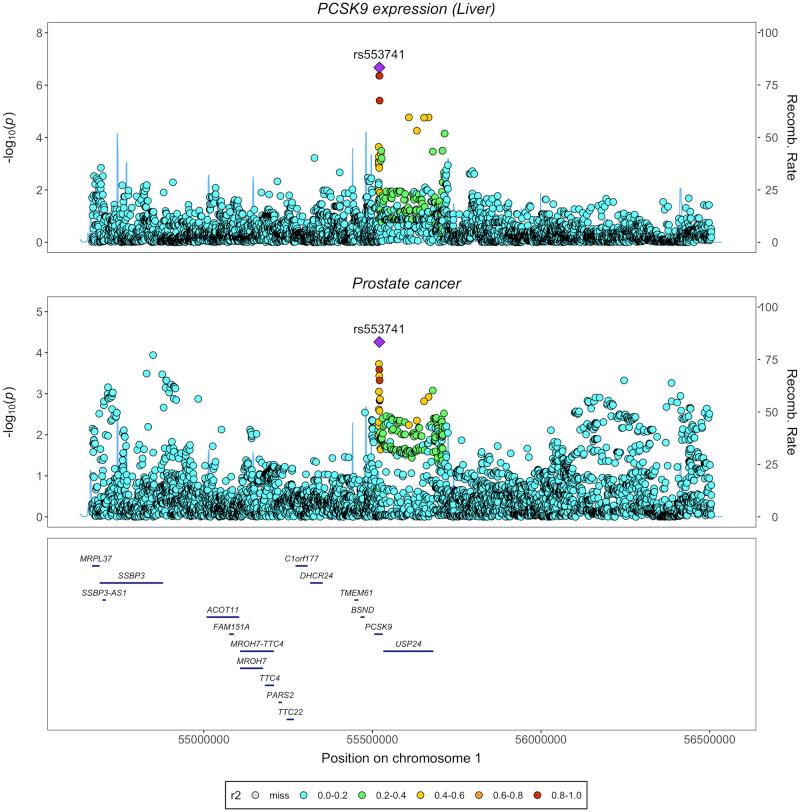
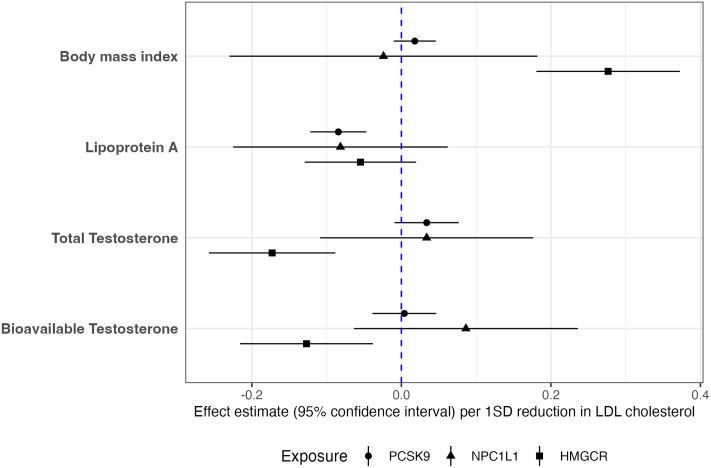
Single-nucleotide polymorphisms (SNPs) associated with LDL-c (P < 5 × 10⁻⁸) from the Global Lipids Genetics Consortium genome-wide association study (GWAS) (N = 1,320,016) and located in and around the HMGCR, NPC1L1, and PCSK9 genes were used to proxy the therapeutic inhibition of these targets. Summary-level data regarding the risk of total, advanced, and early-onset PrCa were obtained from the PRACTICAL consortium. Validation analyses were performed using genetic instruments from an LDL-c GWAS conducted on male UK Biobank participants of European ancestry (N = 201,678), as well as instruments selected based on liver-derived gene expression and circulation plasma levels of targets. We also investigated whether putative mediators may play a role in findings for traits previously implicated in PrCa risk (i.e., lipoprotein a (Lp(a)), body mass index (BMI), and testosterone). Applying two-sample MR using the inverse-variance weighted approach provided strong evidence supporting an effect of genetically proxied inhibition of PCSK9 (equivalent to a standard deviation (SD) reduction in LDL-c) on lower risk of total PrCa (odds ratio (OR) = 0.85, 95% confidence interval (CI) = 0.76 to 0.96, P = 9.15 × 10⁻³) and early-onset PrCa (OR = 0.70, 95% CI = 0.52 to 0.95, P = 0.023). Genetically proxied HMGCR inhibition provided a similar central effect estimate on PrCa risk, although with a wider 95% CI (OR = 0.83, 95% CI = 0.62 to 1.13, P = 0.244), whereas genetically proxied NPC1L1 inhibition had an effect on higher PrCa risk with a 95% CI that likewise included the null (OR = 1.34, 95% CI = 0.87 to 2.04, P = 0.180). Analyses using male-stratified instruments provided consistent results. Secondary MR analyses supported a genetically proxied effect of liver-specific PCSK9 expression (OR = 0.90 per SD reduction in PCSK9 expression, 95% CI = 0.86 to 0.95, P = 5.50 × 10⁻⁵) and circulating plasma levels of PCSK9 (OR = 0.93 per SD reduction in PCSK9 protein levels, 95% CI = 0.87 to 0.997, P = 0.04) on PrCa risk. Colocalization analyses identified strong evidence (posterior probability (PPA) = 81.3%) of a shared genetic variant (rs553741) between liver-derived PCSK9 expression and PrCa risk, whereas weak evidence was found for HMGCR (PPA = 0.33%) and NPC1L1 expression (PPA = 0.38%). Moreover, genetically proxied PCSK9 inhibition was strongly associated with Lp(a) levels (Beta = -0.08, 95% CI = -0.12 to -0.05, P = 1.00 × 10⁻⁵), but not BMI or testosterone, indicating a possible role for Lp(a) in the biological mechanism underlying the association between PCSK9 and PrCa. Notably, we emphasise that our estimates are based on a lifelong exposure that makes direct comparisons with trial results challenging.
CONCLUSIONS
Our study supports a strong association between genetically proxied inhibition of PCSK9 and a lower risk of total and early-onset PrCa, potentially through an alternative mechanism other than the on-target effect on LDL-c. Further evidence from clinical studies is needed to confirm this finding as well as the putative mediatory role of Lp(a).
背景
前列腺癌(PrCa)是全球男性第二大常见恶性肿瘤。观察性研究表明,使用降低低密度脂蛋白胆固醇(LDL-c)的治疗与降低 PrCa 风险相关,这可能归因于混杂因素。在这项研究中,我们进行了药物靶点孟德尔随机化(MR)分析,以评估 LDL-c 降低药物靶点的遗传抑制与 PrCa 风险之间的关联。
方法和发现
我们使用来自全球脂质遗传学联盟全基因组关联研究(GWAS)的与 LDL-c 相关的单核苷酸多态性(SNP)(P < 5 × 10⁻⁸)(N = 1,320,016),并位于 HMGCR、NPC1L1 和 PCSK9 基因内及其周围,以代表这些靶点的治疗性抑制。我们从 PRACTICAL 联盟获得了有关总、晚期和早期发病 PrCa 风险的汇总数据。验证分析使用了来自英国生物库男性参与者的 LDL-c GWAS 的遗传工具(欧洲血统,N = 201,678),以及基于肝脏衍生基因表达和循环血浆靶标水平选择的工具进行。我们还研究了假定的中介物是否可能在以前与 PrCa 风险相关的特征(即脂蛋白 a(Lp(a))、体重指数(BMI)和睾丸激素)中发挥作用。应用两样本 MR 使用逆方差加权方法提供了强有力的证据,支持遗传抑制 PCSK9(相当于 LDL-c 的标准偏差降低)与总 PrCa(比值比(OR)= 0.85,95%置信区间(CI)= 0.76 至 0.96,P = 9.15 × 10⁻³)和早期发病 PrCa(OR = 0.70,95% CI = 0.52 至 0.95,P = 0.023)的低风险之间存在关联。遗传抑制 HMGCR 提供了类似的中心效应估计值,但 95%CI 较宽(OR = 0.83,95%CI = 0.62 至 1.13,P = 0.244),而遗传抑制 NPC1L1 对较高的 PrCa 风险有影响,95%CI 同样包含了零(OR = 1.34,95%CI = 0.87 至 2.04,P = 0.180)。使用男性分层工具进行的分析提供了一致的结果。二级 MR 分析支持肝脏特异性 PCSK9 表达的遗传效应(PCSK9 表达每降低一个标准差的 OR = 0.90,95%CI = 0.86 至 0.95,P = 5.50 × 10⁻⁵)和循环血浆 PCSK9 水平(PCSK9 蛋白水平每降低一个标准差的 OR = 0.93,95%CI = 0.87 至 0.997,P = 0.04)与 PrCa 风险之间的关联。共定位分析确定了肝脏衍生的 PCSK9 表达与 PrCa 风险之间存在强烈的共享遗传变异(后验概率(PPA)= 81.3%)(rs553741),而 HMGCR(PPA = 0.33%)和 NPC1L1 表达(PPA = 0.38%)则发现较弱的证据。此外,遗传抑制 PCSK9 与 Lp(a)水平强烈相关(Beta = -0.08,95%CI = -0.12 至 -0.05,P = 1.00 × 10⁻⁵),但与 BMI 或睾丸激素无关,表明 Lp(a)可能在 PCSK9 与 PrCa 之间的关联的生物学机制中发挥作用。值得注意的是,我们强调我们的估计值是基于终生暴露,这使得与试验结果进行直接比较具有挑战性。
结论
我们的研究支持遗传抑制 PCSK9 与总发病率和早期发病 PrCa 风险降低之间的强烈关联,这可能是通过 LDL-c 以外的替代作用机制。需要进一步的临床研究证据来证实这一发现以及 Lp(a)的潜在中介作用。

 Zotero 插件