
理解 2014-2017 财年退伍军人健康管理局中使用 ICD-9-CM 和 ICD-10-CM 的头痛分类编码。
Understanding headache classification coding within the veterans health administration using ICD-9-CM and ICD-10-CM in fiscal years 2014-2017.
机构信息
Veterans Health Administration Headache Centers of Excellence Research and Evaluation Center, VA Connecticut Healthcare System, West Haven, CT, United States of America.
Pain Research, Informatics, and Multi-morbidities, and Education (PRIME) Center, VA Connecticut Healthcare System, West Haven, CT, United States of America.
出版信息
PLoS One. 2023 Jan 4;18(1):e0279163. doi: 10.1371/journal.pone.0279163. eCollection 2023.
OBJECTIVES
Understand the continuity and changes in headache not-otherwise-specified (NOS), migraine, and post-traumatic headache (PTH) diagnoses after the transition from ICD-9-CM to ICD-10-CM in the Veterans Health Administration (VHA).
BACKGROUND
Headache is one of the most commonly diagnosed chronic conditions managed within primary and specialty care clinics. The VHA transitioned from ICD-9-CM to ICD-10-CM on October-1-2015. The effect transitioning on coding of specific headache diagnoses is unknown. Accuracy of headache diagnosis is important since different headache types respond to different treatments.
METHODS
We mapped headache diagnoses from ICD-9-CM (FY 2014/2015) onto ICD-10-CM (FY 2016/2017) and computed coding proportions two years before/after the transition in VHA. We used queries to determine the change in transition pathways. We report the odds of ICD-10-CM coding associated with ICD-9-CM controlling for provider type, and patient age, sex, and race/ethnicity.
RESULTS
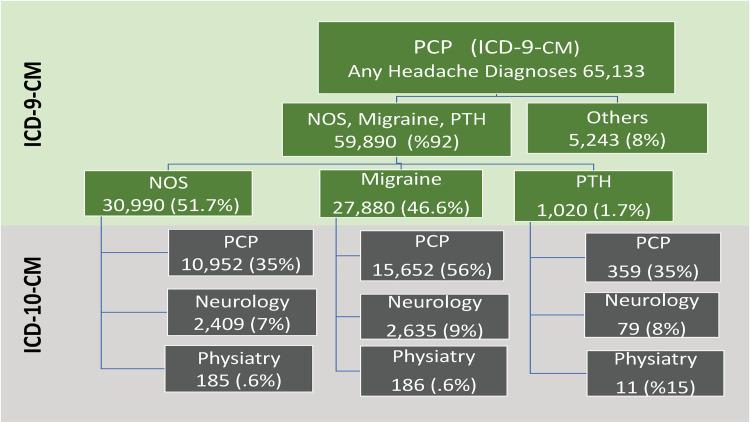
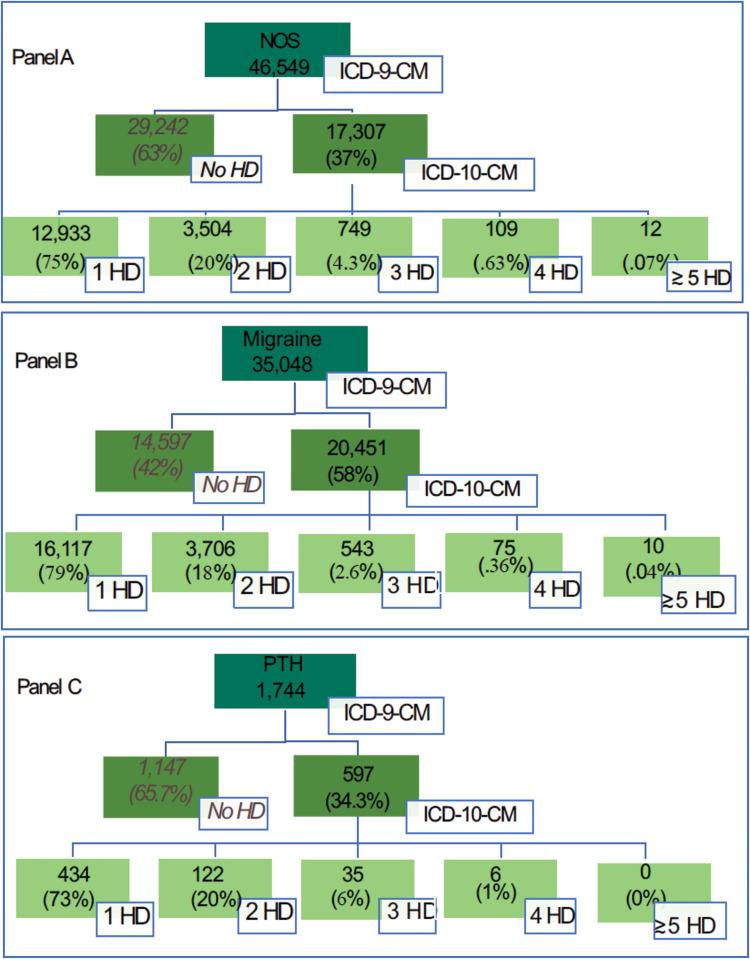
Only 37%, 58% and 34% of patients with ICD-9-CM coding of NOS, migraine, and PTH respectively had an ICD-10-CM headache diagnosis. Of those with an ICD-10-CM diagnosis, 73-79% had a single headache diagnosis. The odds ratios for receiving the same code in both ICD-9-CM and ICD-10-CM after adjustment for ICD-9-CM and ICD-10-CM headache comorbidities and sociodemographic factors were high (range 6-26) and statistically significant. Specifically, 75% of patients with headache NOS had received one headache diagnoses (Adjusted headache NOS-ICD-9-CM OR for headache NOS-ICD-10-CM = 6.1, 95% CI 5.89-6.32. 79% of migraineurs had one headache diagnoses, mostly migraine (Adjusted migraine-ICD-9-CM OR for migraine-ICD-10-CM = 26.43, 95% CI 25.51-27.38). The same held true for PTH (Adjusted PTH-ICD-9-CM OR for PTH-ICD-10-CM = 22.92, 95% CI: 18.97-27.68). These strong associations remained after adjustment for specialist care in ICD-10-CM follow-up period.
DISCUSSION
The majority of people with ICD-9-CM headache diagnoses did not have an ICD-10-CM headache diagnosis. However, a given diagnosis in ICD-9-CM by a primary care provider (PCP) was significantly predictive of its assignment in ICD-10-CM as was seeing either a neurologist or physiatrist (compared to a generalist) for an ICD-10-CM headache diagnosis.
CONCLUSION
When a veteran had a specific diagnosis in ICD-9-CM, the odds of being coded with the same diagnosis in ICD-10-CM were significantly higher. Specialist visit during the ICD-10-CM period was independently associated with all three ICD-10-CM headaches.
目的
了解退伍军人事务部(VA)从 ICD-9-CM 过渡到 ICD-10-CM 后,未特指的头痛(NOS)、偏头痛和创伤后头痛(PTH)诊断的连续性和变化。
背景
头痛是在初级和专科诊所管理的最常见的慢性疾病之一。VA 于 2015 年 10 月 1 日从 ICD-9-CM 过渡到 ICD-10-CM。过渡对特定头痛诊断的编码影响尚不清楚。由于不同类型的头痛需要不同的治疗方法,因此头痛诊断的准确性很重要。
方法
我们将 ICD-9-CM(2014/2015 财年)中的头痛诊断映射到 ICD-10-CM(2016/2017 财年)中,并计算了 VA 过渡前后两年的编码比例。我们使用查询来确定过渡途径的变化。我们报告了与 ICD-9-CM 相比,ICD-10-CM 编码的关联,同时控制了提供者类型、患者年龄、性别和种族/民族。
结果
只有 37%、58%和 34%分别患有 NOS、偏头痛和 PTH 的 ICD-9-CM 编码患者在 ICD-10-CM 中有头痛诊断。在那些有 ICD-10-CM 诊断的患者中,有 73-79%的患者只有一个头痛诊断。在调整了 ICD-9-CM 和 ICD-10-CM 头痛合并症和社会人口统计学因素后,接受相同编码的优势比(OR)在 ICD-9-CM 和 ICD-10-CM 中均为高(范围为 6-26)且具有统计学意义。具体而言,75%的 NOS 头痛患者接受了一种头痛诊断(调整后的 NOS-ICD-9-CM OR 为头痛 NOS-ICD-10-CM = 6.1,95%CI 5.89-6.32)。偏头痛患者中,有 79%的患者接受了一种头痛诊断,主要是偏头痛(调整后的偏头痛-ICD-9-CM OR 为偏头痛-ICD-10-CM = 26.43,95%CI 25.51-27.38)。PTH 也是如此(调整后的 PTH-ICD-9-CM OR 为 PTH-ICD-10-CM = 22.92,95%CI:18.97-27.68)。在调整了 ICD-10-CM 随访期间的专科治疗后,这些强烈的关联仍然存在。
讨论
大多数患有 ICD-9-CM 头痛诊断的患者没有 ICD-10-CM 头痛诊断。然而,初级保健提供者(PCP)在 ICD-9-CM 中的特定诊断显著预测了其在 ICD-10-CM 中的分配,就像看到神经病学家或物理治疗师(与全科医生相比)进行 ICD-10-CM 头痛诊断一样。
结论
当退伍军人在 ICD-9-CM 中有特定诊断时,在 ICD-10-CM 中被编码为相同诊断的可能性显著增加。在 ICD-10-CM 期间的专科就诊与所有三种 ICD-10-CM 头痛独立相关。

 Zotero 插件