
探讨具有不同 PPARγ 亲和力的化合物在体外和体内的神经再生能力。
Exploring the Nerve Regenerative Capacity of Compounds with Differing Affinity for PPARγ In Vitro and In Vivo.
机构信息
Department of Pharmacology, School of Pharmacy, University College London, London WC1N 1AX, UK.
Centre for Nerve Engineering, University College London, London WC1N 6BT, UK.
出版信息
Cells. 2022 Dec 22;12(1):42. doi: 10.3390/cells12010042.
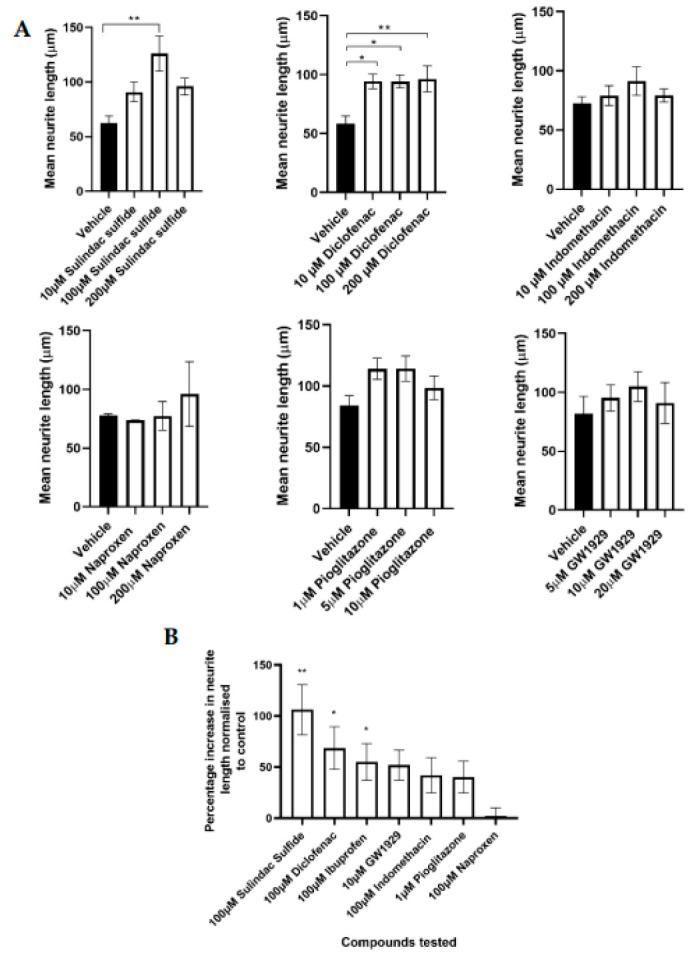
Damage to peripheral nerves can cause debilitating consequences for patients such as lifelong pain and disability. At present, no drug treatments are routinely given in the clinic following a peripheral nerve injury (PNI) to improve regeneration and remyelination of damaged nerves. Appropriately targeted therapeutic agents have the potential to be used at different stages following nerve damage, e.g., to maintain Schwann cell viability, induce and sustain a repair phenotype to support axonal growth, or promote remyelination. The development of therapies to promote nerve regeneration is currently of high interest to researchers, however, translation to the clinic of drug therapies for PNI is still lacking. Studying the effect of PPARγ agonists for treatment of peripheral nerve injures has demonstrated significant benefits. Ibuprofen, a non-steroidal anti-inflammatory drug (NSAID), has reproducibly demonstrated benefits in vitro and in vivo, suggested to be due to its agonist action on PPARγ. Other NSAIDs have demonstrated differing levels of PPARγ activation based upon their affinity. Therefore, it was of interest to determine whether affinity for PPARγ of selected drugs corresponded to an increase in regeneration. A 3D co-culture in vitro model identified some correlation between these two properties. However, when the drug treatments were screened in vivo, in a crush injury model in a rat sciatic nerve, the same correlation was not apparent. Further differences were observed between capacity to increase axon number and improvement in functional recovery. Despite there not being a clear correlation between affinity and size of effect on regeneration, all selected PPARγ agonists improved regeneration, providing a panel of compounds that could be explored for use in the treatment of PNI.
周围神经损伤会给患者带来终身疼痛和残疾等严重后果。目前,临床上在周围神经损伤(PNI)后没有常规使用药物治疗来改善受损神经的再生和髓鞘形成。适当靶向的治疗剂有可能在神经损伤后的不同阶段使用,例如,维持施万细胞活力、诱导和维持修复表型以支持轴突生长或促进髓鞘形成。促进神经再生的治疗方法的开发目前是研究人员的关注重点,然而,用于 PNI 的药物治疗的临床转化仍然缺乏。研究 PPARγ 激动剂治疗周围神经损伤的效果表明具有显著益处。布洛芬是一种非甾体抗炎药(NSAID),已在体外和体内反复证明具有益处,这被认为是由于其对 PPARγ 的激动作用。其他 NSAID 根据其亲和力表现出不同水平的 PPARγ 激活。因此,人们有兴趣确定选定药物对 PPARγ 的亲和力是否与再生增加相关。体外 3D 共培养模型确定了这两个特性之间存在一定的相关性。然而,当在体内(大鼠坐骨神经挤压伤模型)筛选药物治疗时,这一相关性并不明显。在增加轴突数量的能力和功能恢复的改善之间还观察到了进一步的差异。尽管亲和力和对再生影响的大小之间没有明显的相关性,但所有选定的 PPARγ 激动剂都改善了再生,为治疗 PNI 提供了一组可探索使用的化合物。



 Zotero 插件