
鱼类和渔业产品中的微塑料及其对人类健康的风险:综述。
Microplastics in Fish and Fishery Products and Risks for Human Health: A Review.
机构信息
Department of Animal Medicine, Productions and Health, University of Padova, Viale dell'Università 16, 35020 Legnaro, Italy.
Department of Medicine and Health Sciences, University of Molise, 86100 Campobasso, Italy.
出版信息
Int J Environ Res Public Health. 2022 Dec 31;20(1):789. doi: 10.3390/ijerph20010789.
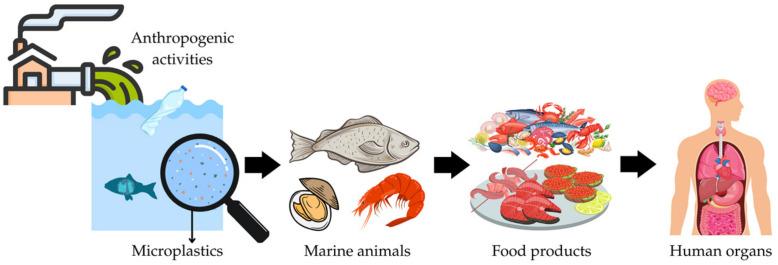
In recent years, plastic waste has become a universally significant environmental problem. Ingestion of food and water contaminated with microplastics is the main route of human exposure. Fishery products are an important source of microplastics in the human diet. Once ingested, microplastics reach the gastrointestinal tract and can be absorbed causing oxidative stress, cytotoxicity, and translocation to other tissues. Furthermore, microplastics can release chemical substances (organic and inorganic) present in their matrix or previously absorbed from the environment and act as carriers of microorganisms. Additives present in microplastics such as polybrominated diphenyl ethers (PBDE), bisphenol A (BPA), nonylphenol (NP), octylphenol (OP), and potentially toxic elements can be harmful for humans. However, to date, the data we have are not sufficient to perform a reliable assessment of the risks to human health. Further studies on the toxicokinetics and toxicity of microplastics in humans are needed.
近年来,塑料废物已成为一个全球性的重大环境问题。人类主要通过摄入受微塑料污染的食物和水而接触微塑料。水产品是人类饮食中微塑料的重要来源。一旦被摄入,微塑料会到达胃肠道并被吸收,从而导致氧化应激、细胞毒性和向其他组织转移。此外,微塑料还可以释放其基质中存在的化学物质(有机和无机)或先前从环境中吸收的化学物质,并充当微生物的载体。微塑料中存在的添加剂,如多溴二苯醚(PBDE)、双酚 A(BPA)、壬基酚(NP)、辛基酚(OP)和潜在有毒元素,可能对人类有害。然而,迄今为止,我们所拥有的数据还不足以对人类健康风险进行可靠评估。需要进一步研究微塑料在人体内的毒代动力学和毒性。
 Zotero 插件