
糖尿病肾病的分子机制有哪些新进展:最新研究进展。
What's New in the Molecular Mechanisms of Diabetic Kidney Disease: Recent Advances.
机构信息
Dialysis Center, Tohoku University Hospital, Sendai 980-8574, Japan.
Division of Clinical Pharmacology and Therapeutics, Faculty of Pharmaceutical Sciences, Graduate School of Pharmaceutical Sciences, Tohoku University, Sendai 980-8578, Japan.
出版信息
Int J Mol Sci. 2022 Dec 29;24(1):570. doi: 10.3390/ijms24010570.
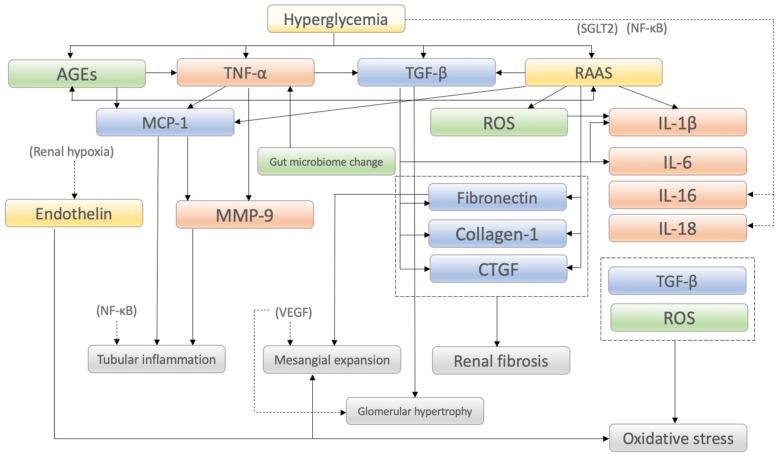
Diabetic kidney disease (DKD) is the leading cause of chronic kidney disease, including end-stage kidney disease, and increases the risk of cardiovascular mortality. Although the treatment options for DKD, including angiotensin-converting enzyme inhibitors, angiotensin II receptor blockers, sodium-glucose cotransporter 2 inhibitors, and mineralocorticoid receptor antagonists, have advanced, their efficacy is still limited. Thus, a deeper understanding of the molecular mechanisms of DKD onset and progression is necessary for the development of new and innovative treatments for DKD. The complex pathogenesis of DKD includes various different pathways, and the mechanisms of DKD can be broadly classified into inflammatory, fibrotic, metabolic, and hemodynamic factors. Here, we summarize the recent findings in basic research, focusing on each factor and recent advances in the treatment of DKD. Collective evidence from basic and clinical research studies is helpful for understanding the definitive mechanisms of DKD and their regulatory systems. Further comprehensive exploration is warranted to advance our knowledge of the pathogenesis of DKD and establish novel treatments and preventive strategies.
糖尿病肾病(DKD)是导致慢性肾脏病(包括终末期肾病)的主要原因,并增加了心血管死亡率。尽管 DKD 的治疗选择,包括血管紧张素转换酶抑制剂、血管紧张素 II 受体阻滞剂、钠-葡萄糖共转运蛋白 2 抑制剂和盐皮质激素受体拮抗剂,已经有所进步,但它们的疗效仍然有限。因此,为了开发治疗 DKD 的新方法和创新方法,深入了解 DKD 发病和进展的分子机制是必要的。DKD 的复杂发病机制包括各种不同的途径,DKD 的机制可以大致分为炎症、纤维化、代谢和血液动力学因素。在这里,我们总结了基础研究的最新发现,重点介绍了每个因素以及 DKD 治疗的最新进展。基础和临床研究的综合证据有助于理解 DKD 的明确发病机制及其调节系统。需要进一步全面探索,以提高我们对 DKD 发病机制的认识,并建立新的治疗和预防策略。

 Zotero 插件