
阿尔茨海默病中小胶质细胞的激活和致敏:现状与未来展望。
Microglial Activation and Priming in Alzheimer's Disease: State of the Art and Future Perspectives.
机构信息
Department of Biomedicine, Neurosciences and Advanced Diagnostics, Institute of Clinical Biochemistry, Clinical Molecular Medicine and Laboratory Medicine, University of Palermo, 90133 Palermo, Italy.
Department of Biological, Chemical and Pharmaceutical Sciences and Technologies (STEBICEF), University of Palermo, 90128 Palermo, Italy.
出版信息
Int J Mol Sci. 2023 Jan 3;24(1):884. doi: 10.3390/ijms24010884.
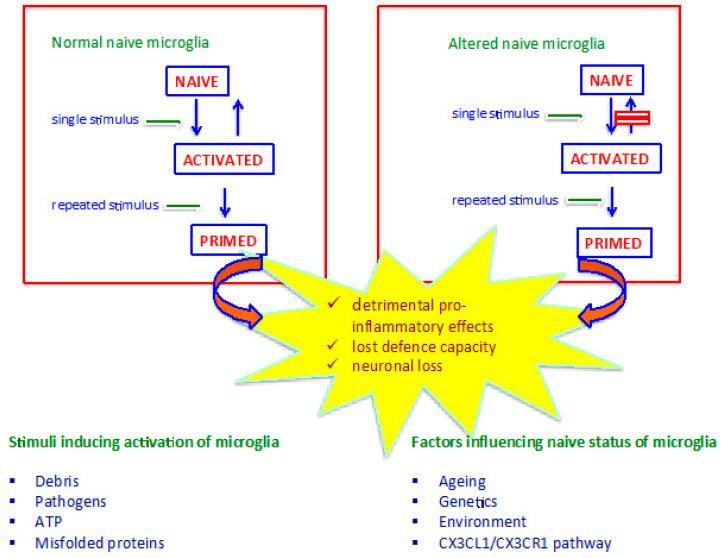
Alzheimer's Disease (AD) is the most common cause of dementia, having a remarkable social and healthcare burden worldwide. Amyloid β (Aβ) and protein Tau aggregates are disease hallmarks and key players in AD pathogenesis. However, it has been hypothesized that microglia can contribute to AD pathophysiology, as well. Microglia are CNS-resident immune cells belonging to the myeloid lineage of the innate arm of immunity. Under physiological conditions, microglia are in constant motion in order to carry on their housekeeping function, and they maintain an anti-inflammatory, quiescent state, with low expression of cytokines and no phagocytic activity. Upon various stimuli (debris, ATP, misfolded proteins, aggregates and pathogens), microglia acquire a phagocytic function and overexpress cytokine gene modules. This process is generally regarded as microglia activation and implies that the production of pro-inflammatory cytokines is counterbalanced by the synthesis and the release of anti-inflammatory molecules. This mechanism avoids excessive inflammatory response and inappropriate microglial activation, which causes tissue damage and brain homeostasis impairment. Once the pathogenic stimulus has been cleared, activated microglia return to the naïve, anti-inflammatory state. Upon repeated stimuli (as in the case of Aβ deposition in the early stage of AD), activated microglia shift toward a less protective, neurotoxic phenotype, known as "primed" microglia. The main characteristic of primed microglia is their lower capability to turn back toward the naïve, anti-inflammatory state, which makes these cells prone to chronic activation and favours chronic inflammation in the brain. Primed microglia have impaired defence capacity against injury and detrimental effects on the brain microenvironment. Additionally, priming has been associated with AD onset and progression and can represent a promising target for AD treatment strategies. Many factors (genetics, environmental factors, baseline inflammatory status of microglia, ageing) generate an aberrantly activated phenotype that undergoes priming easier and earlier than normally activated microglia do. Novel, promising targets for therapeutic strategies for AD have been sought in the field of microglia activation and, importantly, among those factors influencing the baseline status of these cells. The CX3CL1 pathway could be a valuable target treatment approach in AD, although preliminary findings from the studies in this field are controversial. The current review aims to summarize state of the art on the role of microglia dysfunction in AD pathogenesis and proposes biochemical pathways with possible targets for AD treatment.
阿尔茨海默病(AD)是痴呆症最常见的病因,在全球范围内给社会和医疗保健带来了巨大的负担。β淀粉样蛋白(Aβ)和蛋白质 Tau 聚集体是疾病的标志,也是 AD 发病机制中的关键因素。然而,有人假设小胶质细胞也可能有助于 AD 的病理生理学。小胶质细胞是中枢神经系统(CNS)内的免疫细胞,属于先天免疫系统的髓系。在生理条件下,小胶质细胞为了完成其管家功能而不断运动,它们保持抗炎、静止状态,细胞因子表达水平低,没有吞噬活性。在各种刺激(碎片、ATP、错误折叠的蛋白质、聚集体和病原体)下,小胶质细胞获得吞噬功能并过度表达细胞因子基因模块。这个过程通常被认为是小胶质细胞的激活,意味着促炎细胞因子的产生被抗炎分子的合成和释放所平衡。这种机制避免了过度的炎症反应和不适当的小胶质细胞激活,从而导致组织损伤和大脑内环境的损害。一旦致病刺激被清除,激活的小胶质细胞就会回到原始的抗炎状态。在反复的刺激下(如 AD 早期的 Aβ沉积),激活的小胶质细胞向保护作用较低、神经毒性表型转变,这种表型被称为“预激活”小胶质细胞。预激活小胶质细胞的主要特征是它们恢复到原始的抗炎状态的能力降低,这使得这些细胞容易发生慢性激活,并有利于大脑中的慢性炎症。预激活小胶质细胞对损伤的防御能力受损,对大脑微环境有不利影响。此外,预激活与 AD 的发病和进展有关,可能成为 AD 治疗策略的一个有前途的靶点。许多因素(遗传、环境因素、小胶质细胞的基线炎症状态、衰老)产生异常激活的表型,这种表型比正常激活的小胶质细胞更容易和更早地经历预激活。在小胶质细胞激活领域,以及在影响这些细胞基线状态的因素中,人们一直在寻找 AD 治疗策略的新的、有前途的靶点。CX3CL1 途径可能是 AD 治疗的一个有价值的靶点,但该领域研究的初步结果存在争议。本综述旨在总结小胶质细胞功能障碍在 AD 发病机制中的作用,并提出 AD 治疗的可能靶点的生化途径。
 Zotero 插件