
血脂和降脂药物与血管性痴呆风险的关联:一项孟德尔随机研究。
Associations of Lipids and Lipid-Lowering Drugs with Risk of Vascular Dementia: A Mendelian Randomization Study.
机构信息
Department of Anesthesiology, Sanbo Brain Hospital, Capital Medical University, Beijing 100093, China.
Geriatric Department, Emergency General Hospital, Beijing 100028, China.
出版信息
Nutrients. 2022 Dec 23;15(1):69. doi: 10.3390/nu15010069.
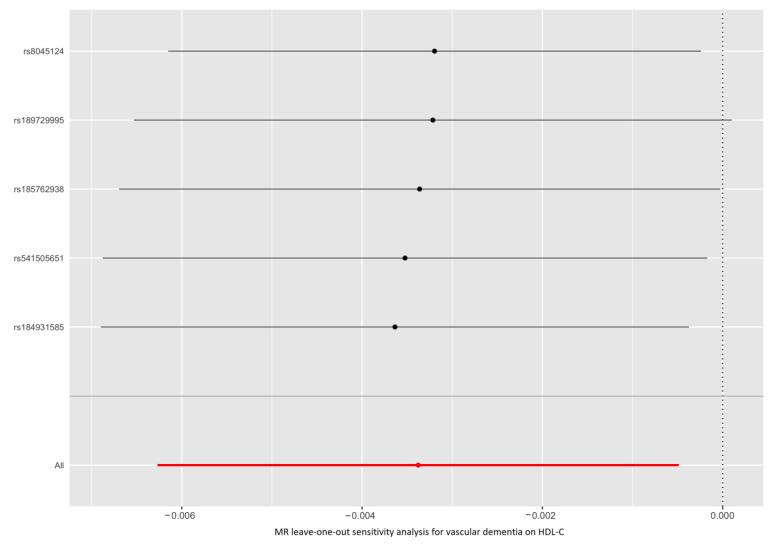
Accumulating observational studies suggested that hypercholesterolemia is associated with vascular dementia (VaD); however, the causality between them remains unclear. Hence, the aim of this study is to infer causal associations of circulating lipid-related traits [including high-density lipoprotein cholesterol (HDL-C), low-density lipoprotein cholesterol (LDL-C), triglyceride (TG), apolipoprotein A-I (apoA-I), and apolipoprotein B (apoB)] with VaD jointly using univariable MR (uvMR), multivariable MR (mvMR) and bidirectional two-sample MR methods. Then, the summary-data-based MR (SMR) and two-sample MR analysis were conducted to investigate the association of lipid-lowering drugs target genes expression (including HMGCR, PCSK9, NPC1L1, and APOB) and LDL-C level mediated by these target genes with VaD. The results of forward MR analyses found that genetically predicted HDL-C, LDL-C, TG, apoA-I, and apoB concentrations were not significantly associated with the risk of VaD (all p > 0.05). Notably, there was suggestive evidence for a causal effect of genetically predicted VaD on HDL-C via reverse MR analysis [odds ratio (OR), 0.997; 95% confidence interval (CI), 0.994−0.999; p = 0.022]. On the contrary, the MR results showed no significant relationship between VaD with LDL-C, TG, apoA-I, and apoB. The results for the SMR method found that there was no evidence of association for expression of HMGCR, PCSK9, NPC1L1, and APOB gene with risk of VaD. Furthermore, the result of MR analysis provided evidence for the decreased LDL-C level mediated by gene HMGCR reduced the risk of VaD (OR, 18.381; 95% CI, 2.092−161.474; p = 0.009). Oppositely, none of the IVW methods indicated any causal effects for the other three genes. Using genetic data, this study provides evidence that the VaD risk may cause a reduction of HDL-C level. Additionally, the finding supports the hypothesis that lowering LDL-C levels using statins may be an effective prevention strategy for VaD risk, which requires clinical trials to confirm this result in the future.
越来越多的观察性研究表明,高胆固醇血症与血管性痴呆(VaD)有关;然而,它们之间的因果关系仍不清楚。因此,本研究旨在使用单变量 MR(uvMR)、多变量 MR(mvMR)和双向两样本 MR 方法联合推断循环脂质相关特征[包括高密度脂蛋白胆固醇(HDL-C)、低密度脂蛋白胆固醇(LDL-C)、甘油三酯(TG)、载脂蛋白 A-I(apoA-I)和载脂蛋白 B(apoB)]与 VaD 之间的因果关系。然后,进行汇总数据的基于 MR(SMR)和两样本 MR 分析,以研究降脂药物靶点基因表达(包括 HMGCR、PCSK9、NPC1L1 和 APOB)与这些靶点基因介导的 LDL-C 水平与 VaD 之间的关联。正向 MR 分析的结果发现,遗传预测的 HDL-C、LDL-C、TG、apoA-I 和 apoB 浓度与 VaD 风险无显著相关性(均 p>0.05)。值得注意的是,通过反向 MR 分析发现,遗传预测的 VaD 对 HDL-C 具有因果效应的证据提示性,[比值比(OR),0.997;95%置信区间(CI),0.994-0.999;p=0.022]。相反,MR 结果表明 VaD 与 LDL-C、TG、apoA-I 和 apoB 之间没有显著关系。SMR 方法的结果表明,HMGCR、PCSK9、NPC1L1 和 APOB 基因的表达与 VaD 的风险没有关联。此外,MR 分析的结果为基因 HMGCR 介导的 LDL-C 水平降低降低 VaD 风险提供了证据(OR,18.381;95%CI,2.092-161.474;p=0.009)。相反,IVW 方法中的任何一种都没有表明其他三个基因有任何因果作用。本研究使用遗传数据提供了证据表明,VaD 风险可能导致 HDL-C 水平降低。此外,这一发现支持了使用他汀类药物降低 LDL-C 水平可能是降低 VaD 风险的有效预防策略的假设,这需要临床试验在未来证实这一结果。


 Zotero 插件