
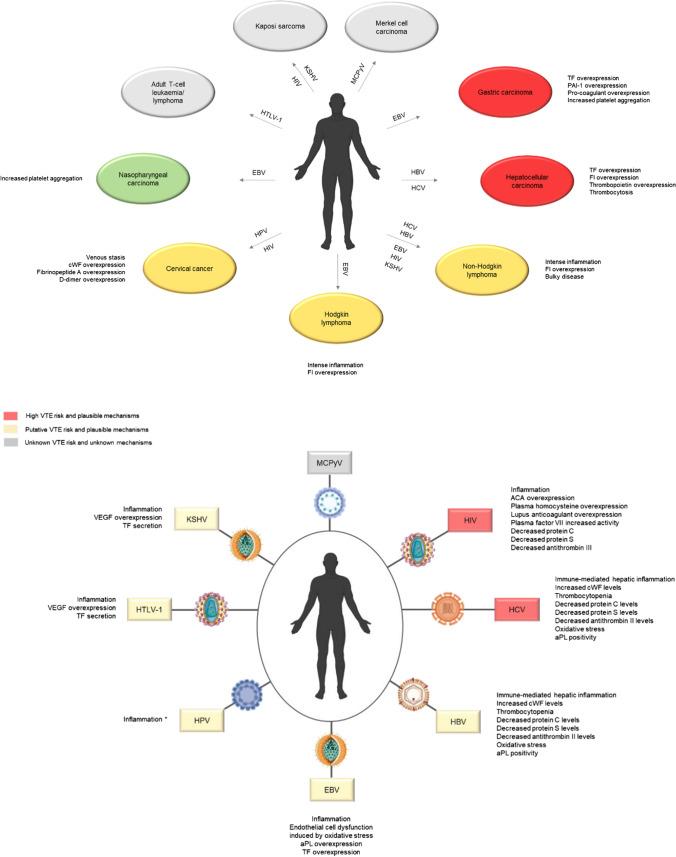
病毒感染和病毒驱动肿瘤中的血栓形成图谱。
Map of thrombogenesis in viral infections and viral-driven tumours.
作者信息
Neto Beatriz Vieira, Tavares Valéria, Santos Joana M O, Cerqueira Fátima, Pereira Deolinda, Medeiros Rui
机构信息
Molecular Oncology and Viral Pathology Group, Research Center of IPO Porto (CI-IPOP)/ Pathology and Laboratory Medicine Dep., Clinical Pathology SV/ RISE@CI-IPOP (Health Research Network), Portuguese Oncology Institute of Porto (IPO Porto)/Porto Comprehensive Cancer Center (Porto.CCC), 4200-072, Porto, Portugal.
FMUP, Faculty of Medicine, University of Porto, 4200-072, Porto, Portugal.
出版信息
Discov Oncol. 2023 Jan 8;14(1):3. doi: 10.1007/s12672-022-00610-1.
Viruses are pathogenic agents responsible for approximately 10% of all human cancers and significantly contribute to the global cancer burden. Until now, eight viruses have been associated with the development of a broad range of malignancies, including solid and haematological tumours. Besides triggering and promoting oncogenesis, viral infections often go hand-in-hand with haemostatic changes, representing a potential risk factor for venous thromboembolism (VTE). Conversely, VTE is a cardiovascular condition that is particularly common among oncological patients, with a detrimental impact on patient prognosis. Despite an association between viral infections and coagulopathies, it is unclear whether viral-driven tumours have a different incidence and prognosis pattern of thromboembolism compared to non-viral-induced tumours. Thus, this review aims to analyse the existing evidence concerning the association of viruses and viral tumours with the occurrence of VTE. Except for hepatitis C virus (HCV) and human immunodeficiency virus (HIV) infection, which are associated with a high risk of VTE, little evidence exists concerning the thrombogenic potential associated with oncoviruses. As for tumours that can be induced by oncoviruses, four levels of VTE risk are observed, with hepatocellular carcinoma (HCC) and gastric carcinoma (GC) associated with the highest risk and nasopharyngeal carcinoma (NPC) associated with the lowest risk. Unfortunately, the incidence of cancer-related VTE according to tumour aetiology is unknown. Given the negative impact of VTE in oncological patients, research is required to better understand the mechanisms underlying blood hypercoagulability in viral-driven tumours to improve VTE management and prognosis assessment in patients diagnosed with these tumours.
病毒是致病因子,约占所有人类癌症的10%,并显著增加了全球癌症负担。到目前为止,已有八种病毒与多种恶性肿瘤的发生有关,包括实体瘤和血液系统肿瘤。除了引发和促进肿瘤发生外,病毒感染还常常与止血变化同时出现,这是静脉血栓栓塞(VTE)的一个潜在危险因素。相反,VTE是一种心血管疾病,在肿瘤患者中尤为常见,对患者预后有不利影响。尽管病毒感染与凝血病之间存在关联,但尚不清楚病毒驱动的肿瘤与非病毒诱导的肿瘤相比,血栓栓塞的发生率和预后模式是否不同。因此,本综述旨在分析有关病毒和病毒肿瘤与VTE发生之间关联的现有证据。除丙型肝炎病毒(HCV)和人类免疫缺陷病毒(HIV)感染与VTE高风险相关外,关于致癌病毒的血栓形成潜力的证据很少。至于可由致癌病毒诱导的肿瘤,观察到四个VTE风险级别,其中肝细胞癌(HCC)和胃癌(GC)风险最高,鼻咽癌(NPC)风险最低。不幸的是,按肿瘤病因分类的癌症相关VTE的发病率尚不清楚。鉴于VTE对肿瘤患者的负面影响,需要开展研究以更好地了解病毒驱动肿瘤中血液高凝性的潜在机制,从而改善对诊断为这些肿瘤的患者的VTE管理和预后评估。
 Zotero 插件