
母亲的童年不良经历、其精神病理学与养育方式以及子女行为问题之间的联系——一种中介模型。
Links between mothers' ACEs, their psychopathology and parenting, and their children's behavior problems-A mediation model.
作者信息
Hanetz-Gamliel Keren, Dollberg Daphna G
机构信息
School of Behavioral Sciences, The Academic College of Tel Aviv-Yaffo, Tel Aviv-Yafo, Israel.
出版信息
Front Psychiatry. 2022 Dec 22;13:1064915. doi: 10.3389/fpsyt.2022.1064915. eCollection 2022.
INTRODUCTION
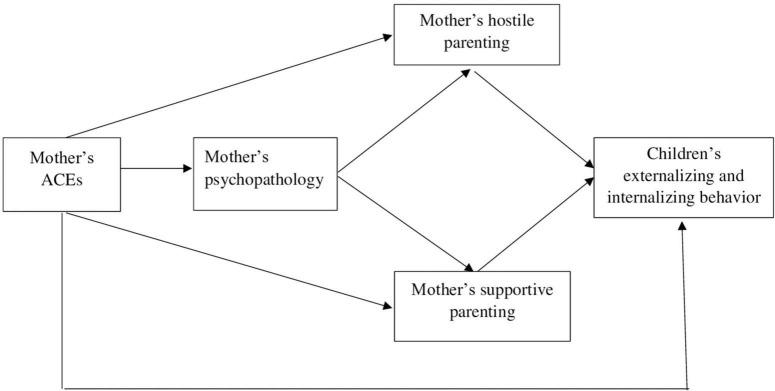
Children of mothers with a history of adverse childhoods are at greater risk of behavior problems. However, the mechanisms through which a mother's early adverse experiences (ACEs) are transmitted to her children need further study. Our goal was to examine a conceptual mediational model linking mothers' ACEs, maternal psychopathology symptoms, and parenting behaviors with children's internalizing and externalizing behaviors sequentially.
METHODS
A sample of 153 Israeli mothers of children ages 3-12 (52% girls) participated in the study, and most of the mothers (94.7%) were cohabiting with a spouse. Mothers completed online questionnaires about their early adverse experiences, psychopathology symptoms, parenting behavior, and their children's internalizing and externalizing behavior.
RESULTS
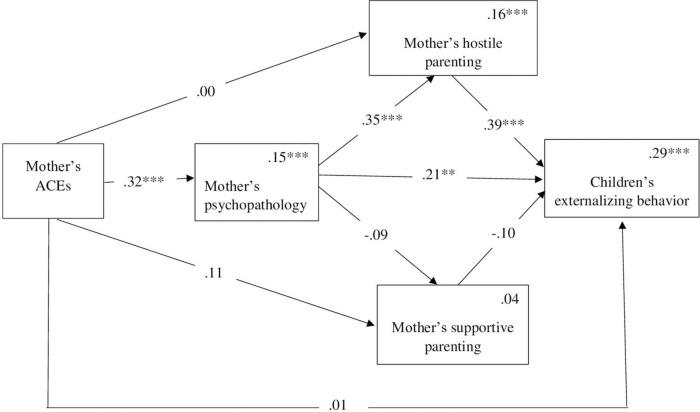
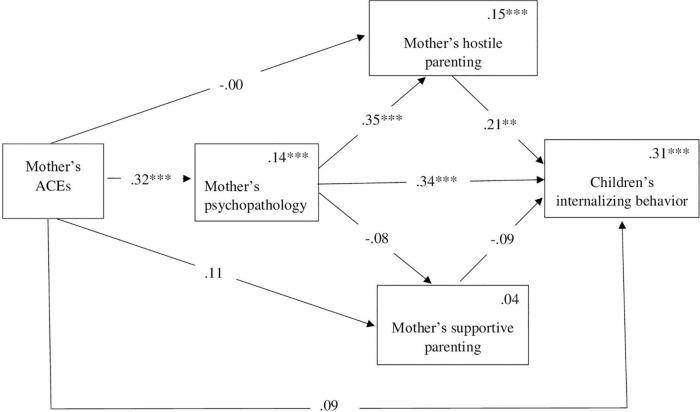
Results showed that mothers with higher ACE scores reported more maternal psychopathology symptoms and more internalizing behavior in their children. The mother's psychopathology in and of itself mediated the link between her ACEs and her child's internalizing and externalizing behavior. Moreover, an indirect sequential path emerged linking ACEs with the mother's psychopathology symptoms, which, in return, were linked with hostile parenting. Hostile parenting, in turn, was linked with children's internalizing and externalizing behavior.
DISCUSSION
These findings highlight the complicated and intertwined ways in which adverse experiences early in the mother's life might put her child's wellbeing at risk. The findings suggest that ACEs are linked to maternal affect dysregulation, which interferes with parenting, increasing the risk of behavior problems in children. The findings underscore the need to assess mothers' adverse history, psychological distress, and parenting behavior, and provide treatments that can reduce the intergenerational transmission of early adverse experiences.
引言
有童年不良经历史的母亲所生子女出现行为问题的风险更高。然而,母亲早期不良经历(童年不良经历)传递给子女的机制尚需进一步研究。我们的目标是依次检验一个概念性中介模型,该模型将母亲的童年不良经历、母亲的精神病理学症状、养育行为与孩子的内化和外化行为联系起来。
方法
153名以色列母亲参与了这项研究,她们的孩子年龄在3至12岁之间(52%为女孩),大多数母亲(94.7%)与配偶同居。母亲们通过在线问卷报告了她们早期的不良经历、精神病理学症状、养育行为以及孩子的内化和外化行为。
结果
结果显示,童年不良经历得分较高的母亲报告有更多的母亲精神病理学症状,其孩子也有更多的内化行为。母亲自身的精神病理学症状在其童年不良经历与孩子的内化和外化行为之间起中介作用。此外,出现了一条间接的顺序路径,将童年不良经历与母亲的精神病理学症状联系起来,而母亲的精神病理学症状又与敌意养育相关。敌意养育进而与孩子的内化和外化行为相关。
讨论
这些发现凸显了母亲生命早期的不良经历可能使孩子的幸福面临风险的复杂且相互交织的方式。研究结果表明,童年不良经历与母亲的情绪调节障碍有关,这会干扰养育行为,增加孩子出现行为问题的风险。这些发现强调了评估母亲的不良历史、心理困扰和养育行为的必要性,并提供能够减少早期不良经历代际传递的治疗方法。
 Zotero 插件