
RanBP9 控制 CTLH 复合物组装的寡聚状态。
RanBP9 controls the oligomeric state of CTLH complex assemblies.
机构信息
Julius-Maximilians-Universität Würzburg, Rudolf Virchow Center for Integrative and Translational Bioimaging, Institute of Structural Biology, Würzburg, Germany.
Julius-Maximilians-Universität Würzburg, Rudolf Virchow Center for Integrative and Translational Bioimaging, Institute of Structural Biology, Würzburg, Germany.
出版信息
J Biol Chem. 2023 Feb;299(2):102869. doi: 10.1016/j.jbc.2023.102869. Epub 2023 Jan 5.
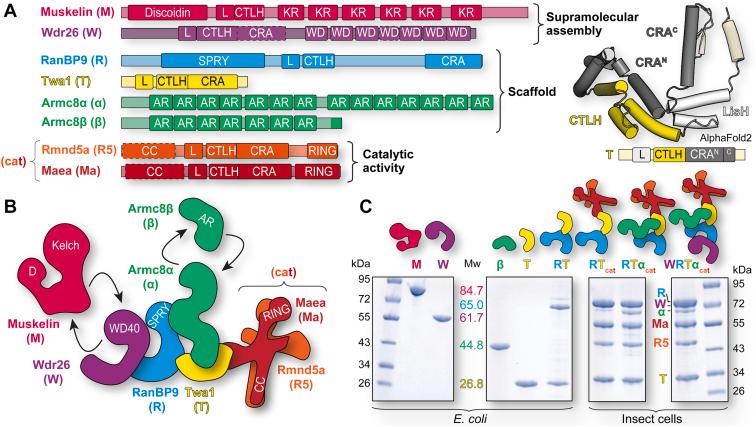
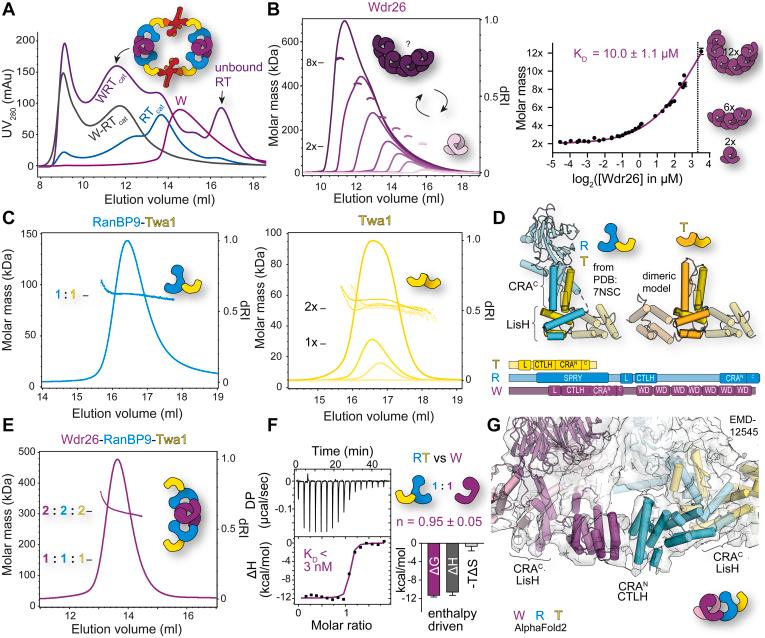
The CTLH (C-terminal to lissencephaly-1 homology motif) complex is a multisubunit RING E3 ligase with poorly defined substrate specificity and flexible subunit composition. Two key subunits, muskelin and Wdr26, specify two alternative CTLH complexes that differ in quaternary structure, thereby allowing the E3 ligase to presumably target different substrates. With the aid of different biophysical and biochemical techniques, we characterized CTLH complex assembly pathways, focusing not only on Wdr26 and muskelin but also on RanBP9, Twa1, and Armc8β subunits, which are critical to establish the scaffold of this E3 ligase. We demonstrate that the ability of muskelin to tetramerize and the assembly of Wdr26 into dimers define mutually exclusive oligomerization modules that compete with nanomolar affinity for RanBP9 binding. The remaining scaffolding subunits, Armc8β and Twa1, strongly interact with each other and with RanBP9, again with nanomolar affinity. Our data demonstrate that RanBP9 organizes subunit assembly and prevents higher order oligomerization of dimeric Wdr26 and the Armc8β-Twa1 heterodimer through its tight binding. Combined, our studies define alternative assembly pathways of the CTLH complex and elucidate the role of RanBP9 in governing differential oligomeric assemblies, thereby advancing our mechanistic understanding of CTLH complex architectures.
CTLH(C 端至无脑回-1 同源基序)复合物是一种多亚基 RING E3 连接酶,其底物特异性定义不明确,亚基组成具有较大的灵活性。两个关键亚基,muskelin 和 Wdr26,指定了两种不同的 CTLH 复合物,它们在四级结构上存在差异,从而使 E3 连接酶能够靶向不同的底物。借助不同的生物物理和生化技术,我们研究了 CTLH 复合物的组装途径,不仅关注 Wdr26 和 muskelin,还关注对建立该 E3 连接酶支架至关重要的 RanBP9、Twa1 和 Armc8β 亚基。我们证明了 muskelin 形成四聚体的能力以及 Wdr26 形成二聚体的能力定义了相互排斥的寡聚化模块,它们以纳摩尔亲和力竞争与 RanBP9 的结合。其余的支架亚基 Armc8β 和 Twa1 彼此之间以及与 RanBP9 之间强烈相互作用,亲和力也在纳摩尔范围内。我们的数据表明,RanBP9 通过其紧密结合组织亚基组装并防止二聚体 Wdr26 和 Armc8β-Twa1 异源二聚体的更高阶寡聚化。总之,我们的研究定义了 CTLH 复合物的替代组装途径,并阐明了 RanBP9 在控制不同寡聚组装中的作用,从而提高了我们对 CTLH 复合物结构的机制理解。



 Zotero 插件