
氧化应激触发的 Wnt 信号转导扰动特征是肺腺-鳞转化的转折点。
Oxidative stress-triggered Wnt signaling perturbation characterizes the tipping point of lung adeno-to-squamous transdifferentiation.
机构信息
State Key Laboratory of Cell Biology, Shanghai Institute of Biochemistry and Cell Biology, CAS Center for Excellence in Molecular Cell Science, Chinese Academy of Sciences, Shanghai, 200031, China.
University of Chinese Academy of Sciences, Beijing, 100049, China.
出版信息
Signal Transduct Target Ther. 2023 Jan 11;8(1):16. doi: 10.1038/s41392-022-01227-0.
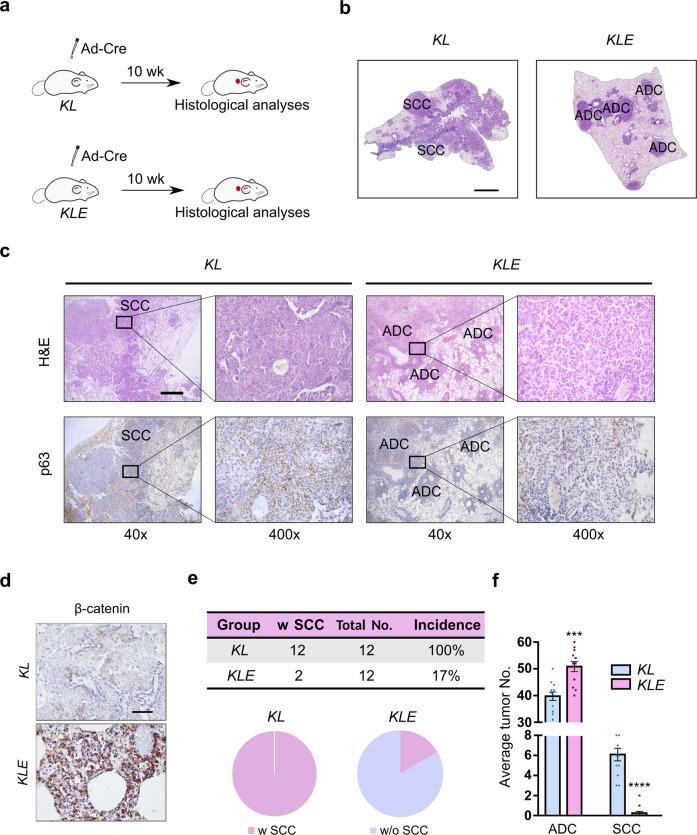
Lkb1 deficiency confers the Kras-mutant lung cancer with strong plasticity and the potential for adeno-to-squamous transdifferentiation (AST). However, it remains largely unknown how Lkb1 deficiency dynamically regulates AST. Using the classical AST mouse model (Kras ;Lkb1, KL), we here comprehensively analyze the temporal transcriptomic dynamics of lung tumors at different stages by dynamic network biomarker (DNB) and identify the tipping point at which the Wnt signaling is abruptly suppressed by the excessive accumulation of reactive oxygen species (ROS) through its downstream effector FOXO3A. Bidirectional genetic perturbation of the Wnt pathway using two different Ctnnb1 conditional knockout mouse strains confirms its essential role in the negative regulation of AST. Importantly, pharmacological activation of the Wnt pathway before but not after the tipping point inhibits squamous transdifferentiation, highlighting the irreversibility of AST after crossing the tipping point. Through comparative transcriptomic analyses of mouse and human tumors, we find that the lineage-specific transcription factors (TFs) of adenocarcinoma and squamous cell carcinoma form a "Yin-Yang" counteracting network. Interestingly, inactivation of the Wnt pathway preferentially suppresses the adenomatous lineage TF network and thus disrupts the "Yin-Yang" homeostasis to lean towards the squamous lineage, whereas ectopic expression of NKX2-1, an adenomatous lineage TF, significantly dampens such phenotypic transition accelerated by the Wnt pathway inactivation. The negative correlation between the Wnt pathway and AST is further observed in a large cohort of human lung adenosquamous carcinoma. Collectively, our study identifies the tipping point of AST and highlights an essential role of the ROS-Wnt axis in dynamically orchestrating the homeostasis between adeno- and squamous-specific TF networks at the AST tipping point.
Lkb1 缺失赋予 Kras 突变型肺癌强大的可塑性和腺-鳞转化(AST)潜能。然而,Lkb1 缺失如何动态调节 AST 仍知之甚少。我们使用经典的 AST 小鼠模型(Kras ;Lkb1, KL),通过动态网络生物标志物(DNB)全面分析了不同阶段肺肿瘤的时间转录组动力学,并确定了 ROS 过度积累通过其下游效应因子 FOXO3A 突然抑制 Wnt 信号的转折点。使用两种不同的 Ctnnb1 条件敲除小鼠品系对 Wnt 通路进行双向遗传干扰,证实了其在负调控 AST 中的关键作用。重要的是,在转折点之前而不是之后,通过药理学激活 Wnt 通路抑制了鳞状转化,突出了 AST 在越过转折点后不可逆转。通过对小鼠和人类肿瘤的比较转录组分析,我们发现腺癌和鳞状细胞癌的谱系特异性转录因子(TFs)形成了一个“阴阳”相互拮抗的网络。有趣的是,Wnt 通路失活优先抑制腺瘤谱系 TF 网络,从而破坏“阴阳”平衡,偏向鳞状谱系,而 NKX2-1(一种腺瘤谱系 TF)的异位表达显著抑制了 Wnt 通路失活加速的这种表型转化。在人类肺腺鳞癌的大样本队列中进一步观察到 Wnt 通路与 AST 之间的负相关。总之,我们的研究确定了 AST 的转折点,并强调了 ROS-Wnt 轴在动态协调 AST 转折点处腺和鳞状特异性 TF 网络之间的平衡中的重要作用。



 Zotero 插件