
德国社会经济剥夺指数(GISD):修订、更新及应用
German Index of Socioeconomic Deprivation (GISD): Revision, update and applications.
作者信息
Michalski Niels, Reis Marvin, Tetzlaff Fabian, Herber Meik, Kroll Lars Eric, Hövener Claudia, Nowossadeck Enno, Hoebel Jens
机构信息
Robert Koch Institute, Berlin Department of Epidemiology and Health Monitoring.
Zentralinstitut für die kassenärztliche Versorgung in Deutschland, Fachbereich Data Science und Versorgungsanalysen.
出版信息
J Health Monit. 2022 Dec 9;7(Suppl 5):2-23. doi: 10.25646/10641. eCollection 2022 Dec.
BACKGROUND
Regional deprivation indices enable researchers to analyse associations between socioeconomic disadvantages and health outcomes even if the health data of interest does not include information on the individuals' socioeconomic position. This article introduces the recent revision of the German Index of Socioeconomic Deprivation (GISD) and presents associations with life expectancy as well as age-standardised cardiovascular mortality rates and cancer incidences as applications.
METHODS
The GISD measures the level of socioeconomic deprivation using administrative data of education, employment, and income situations at the district and municipality level from the INKAR database. The indicators are weighted via principal component analyses. The regional distribution is depicted cartographically, regional level associations with health outcomes are presented.
RESULTS
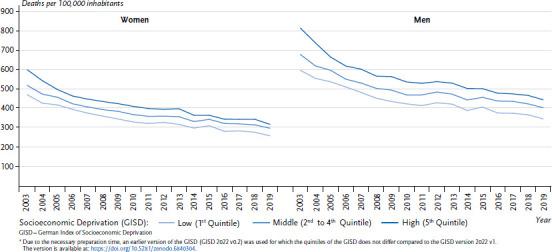
The principal component analysis indicates medium to high correlations of the indicators with the index subdimensions. Correlation analyses show that in districts with the lowest deprivation, the average life expectancy of men is approximately six years longer (up to three years longer for women) than for those from districts with the highest deprivation. A similar social gradient is observed for cardiovascular mortality and lung cancer incidence.
CONCLUSIONS
The GISD provides a valuable tool to analyse socioeconomic inequalities in health conditions, diseases, and their determinants at the regional level.
背景
区域剥夺指数使研究人员能够分析社会经济劣势与健康结果之间的关联,即便所关注的健康数据不包含个体社会经济地位的信息。本文介绍了德国社会经济剥夺指数(GISD)的最新修订版,并展示了其与预期寿命、年龄标准化心血管死亡率以及癌症发病率之间的关联,作为应用实例。
方法
GISD利用INKAR数据库中地区和市镇层面的教育、就业及收入状况行政数据来衡量社会经济剥夺水平。这些指标通过主成分分析进行加权。以地图形式描绘区域分布,并展示区域层面与健康结果的关联。
结果
主成分分析表明各指标与指数子维度之间存在中度到高度的相关性。相关性分析显示,在剥夺程度最低的地区,男性的平均预期寿命比剥夺程度最高地区的男性长约6年(女性长约3年)。心血管死亡率和肺癌发病率也呈现出类似的社会梯度。
结论
GISD为在区域层面分析健康状况、疾病及其决定因素方面的社会经济不平等提供了一个有价值的工具。


 Zotero 插件