
人工智能提升心血管医疗保健全领域的临床价值。
Artificial intelligence to enhance clinical value across the spectrum of cardiovascular healthcare.
机构信息
Institute of Cardiovascular Sciences, University of Birmingham, Vincent Drive, B15 2TT Birmingham, UK.
Health Data Research UK Midlands, University Hospitals Birmingham NHS Foundation Trust, Birmingham, UK.
出版信息
Eur Heart J. 2023 Mar 1;44(9):713-725. doi: 10.1093/eurheartj/ehac758.
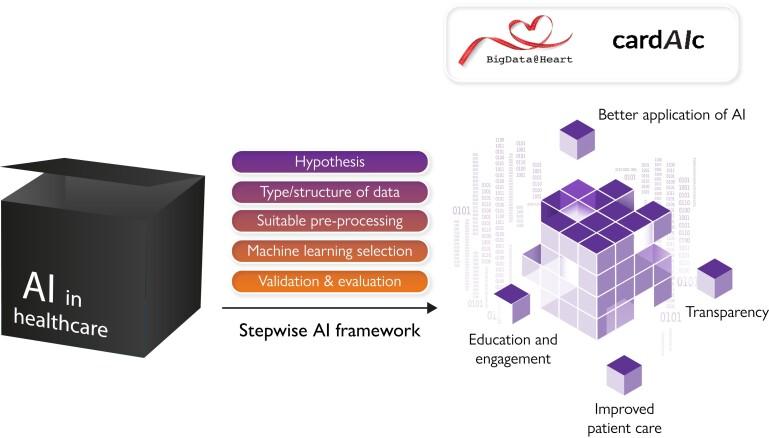
Artificial intelligence (AI) is increasingly being utilized in healthcare. This article provides clinicians and researchers with a step-wise foundation for high-value AI that can be applied to a variety of different data modalities. The aim is to improve the transparency and application of AI methods, with the potential to benefit patients in routine cardiovascular care. Following a clear research hypothesis, an AI-based workflow begins with data selection and pre-processing prior to analysis, with the type of data (structured, semi-structured, or unstructured) determining what type of pre-processing steps and machine-learning algorithms are required. Algorithmic and data validation should be performed to ensure the robustness of the chosen methodology, followed by an objective evaluation of performance. Seven case studies are provided to highlight the wide variety of data modalities and clinical questions that can benefit from modern AI techniques, with a focus on applying them to cardiovascular disease management. Despite the growing use of AI, further education for healthcare workers, researchers, and the public are needed to aid understanding of how AI works and to close the existing gap in knowledge. In addition, issues regarding data access, sharing, and security must be addressed to ensure full engagement by patients and the public. The application of AI within healthcare provides an opportunity for clinicians to deliver a more personalized approach to medical care by accounting for confounders, interactions, and the rising prevalence of multi-morbidity.
人工智能(AI)在医疗保健领域的应用日益广泛。本文为临床医生和研究人员提供了一个逐步的基础,以实现高价值的 AI,可以应用于各种不同的数据模态。其目的是提高 AI 方法的透明度和适用性,有可能使常规心血管护理中的患者受益。在明确的研究假设之后,基于 AI 的工作流程从数据分析前的数据选择和预处理开始,数据类型(结构化、半结构化或非结构化)决定了需要进行哪种类型的预处理步骤和机器学习算法。应进行算法和数据验证,以确保所选择方法的稳健性,然后对性能进行客观评估。提供了七个案例研究,突出了现代 AI 技术可以受益的广泛的数据模态和临床问题,重点是将其应用于心血管疾病管理。尽管 AI 的使用日益增多,但需要对医疗保健工作者、研究人员和公众进行进一步的教育,以帮助他们了解 AI 的工作原理,并缩小现有知识差距。此外,还必须解决数据访问、共享和安全问题,以确保患者和公众的充分参与。AI 在医疗保健中的应用为临床医生提供了一个机会,可以通过考虑混杂因素、相互作用以及多疾病的高发率,为医疗保健提供更个性化的方法。



 Zotero 插件