
遗传字母扩展生成高亲和力 DNA 适体的成功率。
Success probability of high-affinity DNA aptamer generation by genetic alphabet expansion.
机构信息
Xenolis Pte Ltd, 79 Science Park Drive, #06-01/08, Cintech IV, Singapore 118264, Singapore.
Institute of Bioengineering and Bioimaging, Agency for Science, Technology and Research (A*STAR), 31 Biopolis Way, #07-01 Nanos, Singapore 138669, Singapore.
出版信息
Philos Trans R Soc Lond B Biol Sci. 2023 Feb 27;378(1871):20220031. doi: 10.1098/rstb.2022.0031. Epub 2023 Jan 11.
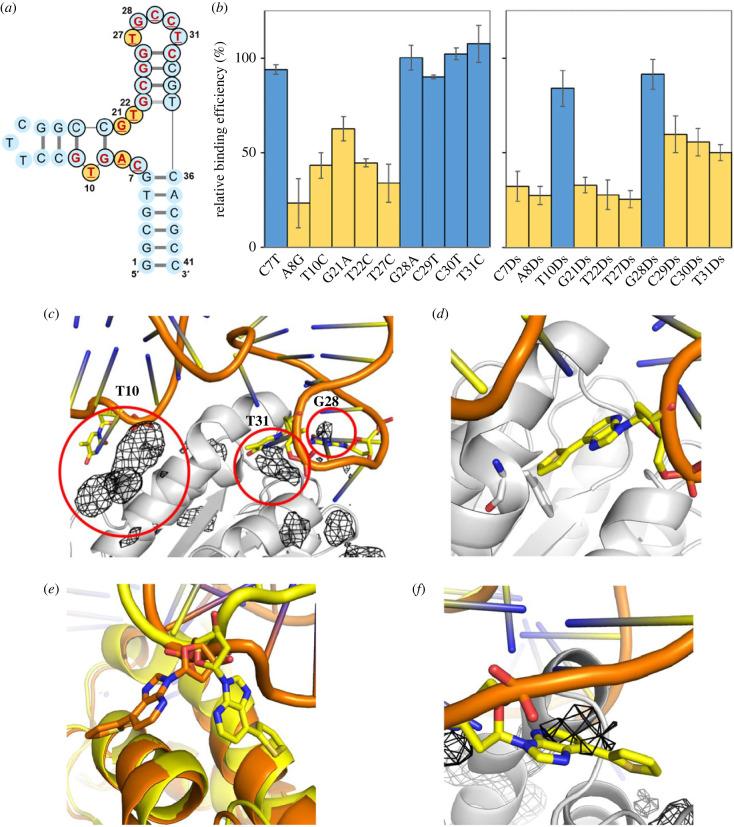
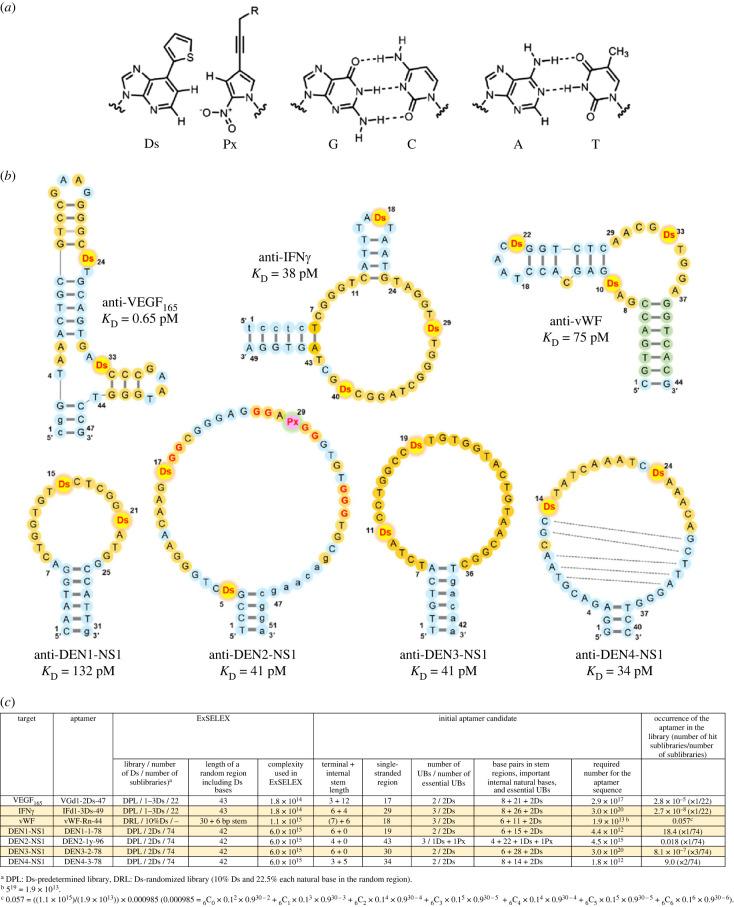
Nucleic acid aptamers as antibody alternatives bind specifically to target molecules. These aptamers are generated by isolating candidates from libraries with random sequence fragments, through an evolutionary engineering system. We recently reported a high-affinity DNA aptamer generation method that introduces unnatural bases (UBs) as a fifth letter into the library, by genetic alphabet expansion. By incorporating hydrophobic UBs, the affinities of DNA aptamers to target proteins are increased over 100-fold, as compared with those of conventional aptamers with only the natural four letters. However, there is still plenty of room for improvement of the methods for routinely generating high-affinity UB-containing DNA (UB-DNA) aptamers. The success probabilities of the high-affinity aptamer generation depend on the existence of the aptamer candidate sequences in the initial library. We estimated the success probabilities by analysing several UB-DNA aptamers that we generated, as examples. In addition, we investigated the possible improvement of conventional aptamer affinities by introducing one UB at specific positions. Our data revealed that UB-DNA aptamers adopt specific tertiary structures, in which many bases including UBs interact with target proteins for high affinity, suggesting the importance of the UB-DNA library design. This article is part of the theme issue 'Reactivity and mechanism in chemical and synthetic biology'.
核酸适体可作为抗体替代品,特异性地与靶分子结合。这些适体是通过从具有随机序列片段的文库中分离候选物,通过进化工程系统产生的。我们最近报道了一种高通量 DNA 适体生成方法,通过遗传字母扩展,将非天然碱基 (UB) 作为第五个字母引入文库。通过引入疏水性 UB,与目标蛋白结合的 DNA 适体的亲和力比仅含有天然四个字母的常规适体提高了 100 多倍。然而,常规生成高亲和力含 UB 的 DNA(UB-DNA)适体的方法仍有很大的改进空间。高亲和力适体生成的成功概率取决于初始文库中适体候选序列的存在。我们通过分析我们生成的几个 UB-DNA 适体作为示例来估计成功概率。此外,我们还研究了在特定位置引入一个 UB 来提高常规适体亲和力的可能性。我们的数据表明,UB-DNA 适体采用特定的三级结构,其中许多包括 UB 的碱基与靶蛋白相互作用以实现高亲和力,这表明 UB-DNA 文库设计的重要性。本文是主题为“化学和合成生物学中的反应性和机制”的一部分。

 Zotero 插件