
尼塞利珠单抗预防早产儿和足月儿呼吸道合胞病毒下呼吸道感染的疗效,以及对伴有先天性心脏病和慢性肺部疾病的婴儿的药代动力学外推:一项随机对照试验的汇总分析。
Efficacy of nirsevimab against respiratory syncytial virus lower respiratory tract infections in preterm and term infants, and pharmacokinetic extrapolation to infants with congenital heart disease and chronic lung disease: a pooled analysis of randomised controlled trials.
机构信息
Children's Hospital Colorado, Aurora, CO, USA.
South African Medical Research Council Vaccines and Infectious Diseases Analytics Research Unit, Faculty of Health Sciences, University of the Witwatersrand, Johannesburg, South Africa.
出版信息
Lancet Child Adolesc Health. 2023 Mar;7(3):180-189. doi: 10.1016/S2352-4642(22)00321-2. Epub 2023 Jan 9.
BACKGROUND
In a phase 2b trial and the phase 3 MELODY trial, nirsevimab, an extended half-life, monoclonal antibody against respiratory syncytial virus (RSV), protected healthy infants born preterm or at full term against medically attended RSV lower respiratory tract infection (LRTI). In the MEDLEY phase 2-3 trial in infants at higher risk for severe RSV infection, nirsevimab showed a similar safety profile to that of palivizumab. The aim of the current analysis was to assess the efficacy of nirsevimab using a weight-banded dosing regimen in infants born between 29 weeks gestational age and full term.
METHODS
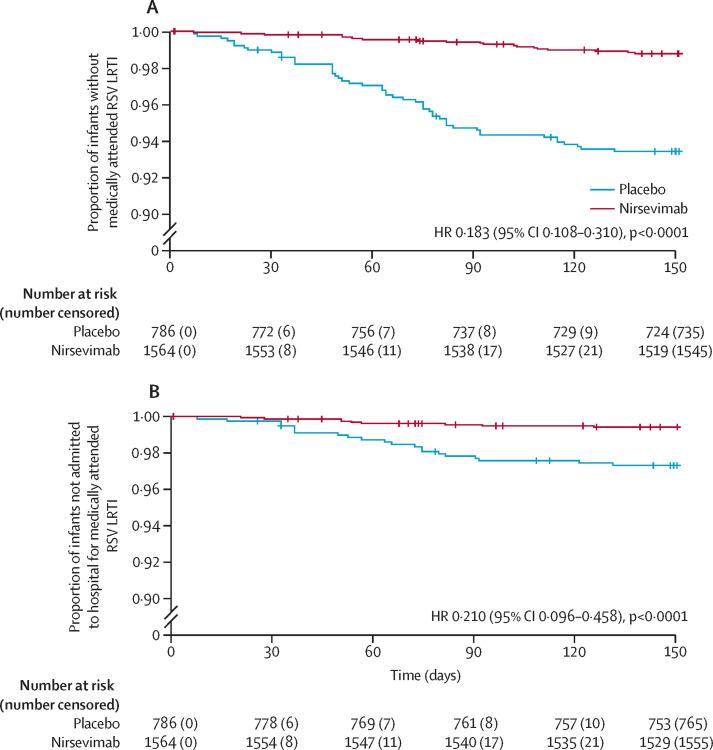
Infants enrolled in the phase 2b and MELODY trials were randomised (2:1) to receive a single intramuscular injection of nirsevimab (infants weighing <5 kg received 50 mg; those weighing ≥5 kg received 100 mg) or placebo before the RSV season. Infants in MEDLEY were randomised (2:1) to receive one dose of nirsevimab (infants weighing <5 kg received 50 mg; those weighing ≥5 kg received 100 mg) followed by four monthly placebo doses, or five once-a-month intramuscular doses of palivizumab. We report a prespecified pooled efficacy analysis assessing the weight-banded dosing regimen proposed on the basis of the phase 2b and MELODY trials, in addition to extrapolated efficacy in infants with chronic lung disease, congenital heart disease, or extreme preterm birth (<29 weeks' gestational age) based on pharmacokinetic data from the phase 2-3 MEDLEY safety trial. For the pooled efficacy analysis, the primary endpoint was incidence of medically attended RSV LRTI through 150 days post-dose. The secondary efficacy endpoint was number of admissions to hospital for medically attended RSV LRTI. The incidence of very severe RSV LRTI was an exploratory endpoint, defined as cases of hospital admission for medically attended RSV LRTI that required supplemental oxygen or intravenous fluids. We also did a prespecified exploratory analysis of medically attended LRTI of any cause (in the investigator's judgement) and hospital admission for respiratory illness of any cause (defined as any upper respiratory tract infection or LRTI leading to hospital admission). Post hoc exploratory analyses of outpatient visits and antibiotic use were also done. Nirsevimab serum concentrations in MEDLEY were assessed using population pharmacokinetic methods and the pooled data from the phase 2b and MELODY trials. An exposure target was defined on the basis of an exposure-response analysis. To successfully demonstrate extrapolation, more than 80% of infants in MEDLEY had to achieve serum nirsevimab exposures at or above the predicted efficacious target.
FINDINGS
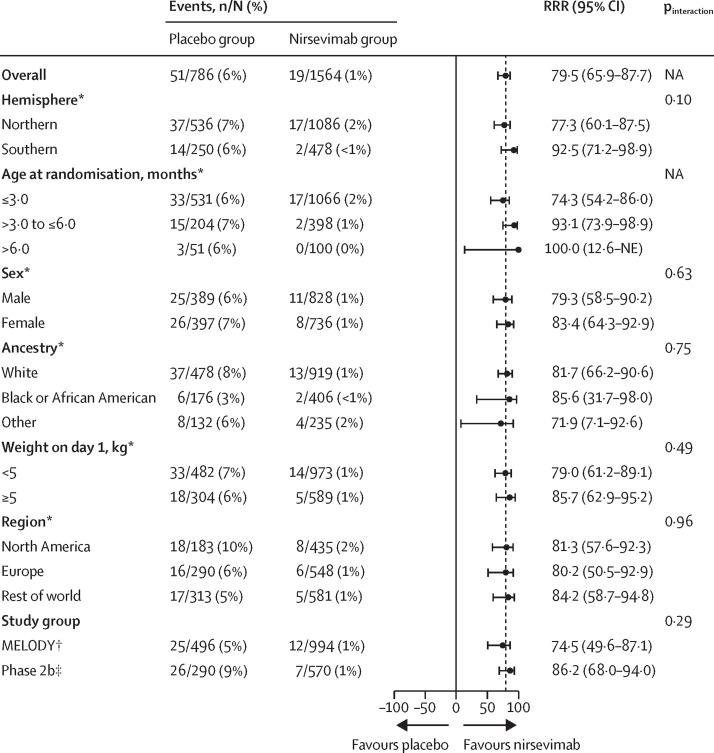
Overall, 2350 infants (1564 in the nirsevimab group and 786 in the placebo group) in the phase 2b and MELODY trials were included in the pooled analysis. Nirsevimab showed efficacy versus placebo with respect to the primary endpoint of medically attended RSV LRTI (19 [1%] nirsevimab recipients vs 51 [6%] placebo recipients; relative risk reduction [RRR] 79·5% [95% CI 65·9-87·7]). Consistent efficacy was shown for additional endpoints of RSV LRTI hospital admission (nine [1%] nirsevimab recipients vs 21 [3%] placebo recipients; 77·3% [50·3-89·7]) and very severe RSV (five [<1%] vs 18 [2%]; 86·0% [62·5-94·8]). Nirsevimab recipients had fewer hospital admissions for any-cause respiratory illness (RRR 43·8% [18·8-61·1]), any-cause medically attended LRTI (35·4% [21·5-46·9]), LRTI outpatient visits (41·9% [25·7-54·6]), and antibiotic prescriptions (23·6% [3·8-39·3]). Among infants with chronic lung disease, congenital heart disease, or extreme preterm birth in MEDLEY, nirsevimab serum exposures were similar to those found in the pooled data; exposures were above the target in more than 80% of the overall MEDLEY trial population (94%), including infants with chronic lung disease (94%) or congenital heart disease (80%) and those born extremely preterm (94%).
INTERPRETATION
A single dose of nirsevimab protected healthy infants born at term or preterm from medically attended RSV LRTI, associated hospital admission, and severe RSV. Pharmacokinetic data support efficacy extrapolation to infants with chronic lung disease, congenital heart disease, or extreme prematurity. Together, these data suggest that nirsevimab has the potential to change the landscape of infant RSV disease by reducing a major cause of infant morbidity and the consequent burden on caregivers, clinicians, and health-care providers.
FUNDING
AstraZeneca and Sanofi.
背景
在一项 2b 期临床试验和 3 期 MELODY 试验中,针对呼吸道合胞病毒(RSV)的延长半衰期单克隆抗体 nirsevimab,对早产或足月出生的健康婴儿具有保护作用,使其免受需要医疗干预的 RSV 下呼吸道感染(LRTI)的影响。在针对 RSV 感染高风险婴儿的 MEDLEY 2-3 期试验中,nirsevimab 显示出与 palivizumab 相似的安全性特征。本分析旨在评估体重带剂量方案在 29 周胎龄至足月出生婴儿中的疗效。
方法
在 2b 期和 MELODY 试验中,入组的婴儿被随机(2:1)接受单剂量肌内注射 nirsevimab(体重<5kg 的婴儿接受 50mg;体重≥5kg 的婴儿接受 100mg)或安慰剂,然后进入 RSV 季节。MEDLEY 中的婴儿被随机(2:1)接受一剂 nirsevimab(体重<5kg 的婴儿接受 50mg;体重≥5kg 的婴儿接受 100mg),然后接受 4 个月的安慰剂剂量,或接受 5 次每月一次的肌内注射 palivizumab。我们报告了一项预先指定的汇总疗效分析,评估了基于 2b 期和 MELODY 试验的体重带剂量方案,此外还根据 MEDLEY 安全性试验的药代动力学数据,对患有慢性肺部疾病、先天性心脏病或极早产儿(<29 周胎龄)的婴儿进行了外推疗效评估。对于汇总疗效分析,主要终点是接受治疗后 150 天内需要医疗干预的 RSV LRTI 的发生率。次要疗效终点是因 RSV LRTI 而住院治疗的人数。非常严重的 RSV LRTI 是一个探索性终点,定义为因 RSV LRTI 而需要补充氧气或静脉输液而住院治疗的病例。我们还对任何原因导致的需要医疗干预的任何原因导致的 LRTI(研究者判断)和任何原因导致的呼吸道疾病住院(定义为任何导致住院的上呼吸道感染或 LRTI)进行了预先指定的探索性分析。还进行了门诊就诊和抗生素使用的事后探索性分析。使用群体药代动力学方法和 2b 期和 MELODY 试验的汇总数据评估了 MEDLEY 中的 nirsevimab 血清浓度。根据暴露反应分析确定了暴露目标。要成功证明外推性,MEDLEY 中超过 80%的婴儿必须达到或高于预测有效的目标血清 nirsevimab 暴露量。
结果
在 2b 期和 MELODY 试验中,共有 2350 名婴儿(nirsevimab 组 1564 名,安慰剂组 786 名)被纳入汇总分析。与安慰剂相比,nirsevimab 显示出对主要终点需要医疗干预的 RSV LRTI 的疗效(nirsevimab 组 19 例[1%],安慰剂组 51 例[6%];相对风险降低[RRR]79.5%[65.9-87.7])。对于 RSV LRTI 住院治疗的其他终点,也显示出一致的疗效(nirsevimab 组 9 例[1%],安慰剂组 21 例[3%];77.3%[50.3-89.7])和非常严重的 RSV(nirsevimab 组 5 例[<1%],安慰剂组 18 例[2%];86.0%[62.5-94.8])。nirsevimab 组因任何原因导致的呼吸疾病住院治疗(RRR 43.8%[18.8-61.1])、任何原因导致的需要医疗干预的 LRTI(RRR 35.4%[21.5-46.9])、LRTI 门诊就诊(RRR 41.9%[25.7-54.6])和抗生素处方(RRR 23.6%[3.8-39.3])的人数均减少。在 MEDLEY 中患有慢性肺部疾病、先天性心脏病或极早产儿的婴儿中,nirsevimab 血清暴露与汇总数据中的发现相似;在总体 MEDLEY 试验人群中(94%),包括患有慢性肺部疾病(94%)或先天性心脏病(80%)和极早产儿(94%)的婴儿,暴露量超过目标值。
解释
单剂量 nirsevimab 可预防足月或早产出生的健康婴儿发生需要医疗干预的 RSV LRTI、相关住院治疗和严重 RSV。药代动力学数据支持对患有慢性肺部疾病、先天性心脏病或极早产儿的婴儿进行疗效外推。这些数据共同表明,nirsevimab 有可能通过减少婴儿 RSV 疾病的主要发病原因,以及由此给照顾者、临床医生和医疗保健提供者带来的相应负担,改变婴儿 RSV 疾病的治疗格局。
资金来源
阿斯利康和赛诺菲。

 Zotero 插件