
波兰家猫、犬和兔弓形虫血清流行率。
Seroprevalence of Toxoplasma gondii in domestic cats, dogs and rabbits from Poland.
机构信息
Department of Preclinical Sciences and Infectious Diseases, Poznan University of Life Sciences, Wolynska 35, 60‑637, Poznan, Poland.
Department of Animal Anatomy, Poznan University of Life Sciences, Wojska Polskiego 71C, 60‑625, Poznan, Poland.
出版信息
Vet Res Commun. 2023 Sep;47(3):1753-1758. doi: 10.1007/s11259-022-10055-0. Epub 2023 Jan 16.
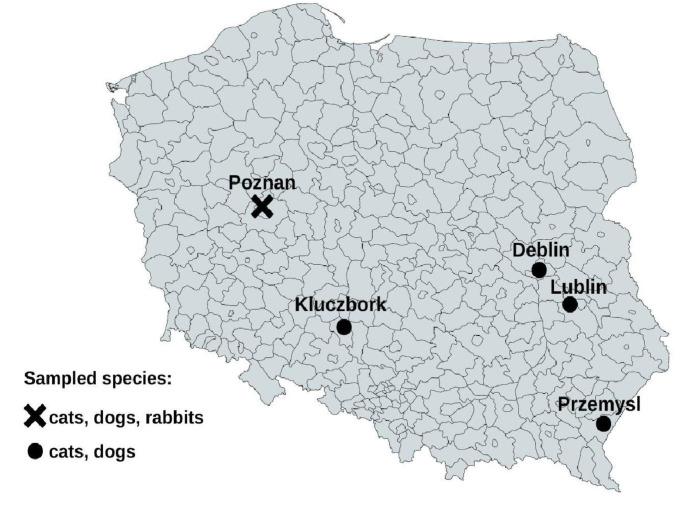
The seroprevalence of Toxoplasma gondii in domestic cats, dogs and rabbits was evaluated. Samples from cats and dogs were collected from five veterinary practices from various parts of Poland - Poznan (wielkopolskie voivodeship), Przemysl (podkarpackie voivodeship), Kluczbork (opolskie voivodeship), Lublin (lubelskie voivodeship) and Deblin (lubelskie voivodeship). Moreover, the samples from rabbits were collected in Poznan. In total, serum samples from 193 cats, 204 dogs and 71 rabbits were randomly selected and tested for specific antibodies against T. gondii using a commercial ELISA test. Pathogen seroprevalence among cats and dogs was calculated at a 95% confidence interval (CI) for each sex and age category (up to 12 months, 1-3 years, 4-7 years and over 8 years) and compared with a chi-squared test. The highest seroprevalence of T. gondii was noted in cats - 49.74% (96/193; 95% CI: 42.76-56.73). In dogs, it reached 28.92% (59/204; 95% CI: 23.13-35.49). Only 1 rabbit (3-year-old male) was seropositive, and the seroprevalence in rabbits was 1.41% (1/71; 95% CI: 0.25-7.56). A statistically significant correlation between seropositivity and age (p < 0.05) was observed in cats and dogs. No statistically significant difference in seroprevalence concerning gender or location was found in cats and dogs. Our findings indicate that cat and dog serum samples had a high frequency of anti-T. gondii antibodies, while rabbit serum samples had low frequency and that these species are exposed to T. gondii in Poland and develop humoral response due to infection.
研究评估了波兰五个兽医诊所的家猫、犬和兔的弓形体血清流行率。来自猫和犬的样本是从波兰各地收集的,包括波兹南(大波兰省)、普热梅希尔(小波兰省)、克洛茨堡(奥波莱省)、卢布林(卢布林省)和德尔宾(卢布林省)。此外,还在波兹南收集了来自兔的样本。总共随机选择了 193 只猫、204 只犬和 71 只兔的血清样本,使用商业 ELISA 检测试剂盒检测针对 T. gondii 的特异性抗体。对每只猫和犬的每个性别和年龄组(0-12 个月、1-3 岁、4-7 岁和 8 岁以上)计算了病原体血清流行率,并与卡方检验进行了比较。猫的 T. gondii 血清流行率最高,为 49.74%(96/193;95%CI:42.76-56.73)。犬的流行率为 28.92%(59/204;95%CI:23.13-35.49)。只有 1 只 3 岁雄性兔呈血清阳性,兔的血清流行率为 1.41%(1/71;95%CI:0.25-7.56)。猫和犬的血清阳性率与年龄呈显著相关(p<0.05)。在猫和犬中,未发现血清流行率与性别或地点有关的统计学差异。我们的研究结果表明,波兰的猫和犬血清样本中抗 T. gondii 抗体的频率较高,而兔血清样本的频率较低,这些物种在波兰暴露于 T. gondii 并因感染而产生体液免疫反应。
 Zotero 插件