
1990 年至 2019 年中国新生儿疾病的疾病负担和归因风险因素及其特定病因,以及到 2024 年的预测。
Disease burden and attributable risk factors of neonatal disorders and their specific causes in China from 1990 to 2019 and its prediction to 2024.
机构信息
Department of Epidemiology and Health Statistics, Xiangya School of Public Health, Central South University, Changsha, China.
Hunan Provincial Key Laboratory of Clinical Epidemiology, Xiangya School of Public Health, Central South University, Changsha, 410008, China.
出版信息
BMC Public Health. 2023 Jan 18;23(1):122. doi: 10.1186/s12889-023-15050-x.
BACKGROUND
Neonatal health is a cornerstone for the healthy development of the next generation and a driving force for the progress of population and society in the future. Updated information on the burden of neonatal disorders (NDs) are of great importance for evidence-based health care planning in China, whereas such an estimate has been lacking at national level. This study aims to estimate the temporal trends and the attributable burdens of selected risk factors of NDs and their specific causes in China from 1990 to 2019, and to predict the possible trends between 2020 and 2024.
METHODS
Data was explored from the Global Burden of Disease study (GBD) 2019. Six measures were used: incidence, mortality, prevalence, disability-adjusted life years (DALYs), years lived with disability (YLDs), and years of life lost (YLLs). Absolute numbers and age-standardized rates (with 95% uncertainty intervals) were calculated. The specific causes of NDs mainly included neonatal preterm birth (NPB), neonatal encephalopathy due to birth asphyxia and trauma (NE), neonatal sepsis and other neonatal infections (NS), and hemolytic disease and other neonatal jaundice (HD). An autoregressive integrated moving average (ARIMA) model was used to forecast disease burden from 2020 to 2024.
RESULTS
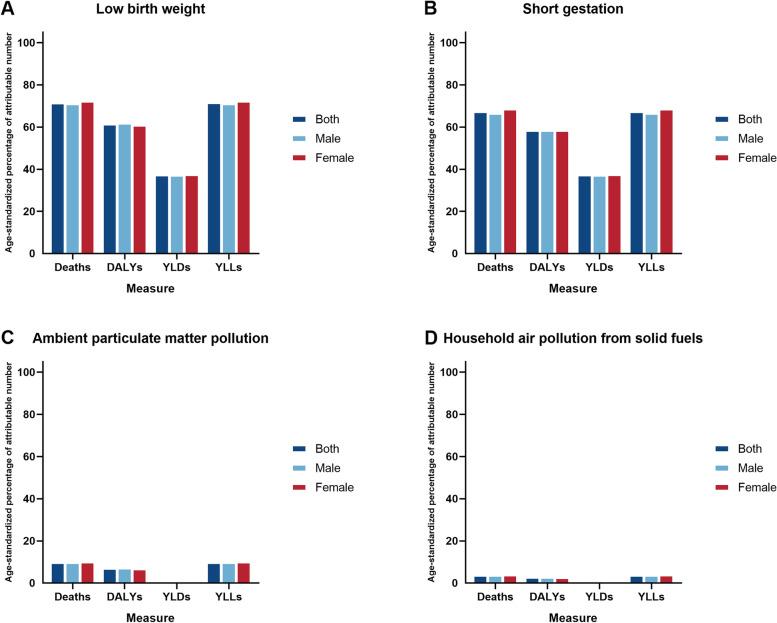
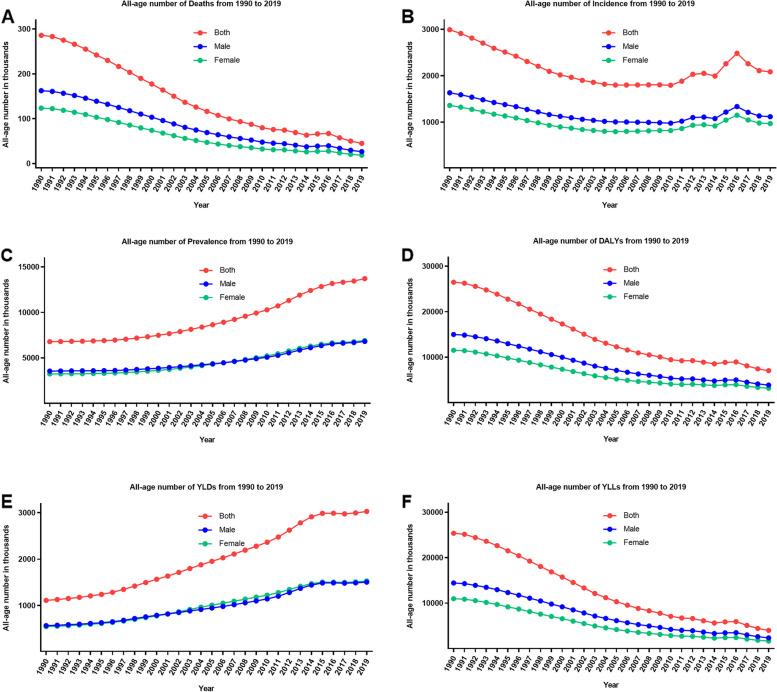
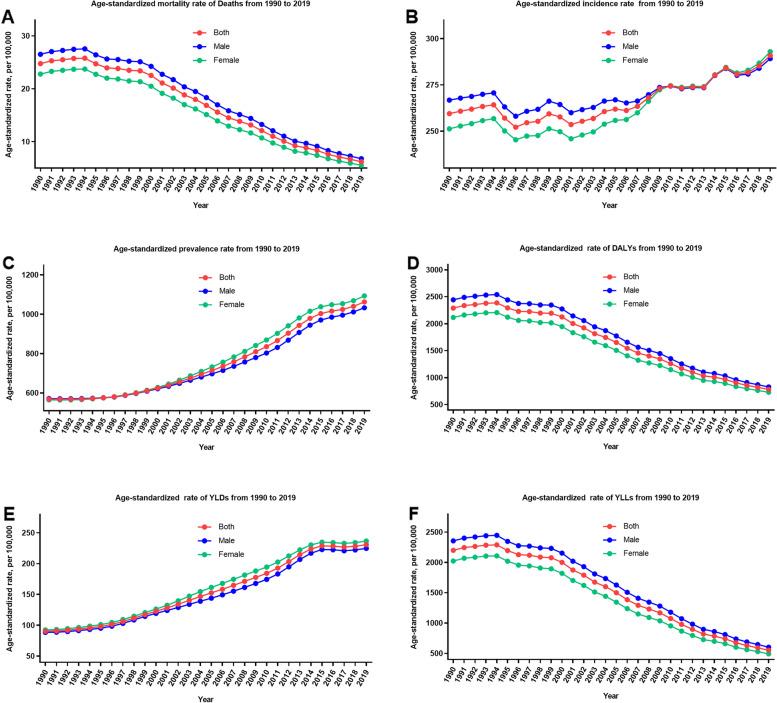
There were notable decreasing trends in the number of deaths (84.3%), incidence (30.3%), DALYs (73.5%) and YLLs (84.3%), while increasing trends in the number of prevalence (102.3%) and YLDs (172.7%) from 1990 to 2019, respectively. The corresponding age-standardized rates changed by -74.9%, 0.1%, -65.8%, -74.9%, 86.8% and 155.1%, respectively. Four specific causes of NDs followed some similar and different patterns. The prediction results of the ARIMA model shown that all measures still maintained the original trends in the next five years. Low birth weight, short gestation, ambient particulate matter pollution and household air pollution from solid fuels were the four leading risk factors.
CONCLUSION
The health burden due to NDs is declining and is likely to continue to decline in the future in China. Delaying the increasing burden of disability may be the next target of concern. Targeted prevention and control strategies for specific causes of NDs are urgently needed to reduce the disease burden.
背景
新生儿健康是下一代健康发展的基石,也是未来人口和社会进步的动力。了解新生儿疾病(NDs)负担的最新信息对于中国循证医疗保健规划非常重要,而国家层面尚未对此进行评估。本研究旨在估计 1990 年至 2019 年中国部分 NDs 风险因素及其具体病因的时间趋势和归因负担,并预测 2020 年至 2024 年可能的趋势。
方法
数据来自全球疾病负担研究(GBD)2019 年的数据。使用了六个指标:发病率、死亡率、患病率、伤残调整生命年(DALYs)、残疾生存年(YLDs)和生命损失年(YLLs)。计算了绝对数量和年龄标准化率(95%置信区间)。NDs 的具体病因主要包括新生儿早产(NPB)、窒息和创伤导致的新生儿脑病(NE)、新生儿败血症和其他新生儿感染(NS)以及溶血性疾病和其他新生儿黄疸(HD)。采用自回归综合移动平均(ARIMA)模型预测 2020 年至 2024 年疾病负担。
结果
1990 年至 2019 年,死亡人数(84.3%)、发病率(30.3%)、DALYs(73.5%)和 YLLs(84.3%)呈显著下降趋势,而患病率(102.3%)和 YLDs(172.7%)呈上升趋势。相应的年龄标准化率分别变化了-74.9%、0.1%、-65.8%、-74.9%、86.8%和 155.1%。四个 NDs 的具体病因呈现出一些相似和不同的模式。ARIMA 模型的预测结果表明,在未来五年内,所有指标仍将保持原有趋势。低出生体重、早产、环境颗粒物污染和固体燃料引起的室内空气污染是四个主要的风险因素。
结论
中国 NDs 的健康负担正在下降,并有望在未来继续下降。延迟残疾负担的增加可能是下一个关注目标。迫切需要针对 NDs 具体病因的有针对性的预防和控制策略,以减轻疾病负担。
 Zotero 插件