
无细胞游离 DNA 作为儿科横纹肌肉瘤的诊断和预后生物标志物。
Cell-Free DNA as a Diagnostic and Prognostic Biomarker in Pediatric Rhabdomyosarcoma.
机构信息
Princess Máxima Center for Pediatric Oncology, Utrecht, the Netherlands.
Sanquin Research Department, Amsterdam, the Netherlands.
出版信息
JCO Precis Oncol. 2023 Jan;7:e2200113. doi: 10.1200/PO.22.00113.
PURPOSE
Total cell-free DNA (cfDNA) and tumor-derived cfDNA (ctDNA) can be used to study tumor-derived genetic aberrations. We analyzed the diagnostic and prognostic potential of cfDNA and ctDNA, obtained from pediatric patients with rhabdomyosarcoma.
METHODS
cfDNA was isolated from diagnostic plasma samples from 57 patients enrolled in the EpSSG RMS2005 study. To study the diagnostic potential, shallow whole genome sequencing (shWGS) and cell-free reduced representation bisulphite sequencing (cfRRBS) were performed in a subset of samples and all samples were tested using droplet digital polymerase chain reaction to detect methylated (M). Correlation with outcome was studied by combining cfDNA M detection with analysis of our rhabdomyosarcoma-specific RNA panel in paired cellular blood and bone marrow fractions and survival analysis in 56 patients.
RESULTS
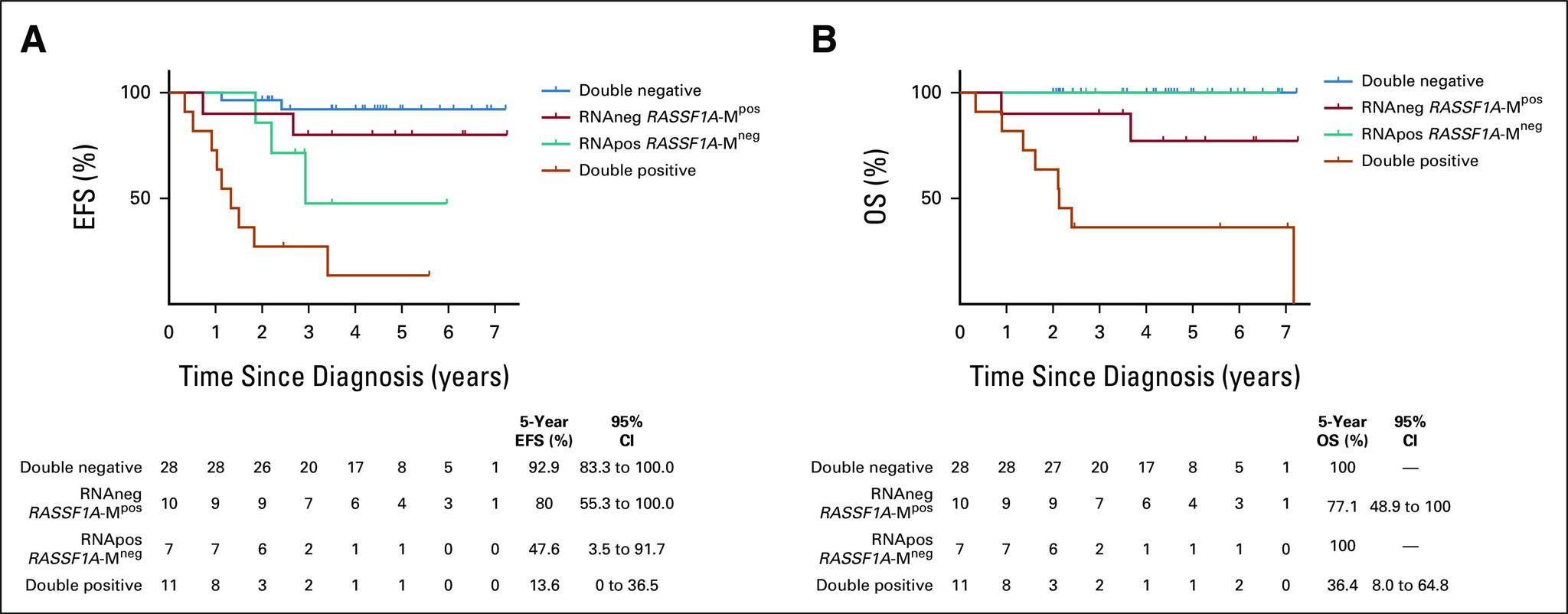
At diagnosis, ctDNA was detected in 16 of 30 and 24 of 26 patients using shallow whole genome sequencing and cfRRBS, respectively. Furthermore, 21 of 25 samples were correctly classified as embryonal by cfRRBS. -M was detected in 21 of 57 patients. The presence of -M was significantly correlated with poor outcome (the 5-year event-free survival [EFS] rate was 46.2% for 21 -Mpositive patients, compared with 84.9% for 36 -Mnegative patients [ < .001]). -M positivity had the highest prognostic effect among patients with metastatic disease. Patients both negative for -M and the rhabdomyosarcoma-specific RNA panel (28 of 56 patients) had excellent outcome (5-year EFS 92.9%), while double-positive patients (11/56) had poor outcome (5-year EFS 13.6%, < .001).
CONCLUSION
Analyzing ctDNA at diagnosis using various techniques is feasible in pediatric rhabdomyosarcoma and has potential for clinical use. Measuring M in plasma at initial diagnosis correlated significantly with outcome, particularly when combined with paired analysis of blood and bone marrow using a rhabdomyosarcoma-specific RNA panel.
目的
总游离 DNA(cfDNA)和肿瘤衍生的 cfDNA(ctDNA)可用于研究肿瘤衍生的遗传异常。我们分析了来自横纹肌肉瘤患儿的 cfDNA 和 ctDNA 的诊断和预后潜力。
方法
从参加 EpSSG RMS2005 研究的 57 名患者的诊断性血浆样本中分离 cfDNA。为了研究诊断潜力,在亚组样本中进行了浅层全基因组测序(shWGS)和游离细胞还原代表性亚硫酸氢盐测序(cfRRBS),并使用液滴数字聚合酶链反应检测所有样本中甲基化(M)的存在。通过将 cfDNA M 检测与我们的横纹肌肉瘤特异性 RNA 面板在配对的细胞血液和骨髓部分中的分析相结合,并对 56 名患者进行生存分析,来研究与结局的相关性。
结果
在诊断时,使用浅层全基因组测序和 cfRRBS 分别在 30 名患者中的 16 名和 26 名患者中检测到 ctDNA。此外,cfRRBS 中 25 个样本中有 21 个被正确分类为胚胎。在 57 名患者中,有 21 名检测到 -M。-M 的存在与不良预后显著相关(21 名 -M 阳性患者的 5 年无事件生存率[EFS]为 46.2%,而 36 名 -M 阴性患者为 84.9%[<0.001])。-M 阳性在转移性疾病患者中的预后效果最高。-M 和横纹肌肉瘤特异性 RNA 面板均为阴性的患者(56 名患者中的 28 名)具有良好的预后(5 年 EFS 为 92.9%),而双阳性患者(56 名患者中的 11 名)预后较差(5 年 EFS 为 13.6%,<0.001)。
结论
使用各种技术在儿科横纹肌肉瘤中分析 ctDNA 是可行的,并且具有临床应用的潜力。在初始诊断时测量 M 在血浆中的含量与结局显著相关,特别是当与使用横纹肌肉瘤特异性 RNA 面板对血液和骨髓进行配对分析结合使用时。


 Zotero 插件